


Assam, one of the most diverse and politically charged states in India, is facing rise in humanitarian crises as government eviction drives continue to displace thousands. The state government, as per Assam’s Chief Minister Himanta Biswa Sarma, has cleared 1,19,548 bighas of forest and government land since May 2021, which equivalent to over 16,000 hectares. As a result, more than 50,000 people have lost their homes in the period.
Earlier this month, the circumstances deteriorated further when eviction drives were conducted back-to-back in Goalpara and Dhubri districts. In the Paikan Reserve Forest of Goalpara, authorities demolished almost 2,700 households, leaving 1,080 families displaced across 140 hectares of land. Just a few days ago, over 1,069 family homes in Dhubri were evicted in a day-long operation that resulted in the clearing of over 3,500 bighas, about 465 hectares, of government land.
Opposition parties and human rights groups have condemned the evictions as arbitrary and politically motivated and the Jamiat Ulama-i-Hind, described the government’s action as unconstitutional and unfair.
Dr Rafiqul Islam, AIUDF MLA from Jania constituency of Barpeta district said this eviction is “inhuman and unconstitutional,” Islam stated that many displaced families had valid documents, such as voter ID cards, ration cards, electricity bills, and even land pattas, which contradicts the government’s claim of illegal encroachment. He demanded immediate rehabilitation of the affected families.
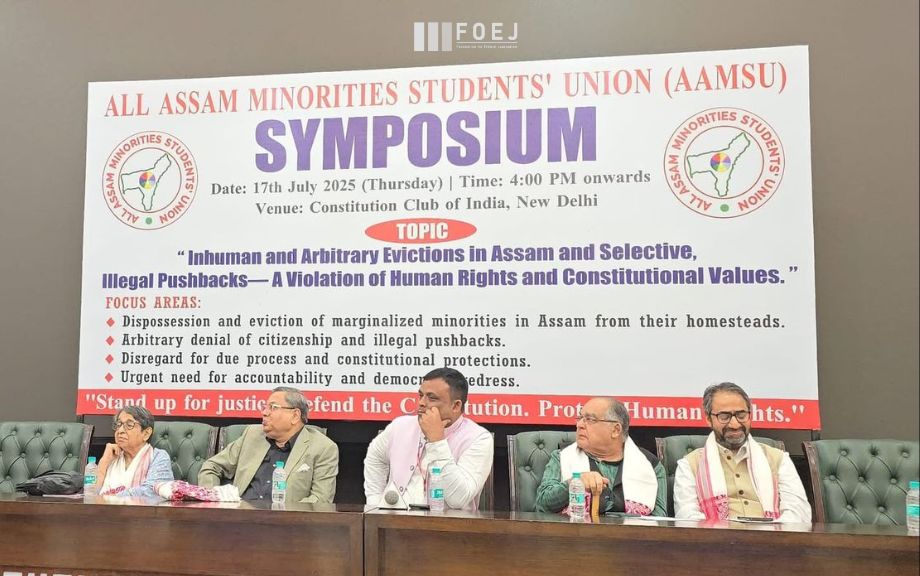
The All-Assam Minorities Students’ Union (AAMSU) organised a National Symposium in New Delhi at the Constitution Club of India on July 17, 2025, in the wake of the deteriorating situation in Assam due to mass evictions. It brought together a range of politicians, legal minds, professors, retired-judges and human rights activists, all expressed serious concerns about the ongoing humanitarian issues in the state.
AAMSU organized this event to draw national attention to the situation in Assam and to inform the rest of the country about the realities faced by the people, The union claimed that under the guise of anti-encroachment and forest conservation efforts, Muslim communities are being intentionally targeted.
At the symposium, several prominent speakers expressed their views on the Assam crisis, focusing on the humanitarian, political, and legal sides of the mass evictions on July 17, earlier this month.
Foej Media went on ground to take the insights of some of the significant speeches delivered at the event. Each speaker gave a different perspective yet they all raised the same concern of Assam’s ongoing eviction which have rendered thousands of people homeless.
Nadeem Khan: We can feel the weight on our shoulders
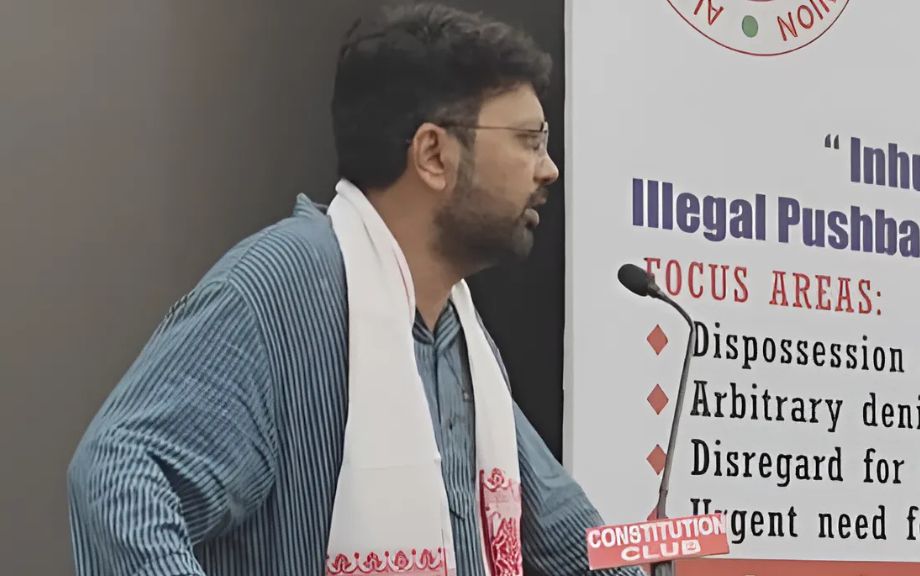
The event started with the speech of Nadeem Khan, human activist and secretary of the Association for Protection of Civil Rights (APCR).
Hitting at the reality, Khan said, “Whatever we say here today, in reality we have failed as a society.” Meanwhile, recognizing the helplessness of the delegate, he expressed his solidarity and said, “We can feel the weight on our shoulders.”
Systematic Cause of the Crisis
Khan further highlighted the systematic cause of the issues and shed light on the long-standing denial of justice in Assam, the set of systematic issues, and the social, political, legal, and administrative issues. The issues that have marginalized various communities, suppressed the rights, and created ongoing unrest and mistrust. “Justice has never really been delivered in Assam,” he said.
Nadeem asserted that meaningful transformation in Assam could only be achieved if the voices of the oppressed were acknowledged and amplified beyond the boundaries of the state. “Your struggle must not remain confined to Assam. You need to take this voice to all corners of the nation,” he said, with a tone of assertiveness.
Lack of Transparency and Accessible Data
Raising the concerns about the lack of transparency and accessible data from the region, Khan said, “If you ask me how many police encounters occurred in Uttar Pradesh between 2017 and 2022, I can give you exact figures. But when it comes to Assam, we have no such data—and that silence speaks volumes.”
Furthermore, addressing fellow activists and concerned citizens, Nadeem issued a powerful appeal: “Let us come together and ensure that Assam’s voice is heard across the country.”
Concluding his speech with a call for continued and coordinated action, Khan said, “We must organize such programs (National Symposium) in every part of India. Only then can we make sure the voice of Assam echoes throughout the nation.”
Aasif Mujtaba: The Bulldozer doesn’t just target our homes; It silences our voices and humiliates the community
Aasif Mujtaba, Director and Founder of Miles2Smile Foundation and a human rights activist, started his speech with bringing notice towards the recent police firing in Assam’s Goalpara district where two people were killed in the firing, including a teenager. He labelled them martyrs and used the incident to condemn government-sponsored demolitions and the persecution of the Muslim community.
Mujtaba urged the audience to understand the real intention behind these demolitions. He stated, “Aaj ka bulldozer hamare ghar ko todne nhi balki hamari zuban ko khamosh krne aata hai” (Today’s bulldozer doesn’t just come to bulldoze our house but it comes to silence our voice).
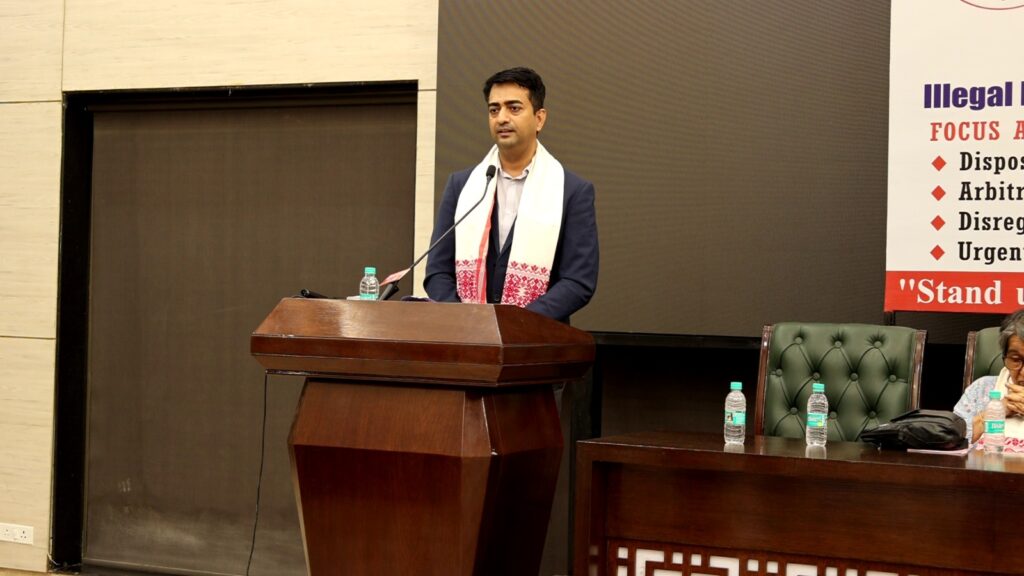
He underlined that what appears to be demolition is actually an act of humiliation and explained that these actions are not about legality or illegality of structures but an attempt to undermine the dignity and erase the identity of an entire community.
Subsequently in his speech, Mujtaba called for self-reliance and fearlessness resistance from within the community. “Our struggle belongs to us; no one else will fight it for us. We have to become our own Bhagat Singh.” He said. Mujtaba concluded his speech with a poignant couplet:
“Hamare paaon ulte the faqat chalne se kya hota,
Bahot aage gaye lekin bahot peechhe nikal aaye.”
Through this verse, he reminded the Muslim community that progress without direction and principle has no value and urged the community to base their struggle on the right ideas and values. Only then can they achieve meaningful and lasting success.
Prashant Bhushan: BJP Wants to Reduce Muslims to Second Class Citizens in India
“The BJP government is deliberately trying to make Muslims second-class citizens and trying to take away their voting rights”, said Prashant Bhushan, a well-known author, activist, and public interest lawyer in the Supreme Court of India. Furthermore, Bhushan accused Hemant Biswa Sharma, the chief minister of Assam, of breaking the law and acting without restraint. “It is very regrettable that our judiciary does nothing to stop such egregious misuse of power,” he said. “The judiciary’s main job is to check such lawlessness, but it is failing to do so today,” he added. Moreover, Bhushan referred to international principles of law and pointed out that no nation can deport anyone without the receiving nation’s consent.
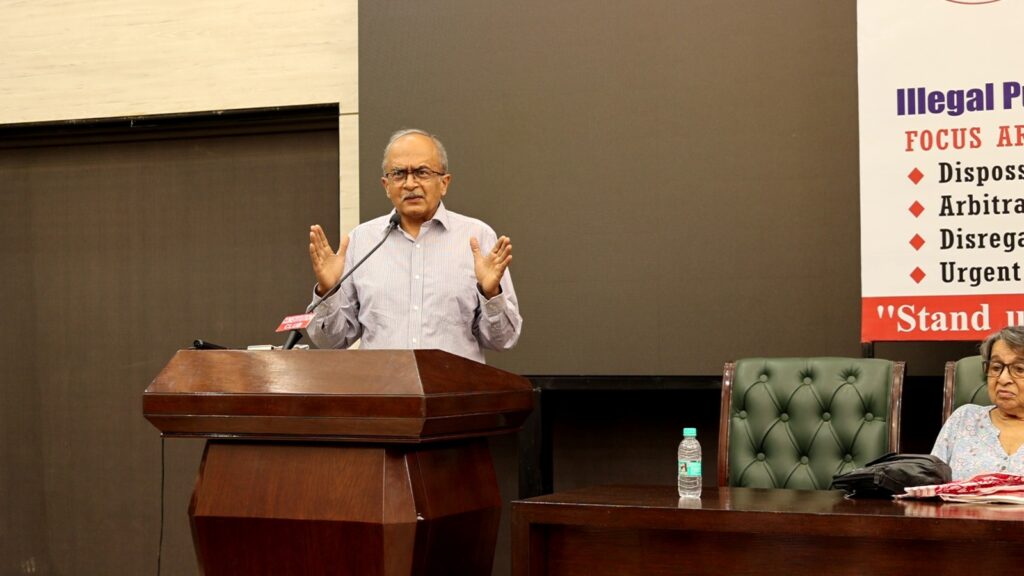
He claimed the Indian government is violating this by forcing Muslims to move to border areas and threatening them to flee or face being shot. Discussing the role of tribunals, Bhushan raised serious concerns about the Foreigners Tribunals, describing them as arbitrary and biased. He alleged that tribunal members face pressure to label more people as foreigners to secure extensions and pointed out that even those not classified as foreigners by these tribunals are being deported, mainly from the Muslim community. In his closing remarks, Bhushan called for a widespread protest against these unfair practices. He said, “Those who are directly affected must come forward, but those who are not currently impacted should also join the protest because soon they too could be affected. Courts respond only when there is a visible and public outcry.”
Prof. Apoorvanand Jha: In a Democracy, we don’t live like animals; We live with Dignity and Rights
Apoorvanand Jha is a professor in the Hindi Department at the Faculty of Arts, University of Delhi. He began his speech with a striking remark: “We should have been the audience, and the people of Assam should have been the speakers because they can truly convey the reality of what’s unfolding on the ground.” During his address, Apoorvanand stated, “In a democracy, we do not live like animals; we live with rights. The moment those rights are taken away, we are no longer treated as human beings.” He stressed the urgent need for collective awakening and called for nationwide solidarity and mobilization. Justice will not come on its own. It requires awareness across India, and for that we must step forward,” he said. Prof. Apoorvanand concluded his speech with a strong message of hope and defiance, declaring, “We will fight this battle, and we will win.”
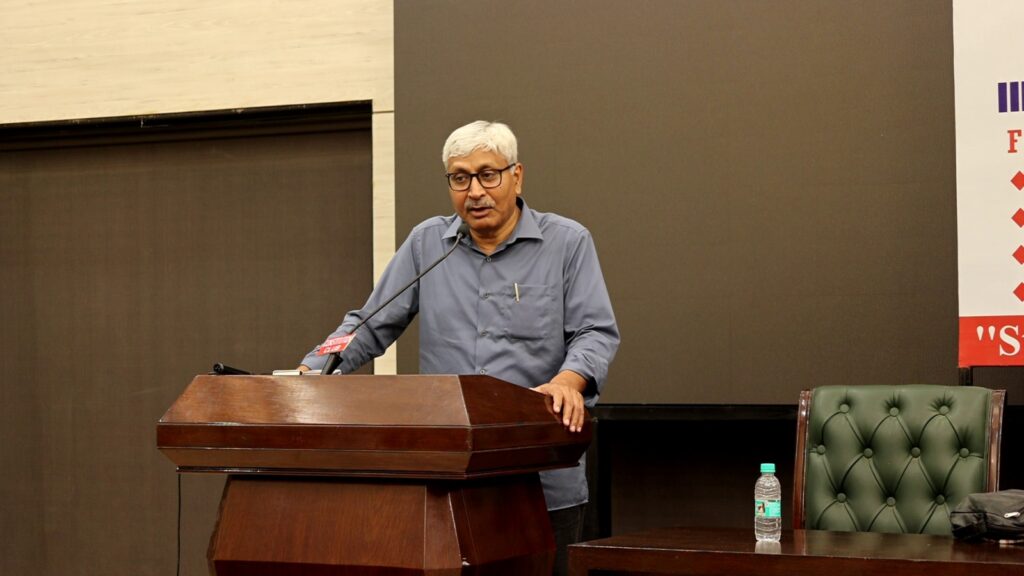
Taslim Ahmed Rehmani: Your Issues Will Remain Until You Build Cultural and Friendly Ties with the Tribals
Taslim Ahmad Rehmani, President of the Muslim Political Council of India, stated that the biggest crisis in this country is not the presence of problems but how they are handled. “In this nation, problems are never resolved. Those who speak up are either silenced or bought out, and the issue remains unchanged,” he said. Connecting this idea to Assam, Rehmani noted that the issue that arose in 1979 has continued to change form. Its faces may have shifted, but the problem stays exactly where it was. In his remarks, he pointed to a sensitive but important reality: “Both the northwestern and northeastern border regions of India have large Muslim populations and share borders with Muslim-majority countries.
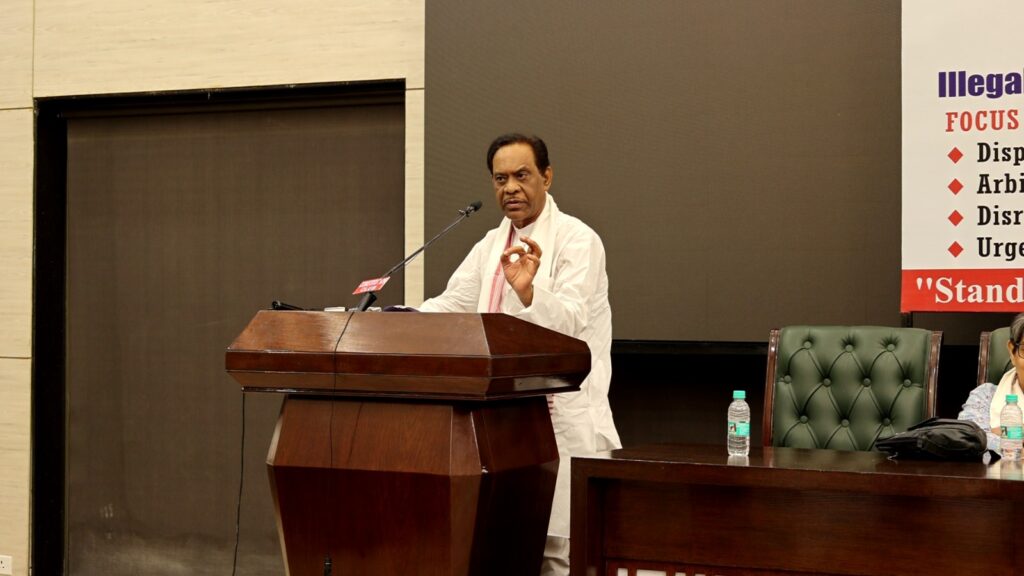
This has long been met with suspicion by the state; instead of discussing it openly, we choose to stay silent, driven by fear, hesitation, or political pressure.” Regarding the political situation, Rehmani was critical. He claimed that all parties act similarly. “If you remove the BJP from Assam today, who will you bring in, the Congress? Let’s remember that it was the Congress that first mentioned NRC. Changing governments will not fix your problems.” To find a solution, Rehmani proposed that the issue will only be resolved when friendly and culturally rooted ties are built with tribals. The tribals should be your allies, not your enemies; somehow, they have become your opponents. He ended with a pointed critique of how Muslim-related issues are presented in India: “When the problem affects Muslims, don’t hide behind the term minority issue. Call it what it truly is: a Muslim issue. If you are too afraid to even say the word Muslim, then we can’t expect these issues to be resolved, just as they have not been for the past 75-76 years and likely won’t be for the next 75-76 years.”
Vote of Appreciation Extented
The symposium concluded with a strong speech by AAMSU president Rejaul Karim Sarkar. He thanked all the speakers and participants, as well as AAMSU members for their cooperation. In his concluding remarks, Rehman drew attention to the continuing humanitarian crisis in Assam and added that Muslims in the state are being systematically targeted and oppressed on the pretext of land encroachments and forest conservation. Karim alleged that Indian citizens are identified as Bangladeshi and deported though they have legal documents. He also said that injustice to the Muslim community in Assam has been institutionalised after Himanta Biswa Sarma took over as Chief Minister. He accused the government of taking land from Muslims and handing it over to corporate groups like Adani. “This government is doing this to us because we are Muslims,” he asserted. Karim announced that AAMSU would hold similar events across India to raise awareness about the brutality faced by Muslims under BJP rule and concluded his speech with a strong call for unity and resistance, stating, “We have no choice but to fight. We will fight, and we will win.”


