


Shahbaz Ansari, an average built Muslim man, working his daily tasks to run his household was accused under India’s stringent Unlawful Activities (Prevention) Act (UAPA), has been granted bail by a Delhi court after spending over three months in jail in connection with the so-called “Jharkhand Al-Qaeda module” case. He is one of four accused to receive bail so far due to the prosecution’s failure to file a charge sheet within the mandatory 90-day period.
The case, registered as FIR No. 301/24, involves 12 individuals accused of being linked to Al-Qaeda in the Indian Subcontinent (AQIS). Charges include conspiracy to establish a “Khilafat” in India, as per the Delhi Police Special Cell. The group is alleged to have conducted arms training in the forested hills of Bhiwadi, Rajasthan, with support from sympathizers based in Delhi. A joint operation conducted on August 22, 2024, led to arrests across four states—Delhi, Jharkhand, Rajasthan, and Uttar Pradesh—and the seizure of weapons, ammunition, and cash.
Ansari is a resident of the Chanho area in Ranchi and is a mason by profession who was recently at the center of a high-profile case involving allegations of links to Al-Qaeda’s Jharkhand module, he is well Known in his community for his work as a daily wage laborer and often associated with the helping the locals in his society. Ansari was arrested in Lohardaga in 2024 during a joint operation by the Delhi Police Special Cell and Jharkhand ATS. However, following legal proceedings, the court ruled that he had been falsely accused and ordered his release, clearing him of all charges. Yet, despite these dramatic claims, the prosecution failed to present timely evidence in court. According to Advocate Abu Bakr Sabbaq, who represents 11 of the 12 accused, including Shahbaz, the case is fabricated and politically motivated.
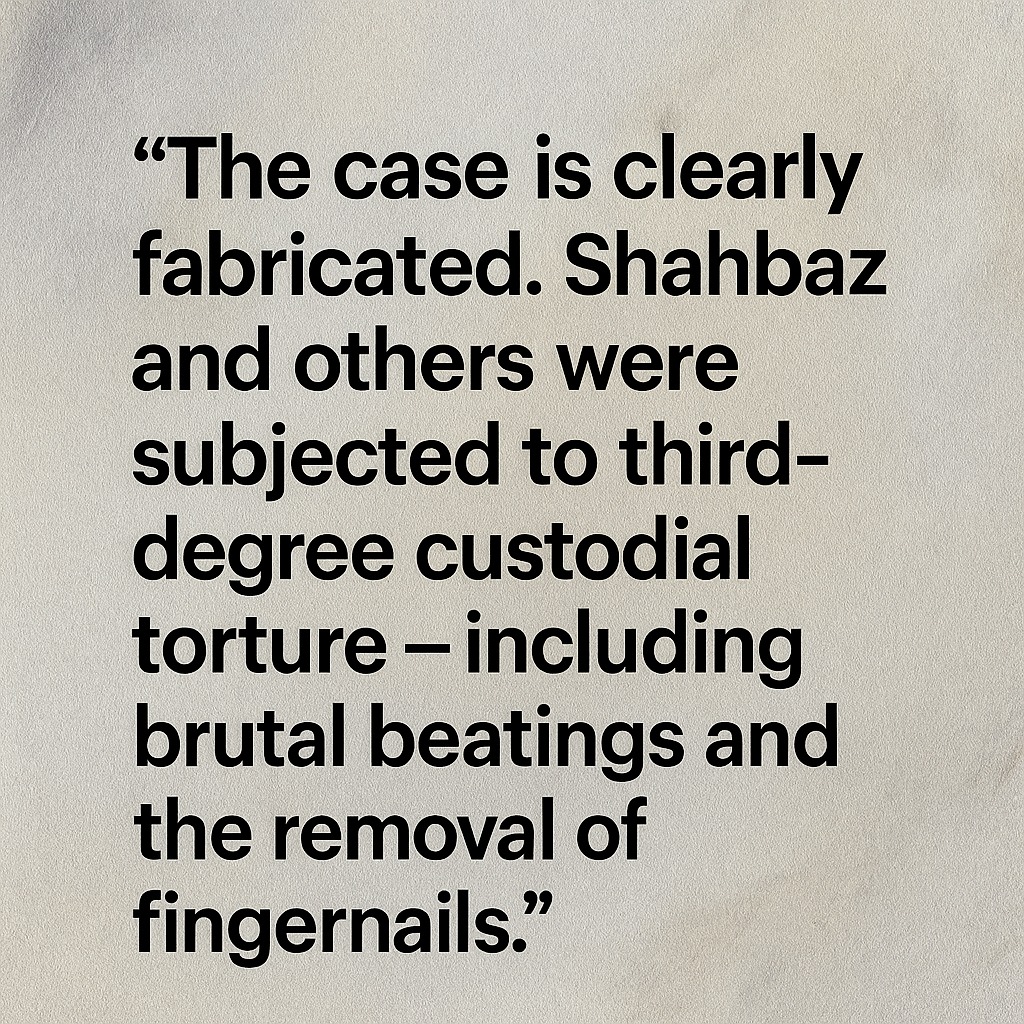
“The police neither filed a chargesheet nor produced any concrete evidence against my client. Shahbaz and others were subjected to third-degree torture in custody—including beatings and the removal of fingernails,” said Sabbaq, adding that a formal complaint regarding custodial torture is under judicial consideration.
A Pattern of Wrongful Prosecution
Shahbaz’s case is far from isolated. Civil liberties activists argue that India has seen a growing trend of Muslim men being arrested under terror charges, only to be acquitted years—sometimes decades—later due to lack of evidence.
As of now, eight of the twelve men remain behind bars without trial. The case has once again brought into sharp focus the misuse of anti-terror laws in India—particularly the UAPA—and the pattern of pretrial punishment through prolonged incarceration.
Some of the most glaring examples include:
Maharashtra (1994–2019): Eleven men arrested under TADA were acquitted after 25 years.
Surat, Gujarat (2001–2021): 127 Muslims attending a seminar were arrested under UAPA for alleged links to SIMI. All were acquitted after 19 years.
Akshardham Temple Case (2002–2014): The Supreme Court acquitted all accused, sharply criticizing investigative agencies.
Faheem Ansari (2009–2010): Arrested for alleged links to the 2008 Mumbai attacks, Ansari was acquitted within a year due to lack of evidence.
Muzaffarnagar (2000–2019): Five men accused of sheltering a terrorist were acquitted after 19 years.
Rampur CRPF Attack (2008–2019): Two men were acquitted after over a decade of incarceration.
These cases not only reflect investigative lapses but suggest the weaponization of anti-terror laws to target a specific community, according to human rights lawyers.
Global Echoes of Injustice
This trend is not limited to India. Around the world, Muslim men have faced similar injustices under the guise of national security:
Moazzam Begg, a British aid worker, was detained by the CIA in 2002 and held in Guantanamo Bay for three years without charge. He was subjected to over 300 interrogations and severe torture.
Mansoor Adayfi, a Yemeni national, was held in Guantanamo for 14 years after being handed over to U.S. forces by Afghan warlords. He too was never charged with a crime but described systematic torture and dehumanization.
These global cases highlight a disturbing norm: being Muslim is often conflated with being a suspect, even in the absence of evidence or legal justification.
The Role of Media and Public Perception
One of the most troubling aspects of such cases is how media coverage contributes to public prejudice. Once arrested, individuals are often branded “terrorists” long before any evidence is produced or trial is held. Even when acquitted, the stigma remains.
“Agencies may acquit someone today, only to imprison someone else tomorrow under another false case. The cycle continues,” said Advocate Sabbaq.
A 2018 survey by Common Cause and Lokniti revealed that nearly 47% of Indian Muslims feared being falsely accused of terrorism, while a 2019 report found that over half of police personnel believed Muslims were ‘naturally’ inclined to crime.
Legal experts and civil society groups have repeatedly called for police accountability and judicial reform, especially concerning the use of UAPA and similar laws. The 2019 amendment to UAPA, which allows the central government to label individuals as terrorists without trial, is widely criticized for undermining constitutional rights.
Until legal safeguards are strengthened and law enforcement agencies held accountable for malicious prosecutions, critics warn that innocent lives will continue to be destroyed—silently, and often without justice.
School teacher Mistakenly Labeled as Terrorist After Pahalgam Attack
In the wake of the 2025 Pahalgam attack in Jammu and Kashmir, a tragic incident of misreporting has sparked outrage and calls for accountability. Maulana Mohammad Iqbal, a 46-year-old schoolteacher from Poonch, lost his life in cross-border shelling. However, several media outlets, including Republic TV and CNN-News18, erroneously identified him as a terrorist—citing his affiliation with a madrasa and his religious appearance as grounds for suspicion.
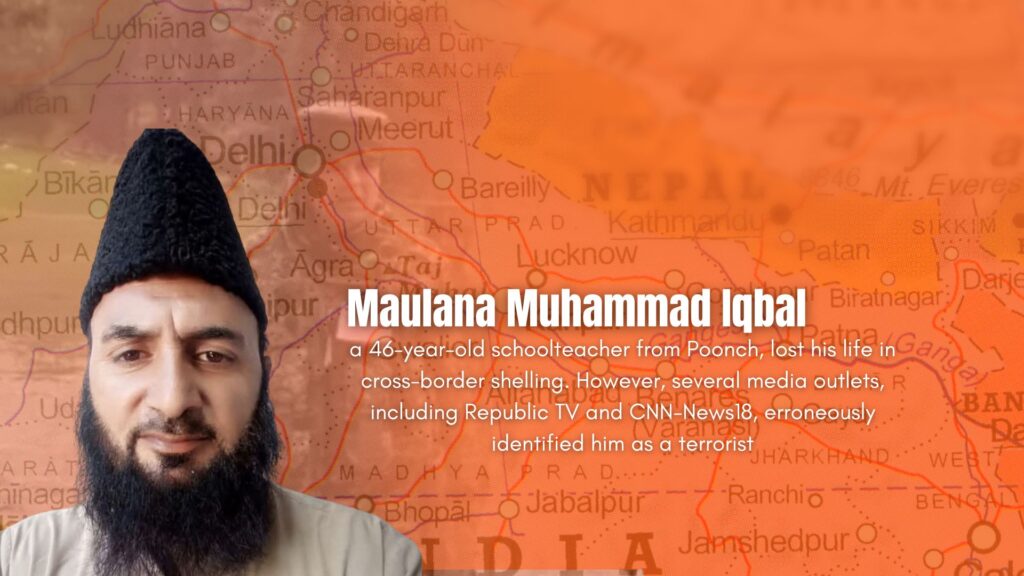
The claims were quickly refuted by local police authorities and community leaders, who affirmed Iqbal’s identity as a respected educator and compassionate figure in his community. In response, the All India Muslim Personal Law Board (AIMPLB) issued a strong condemnation of the false reporting, demanding that both news channels issue formal apologies for spreading misinformation and maligning an innocent man.
The incident has reignited concerns over media ethics, bias, and the dangers of profiling based on religion or attire.
Pattern of Misreporting Raises Alarms Over Media Accountability
In 2019, Republic TV wrongly accused Maulana Syed Jalaluddin Umri, then Vice President of the All India Muslim Personal Law Board (AIMPLB), of being involved in terrorism. The channel later admitted the error, citing a mix-up involving an incorrect image, and issued a formal apology.
Similarly, CNN-News18 drew widespread criticism for broadcasting images of revered Islamic sites—the Grand Mosque in Mecca, Al-Aqsa Mosque in Jerusalem, and the Prophet’s Mosque in Madina—in a segment allegedly linking them to terrorism. The AIMPLB denounced the move as blasphemous and called for an immediate apology, which CNN-News18 has yet to issue.
These incidents highlight the perils of unchecked, sensationalist journalism and the urgent need for media houses to verify information before going to air. While Republic TV took corrective action in the 2019 case, CNN-News18’s silence on the matter continues to fuel concern. The repeated targeting of religious figures and institutions underlines the broader issue of bias in media narratives and reinforces the need for ethical reporting that respects both truth and human dignity.
False Claims in Pahalgam Aftermath Spotlight Dangers of Misinformation and Sensationalism
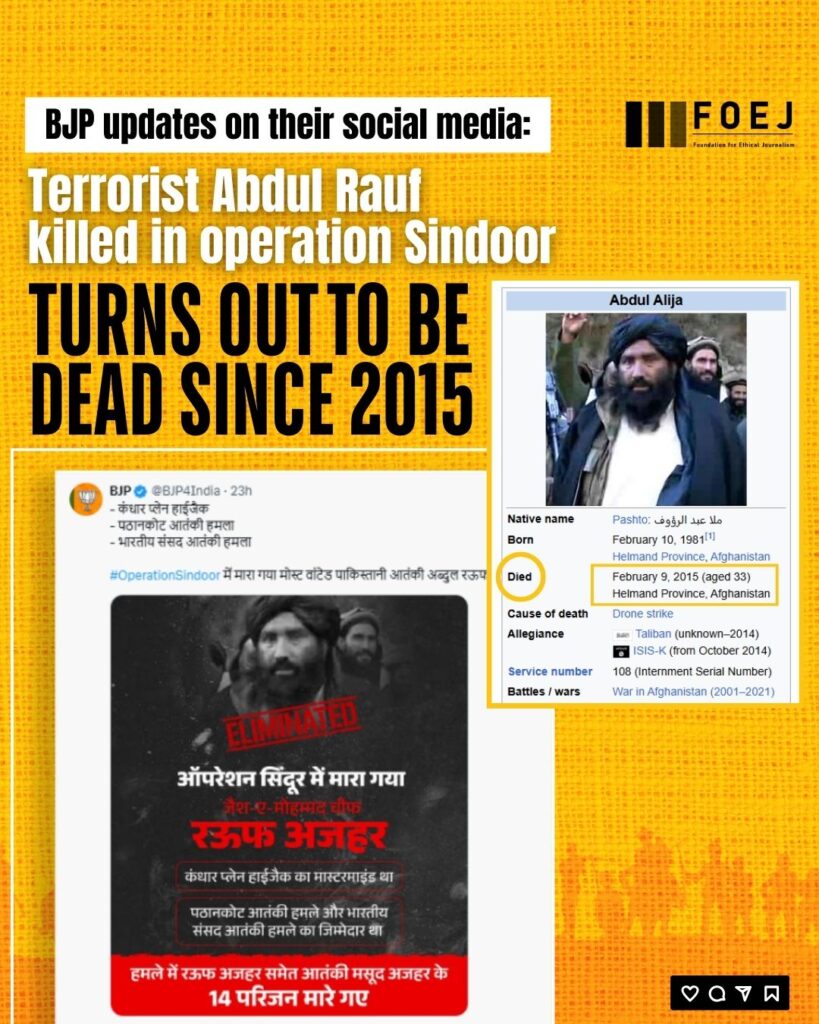
A wave of patriotic fervor and calls for retaliation against Pakistan swept through political and media circles in India. However, amid this atmosphere, a serious misinformation incident has come to light. The official Twitter handle of the Bharatiya Janata Party (BJP) claimed that a terrorist named Muhammad Rauf had been killed in India’s retaliatory strikes. It was later revealed that the individual named had actually died in 2015, rendering the claim factually incorrect.
The BJP’s tweet aligned with a broader narrative being advanced by several media outlets and political leaders, aimed at projecting a strong and decisive Indian response to cross-border terrorism. Among them, Uttar Pradesh Chief Minister Yogi Adityanath launched the Bharat Shaurya Tiranga Yatra in Lucknow, celebrating the success of Operation Sindoor and denouncing Pakistan for its alleged role in supporting terrorism. The event sought to instill national pride and reinforce India’s hardline stance following the Pahalgam attack.
Yet, the revelation that the purportedly neutralized terrorist had been dead for nearly a decade underscores the risks of disseminating unverified information—especially in matters as sensitive as national security. Despite the factual inaccuracy, the BJP has not issued a correction or apology.
In 2019, Republic TV came under fire for falsely identifying Maulana Syed Jalaluddin Umri, then Vice President of the All India Muslim Personal Law Board (AIMPLB), as a terrorist. The channel later acknowledged the error, citing the use of an incorrect image, and issued an apology.
These recurring instances of misinformation—from both political and media entities—highlight a disturbing trend of sensationalism at the expense of truth. As narratives around terrorism and national security often shape public opinion and policy, they demand the highest standards of accuracy and integrity. The continued spread of such falsehoods reinforces the urgent need for responsible journalism and political accountability.
Article & Research by : Mhd. Imran
[ Special mention : Research – Sidra Fatima, Shariq Adeel Yusuf]
(This article reflects the personal opinions of the author and does not represent the views of FoEJ Media)


