


A protest march held by students of Jamia Millia Islamia on Friday to mark the 17th anniversary of the 2008 Batla House encounter ended in a heavy-handed police crackdown, with approximately 10 students detained, forcibly removed from campus, and allegedly assaulted by both police and university security guards.
Organized by the All India Students’ Association (AISA), the demonstration—titled “Insaf Mashaal Juloos”—was intended to address long-standing demands for a judicial inquiry into the police operation that claimed the lives of two Jamia students, Atif Amin and Mohammad Sajid, in Delhi’s Batla House locality in 2008.
As the students attempted to end their march near Central Canteen to Gate No. 7, Jamia Milia Islamia, they were met with a disproportionate response involving detentions, alleged “manhandling,” and what student leaders have described as a “coordinated assault” on their right to “peaceful” march.
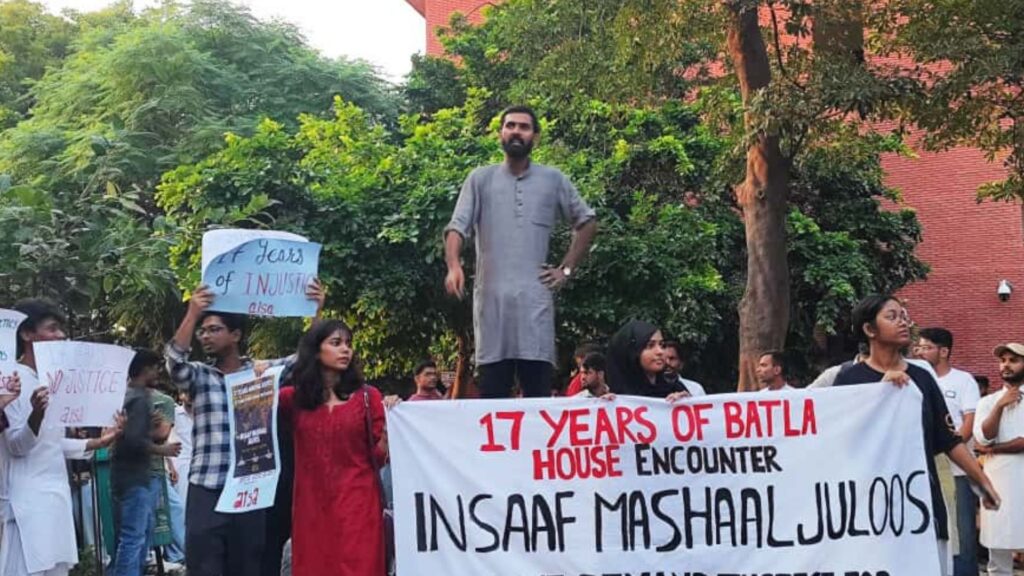
Among those detained were AISA national secretary Sourabh and student activists Mantesha and Shajahan. AISA Jamia president Mishkat accused university authorities of actively aiding the police, alleging that students were removed from inside the campus premises and handed over to the police. Mishkat further claimed she was assaulted by male guards.
“Gate number 7 was already open, even though it’s always kept closed—just seeing that made it clear that there was a deliberate attempt to detain us,” Miskhat, the president of AISA, said while talking to FoEJ Media.
“As soon as we reached near Gate 7, the proctorial team and guards started pushing us outside so that the police could detain us,” she added.
Female Student Dragged Around Campus
A video making rounds on the internet also shows a woman identified as Mantasha being dragged around campus grounds.
Mishkat stated that the incident occurred while police were attempting to detain Mishkat, and fellow student Mantasha came forward in an effort to protect her
“The guards were taking me away when Mantasha came to protect me, so they dragged her off instead. They had created such a situation that anyone who tried to help someone else was being detained. Even one or two regular students, who weren’t part of the march at all, were also picked up.” Mishkat said.
AISA secretary Saurabh alleged that the detentions appeared to be premeditated, claiming that university guards were actively identifying students and handing them over to the police for detention.
“It was all planned in advance—the goal was to hand over students to the police. The security first handed me over, and after that, the guards were grabbing students one by one and turning them in,” Saurabh said, speaking to FoEJ Media.
“Given the way the administration has behaved and the manner in which students were picked up in broad daylight, we will definitely raise our voices against this,” he added.
The “Insaf Mashaal Juloos” march, organized by AISA on Friday, was a march to commemorate the anniversary of the “Batla House Encounter” that happened on September 19, 2008. The operation, conducted during the holy month of Ramadan, saw the Delhi Police Special Cell raid a flat in the L-18 building of Batla House, resulting in the deaths of two students of Jamia Milia Islamia, Atif Amin and Mohammad Sajid, who were accused of being members of the Indian Mujahideen.
Batla House Encounter
The Batla House encounter, carried out by the Delhi Police Special Cell on 19 September 2008, was an operation that claimed the lives of two Jamia Milia Students, alleging Indian Mujahideen (IM), suspected to be behind a series of serial blasts in the capital just days earlier. The raid took place at a residential flat in L-18, Batla House, in Jamia Nagar, Okhla.The operation also took the life of Inspector Mohan Chand Sharma, an officer with the Special Cell.
Additionally, two other suspects, Shahzad Ahmad and Ariz Khan alias Junaid, were later arrested and charged. Legal proceedings in the case have been extensive. On 28 April 2010, police filed a chargesheet against Atif Amin, Mohammad Sajid, Shahzad Ahmad, and Ariz Khan. In February 2011, Shahzad was formally charged under various sections of the Indian Penal Code, including murder, attempt to murder, and obstructing public servants, in addition to charges under the Arms Act.
The Delhi Police maintained that the encounter was based on credible intelligence indicating the presence of terror suspects in the Batla House flat. However, the incident quickly created controversy and political debate.
A public interest litigation filed by the NGO ‘Act Now For Harmony and Democracy’ prompted the Delhi High Court to direct the National Human Rights Commission (NHRC) to conduct an independent inquiry. The NHRC’s report, submitted in July 2009, cleared the Delhi Police of wrongdoing and dismissed allegations that the encounter had been staged. The report cited medical evidence showing that Sharma had been shot from the front, undermining conspiracy theories of internal foul play. The Delhi High Court later accepted the NHRC’s findings and declined to order a judicial probe.
Despite the legal conclusions, questions around the operation continue to surface. Families of the accused, including Shahzad’s sister, have consistently maintained that they were falsely implicated and have pledged to pursue justice through appeals to the Supreme Court.
Shrinking Space for Student
In recent years, Jamia Millia Islamia has come to represent student resistance, especially during the 2019–2020 National Register of Citizens (NRC) and anti-Citizenship Amendment Act (CAA) demonstrations. Students at the time organized massive protests against the citizenship law, claiming it discriminated against Muslims. Aggressive police response to those protests, both inside the campus library and classrooms, created widespread condemnation from human rights organizations and civil society groups as well as national outrage.
“Universities like Jamia Millia Islamia (JMI), Aligarh Muslim University (AMU), and Jawaharlal Nehru University (JNU) have long been recognized as centers of dissent, intellectual freedom, and democratic involvement. These schools have produced generations of thinkers, activists, and leaders who have been at the forefront of progressive movements, often pushing against the status quo. Around the world, universities have played a key role in protests against injustice, sometimes even helping to bring down authoritarian regimes. It is concerning that in the world’s largest democracy, these spaces are increasingly being stifled.” Said Human right Activist, Aasif Mujtaba, to FoEJ Media.
The increasing intolerance for student-led dissent on Indian university campuses is yet again reflected in the Friday march. Student protests at universities like Jawaharlal Nehru University, Aligarh Muslim University, and Hyderabad Central University have often resulted in police crackdowns, sedition charges, or campus suspensions during the last years.
“The events at Jamia in 2019, during the anti-CAA protests, were deeply disturbing. Peaceful student demonstrations faced harsh police crackdowns, and the administration did not protect the rights of its own students. This is not merely an assault on universities; it is a decline of democratic spirit itself,” Mujtaba added.


