


The exceptionally stunning and mesmerizing Jammu and Kashmir turned into an avalanche of grief and loss in late August. A series of landslides and cloudbursts occurred, sweeping away the houses, shops, and belongings of people, and with that, their hopes too.
On August 29, a cloudburst triggered by intense rainfall struck Rajgarh tehsil in Ramban district, unleashing landslides and flash floods that damaged several houses. The disaster claimed at least three lives, with five individuals reported missing. On the same day, tragedy struck Bhadder village in the Mahore tehsil of the Reasi district, where a massive landslide buried a family home, killing seven people—including five children.

The Jamsalan region of Jammu and Kashmir also faced severe devastation after days of relentless rainfall and a powerful cloudburst triggered a massive landslide. According to reports, the disaster left nearly 70 families homeless, with several houses and entire settlements either swept away or buried beneath layers of debris.
And within just a matter of a few days, Jammu and Kashmir shifted from the synonym ‘mesmerizing’ to ‘devastating.’ The sobs of men, the weeping of women, and the screams of children echoed through the bushes and trees, making them the witness of the pain.
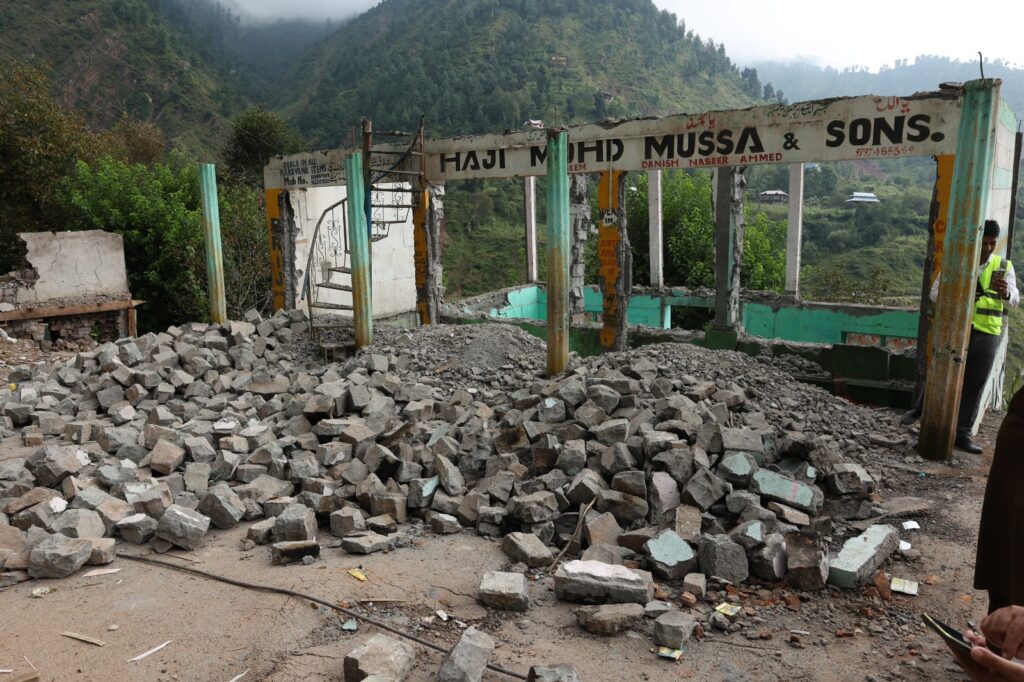
Jammu and Kashmir remains highly vulnerable to landslides, owing to its rugged mountainous terrain, intricate geological structure, and geodynamic ally unstable slopes. These factors create a conducive environment for frequent landslide occurrences, especially along the vital National Highway (NH-44), which serves as the region’s key lifeline connecting it to the rest of India.
Between 1990 and 2020, Jammu and Kashmir—particularly the Udhampur–Banihal section of the Jammu–Srinagar National Highway (NH-44)—witnessed a significant number of landslide events. As per the reports at least, 960 reported landslide incidents over the three-decade period occured. Relatively moderate rainfall intensities are sufficient to trigger landslides in the region. Specifically, daily rainfall of 9.4 mm in the Kashmir Valley and 14.35 mm along the NH-44 corridor can initiate landslide activity.
“Cloudbursts and landslides used to happen before as well — they are a natural process — but now their frequency has increased. We have constructed roads, railway tracks, cut through hills and mountains, and this has disturbed the ecosystem. ” said Dr. Raja Muzaffar Bhat J&K based environmentalist to FoEJ Media.
Heaviest Ever 24 hour Rainfall
Jammu experienced its heaviest-ever 24-hour rainfall in late August, recording an unprecedented 380 mm, surpassing the previous record of 270.4 mm set in 1988. This extreme weather event triggered widespread devastation across the region, “The sound was so terrifying, it felt like a bomb had exploded — it was incredibly loud” Aashique, a witness of the landslide told FoEJ Media.
Aashique, who lost his home in the flash floods and cloudburst, is now living in a makeshift hut near the site where his house once stood. He says he wasn’t even allotted a relief tent, despite repeated requests.
“I’m living in a small hut a little deeper into the forest. My name wasn’t even on the tent allotment list. When I asked, they said only 12 tents were available, and all had already been allotted.” he said.
“Who listens to the poor? No one hears their voices.” Aashique added, with a sign of exhaustion in his voice
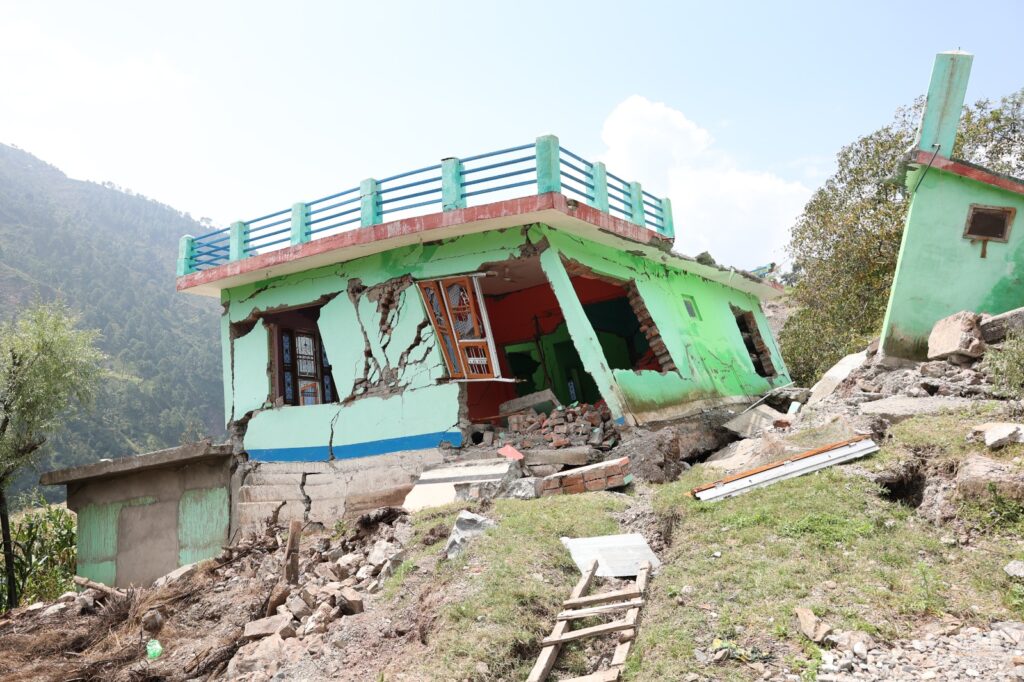
A father of four children with disabilities—two sons and two daughters— Aashique’s life has upended after a devastating landslide. Although the structure remains standing, it is now riddled with severe cracks, rendering it unsafe and uninhabitable.
“I can’t go back to my house now — it’s too dangerous there. If something like this happens again, how will we survive?” Aashique said.
“After two months, I’ll have to leave this hut too, because the snowfall season will begin — and I can’t survive here in the snow,” Aashique added.
With his home destroyed and his hopes diminished, Aaqshiue is gripped by anguish, uncertain about how he will rebuild his life.

Life remains difficult for those relocated to temporary shelters as well. In the same region, another family mourns their loss while living in a tent.
Sawal Singh’s family was having dinner when a sudden cloudburst caused severe damage to their home and the surrounding area, including a plot of land they owned. He says he never imagined—even in his worst nightmares—that such a disaster would strike his family.
“Everything was fine, even the weather was normal — I never imagined something like this could happen,” he said.
For generations, Sawal Singh’s family had lived in the house now rendered unusable by cracks caused by a landslide
“I eat whatever the people around the tent give me. Some people came from Delhi too — they brought food and rations. That’s what’s keeping us going,” he added.
Displaced by cloudbursts and landslides, Aashique and Sawal Singh’s families now survive in makeshift shelters with minimal support. Denied basic relief, they rely on sporadic aid and the goodwill of strangers
A ray of hope
Amidst the grief, sorrow, and somber clouds, a silver line shone through a few people—Aasif Mujtaba from Miles2Smile and Yasir from Ababeel NGO are two of them.
The two organizations, one from Delhi (Miles2Smile) and the other from Jammu (Ababeel), collaborated together and provided respite to the survivors.“I don’t see this opportunity as something carrying someone’s pain on my shoulder; I see it as an honor that I am able to create a difference in the lives of people.” Aasif Mujtaba said, talking about his relief work, whereas Yasir believes that “working tirelessly and selflessly for humanity is his passion.”
Both organizations crossed traffic-clogged routes, broken bridges, and damaged roads to reach survivors. In the Jamslan and Bagga regions, their teams witnessed scenes that Mujtaba described as “people desperately waiting for medical aid and food.”
And it was here that their mission began — a medical camp was set up, rations were distributed, and hearts were won.
Yasir believes that their work is for “Allah,” and it is He who motivates him to risk his life and reach out to places for help, whereas Mujtaba believes that “by mere words a real change cannot happen; we need to stand up, set up, and act.”
The landslide and cloudburst not only took away the house and livelihood of people but also the happiness and innocence of children.
“The faces of children were as if the happiness had been sucked from them, as if colors from their lives had been taken away, as if they were forced to grow up before their age,” Mujatba said, revealing the cost the children had to bear for the landslide.
Jammu Kashmir’s Looming Crisis
As rescue operations taper off and the region begins the long road to recovery, the aftermath of the cloudbursts and landslides in Jammu and Kashmir leaves behind more than just physical destruction—it exposes a humanitarian and ecological fault line.
Experts like Dr. Raja Muzaffar Bhat warn of a looming crisis. “In the coming decades, we’re going to see migration on a scale this region has never experienced,” he says. “Earlier it was scattered. Now, it will be massive and unmanageable.”
“Highways have been built, roads have been carved through mountains, our rivers and valleys are getting choked, and waste is being disposed of unscientifically. All of this is contributing to the rising frequency and intensity of cloudbursts and landslides. If this continues, I believe we will witness large-scale migration within the next 20 to 30 years,” he warns.


