


In a democracy, few dangers are greater than the politicisation of the armed forces. When governments use military actions as instruments for electoral advantage rather than for coherent national strategy, truth is the first victim—soon followed by public trust and strategic purpose. The ongoing Sindoor controversy may be India’s clearest warning yet of this peril.
A new report submitted by the U.S.–China Economic & Security Review Commission (USCC) to the U.S. Congress has set off a political and diplomatic storm in New Delhi. Renowned for its measured intelligence assessments and rigorous research, the Commission’s 2025 report presents claims that sharply diverge from the version of events the Indian government has shared with its citizens.
The Narrative Collapse
At home, Operation Sindoor was projected as a swift, decisive retaliation, cloaked in symbolism and sentiment. Naming it “Sindoor” linked it to the grief of widows whose husbands died in Pahalgam, lending the operation a moral purpose transcending mere battlefield calculations.
Yet, if the trigger is now being viewed internationally as an internal insurgent attack, the moral legitimacy begins to crumble. If Pakistan, far from being deterred, was emboldened—advancing deeper than at any point in the last 50 years—the strategic assessment utterly collapses. What remains then is political spectacle. And political spectacle is not national security.
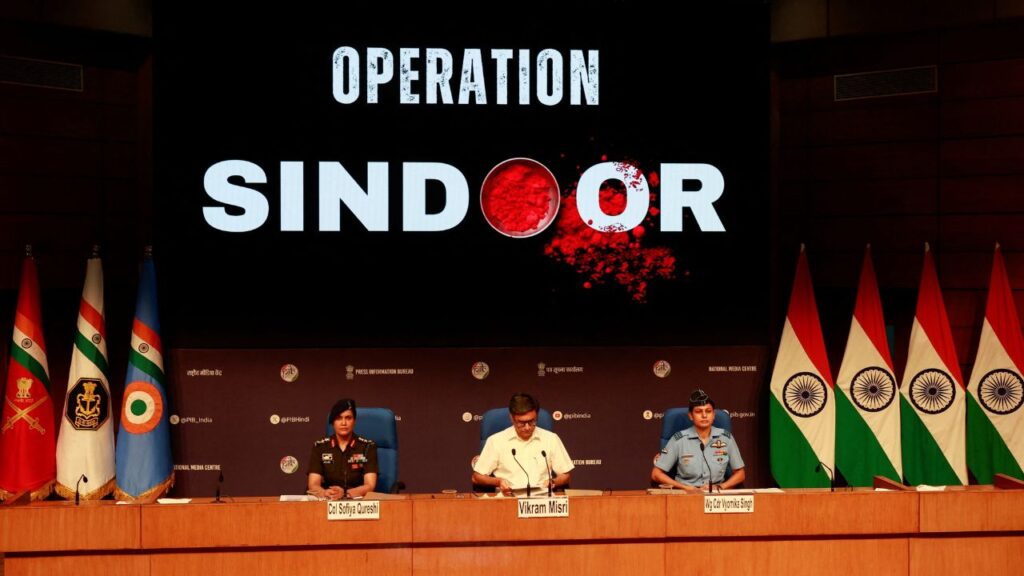
Diplomacy on the Back Foot
Congress MP Jairam Ramesh has rightly called the USCC’s findings “astonishing” and a “severe setback” for India’s diplomacy. When a respected U.S. Congressional body directly contradicts India’s official narrative, the resulting credibility gap becomes an international liability.
The Ministry of External Affairs has so far responded with selective denials, while the Prime Minister has maintained an uncharacteristic silence—particularly on the U.S. claim that Donald Trump personally intervened to halt Operation Sindoor.
Even more damaging, China launched a disinformation campaign claiming Pakistani forces downed three Indian Rafales—a claim France itself firmly refuted. That such propaganda gained any traction speaks volumes about the geopolitical vacuum India allowed to form around this critical operation.
The High Cost of Narrative-Making
The question before the country is stark:
Did the government exaggerate successes, conceal setbacks, and convert a complex military exchange into a campaign event?
If the USCC report’s claims are true—or even partially true—then the government’s narrative of heroism and victory was at best recklessly incomplete, and at worst deliberately misleading.
This is not merely an issue of optics. When democratic leaders leverage military action for domestic applause, they compromise operational secrecy, distort strategic priorities, and undermine professional military judgment. The armed forces become props. Citizens become spectators. The truth becomes negotiable.
Is This Treason?
Legally, treason is a tightly defined offence. But politically and morally, misleading a billion people on matters of war is no small betrayal. If a government knowingly inflated claims, distorted causes, or manipulated military facts for electoral gain, it stands in violation of the unwritten but sacred compact between the state and its citizens.
No leader, however popular, is above accountability.
No operation, however emotionally packaged, is above scrutiny.

A Moment of National Reckoning
Operation Sindoor may be remembered not for its tactical outcomes, but for what it revealed about the fragility of truth in an over-centralised, personality-driven political ecosystem. The USCC report should be treated not as an insult, but as a warning.
Great powers do not rise on propaganda. They rise on transparency, strategic clarity, and the moral authority that comes from honest leadership.
If India is to avoid further diplomatic embarrassments and strategic surprises, it must insist—firmly and without fear—that national security is not a political toy. The country deserves the truth about Sindoor. It deserves an explanation. It deserves accountability.
Because when the line between statecraft and stagecraft disappears, a nation’s security becomes the collateral damage.


