


A huge crowd surrounds Jamshed (52) as he stands with steaming pots of food at the relief camp set up in Mayur Vihar Phase 1 for survivors of the Yamuna floods in Delhi. The basic dal and rice he serves—so ordinary in the everyday life of these people—seem like a rare luxury here.
The camp, spread between nearly 300 makeshift tents, an ambulance, and a small medical setup, shelters those whose homes and belongings were swallowed by the river. It accommodates approximately 571 families, 559 women, and 1300 males. It was built to offer respite, yet for many survivors, it carries the discomfort that resurfaces the horror of the flood itself.
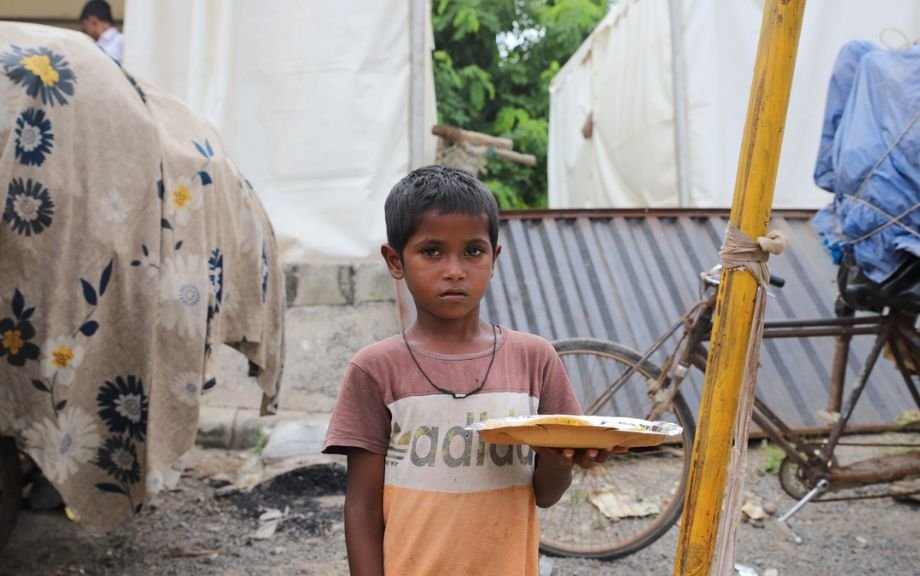
In the blistering heat, families huddle inside fragile tents, some without even a fan to ease their suffering. Women talk about their struggles to find privacy, with no space to bathe or wash in dignity, and children often set off for school on empty stomachs.
Inside a white tent, 52-year-old Reshama sits surrounded by stacked mattresses and broken chairs—emblems of all that the flood has washed away.
“I don’t have a proper space to bathe or wash clothes,” she says to FoEJ Media. Reshama recounts how she lodged several complaints, but “no one paid heed; no action has been taken.”
For Reshma and many like her, the flood did not end when the waters receded. It lingers in every meal, every sweltering night inside the tents, and every hullabaloo that their children create due to hunger.
A few tents away from Reshama’s is where Neha Devi stays. For the past ten days, Neha Devi (40) has been living in the camp, clutching her child close to her chest as if shielding it from the weight of her exhaustion. Her face betrays a quiet fatigue as she points out, “There is a need for facilities in the camp at the moment.”
Lamenting the loss of her livelihood, she recalls, “All the crops have been destroyed; there’s not much left.” Whatever could be saved—like a mattress or a pillow—was brought along.”
But Neha’s struggle does not end there. She alleges that the camp provides no ration for cooking. “When my children are hungry,” she says, “I have nothing to feed them.” She struggles daily to preserve her dignity—”There is no private space to bathe, no soap, not even extra clothes to change into,” she claims.
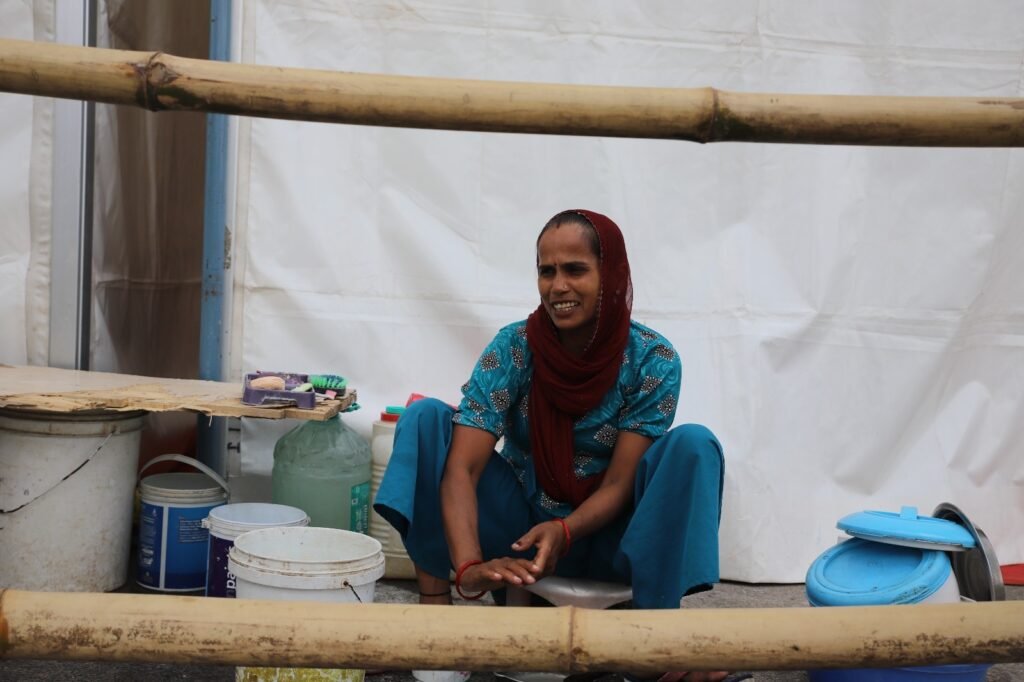
Next to her sits Nisha (46), whose world has shrunk to the walls of her tent. She has carved out tiny corners there for survival: a bucket and stool squeezed into a corner serve as her bathing space; beside it lies her kitchen, where the whistle of a pressure cooker is never heard, for she, too, has not been provided with raw rations.
“The crop I had is gone. We don’t have any rations, so when the children are hungry, how are we supposed to cook and feed them?” Nisha says
Even water, Neha says, she gets sporadically. “When the water comes, there’s such a crowd. You can’t even tell who gets it and who doesn’t.” she says to FoEJ Media.
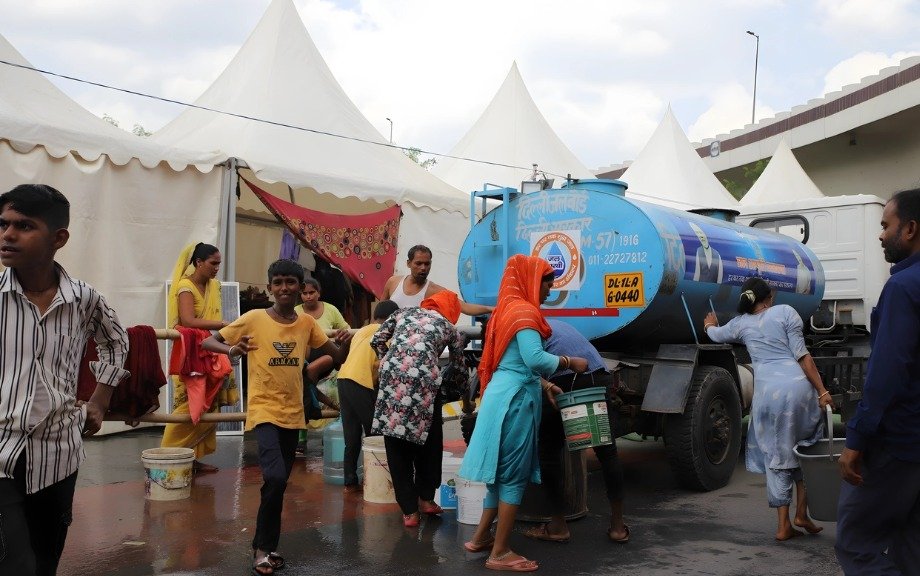
Outside Nisha’s tent stands Vikas Kumar, in his early thirties. He recalls how the floods ripped away the livelihoods of families like his, highlighting that “most of the survivors here are farmers.” The memory of that night remains vivid for Vikas. “It was a horrifying sight,” he says, summing up the chaos and fear in a single phrase.
Like others in the camp, Vikas chronicles the same struggles—hunger that lingers even after food is served, the scramble for drinking water, and the absence of space and privacy that turns survival into a daily battle.
However, the pangs of anguish of survivors in the camp seem to end soon as the Yamuna’s water level at the Old Railway Bridge in north Delhi continued to fall on Sunday, reaching 205.47 metres at 3 p.m., with the Central Water Commission (CWC) predicting a further decline by evening. According to the CWC’s afternoon forecast, the river was expected to dip to 205.35 metres by 8 p.m.—just above the danger mark of 205.33 metres.


