


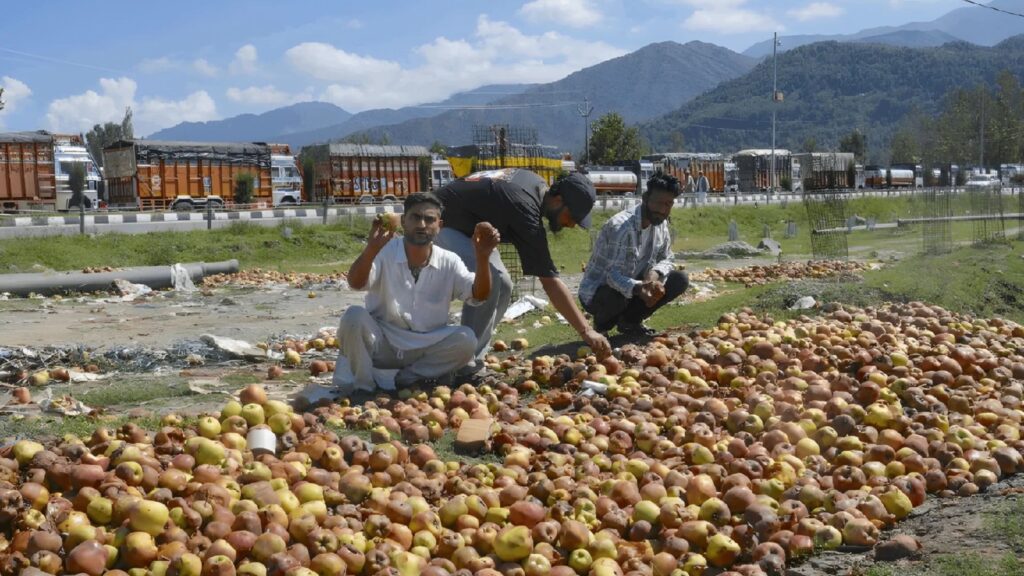
Thousands of tons of apples are reeking and rotting in marooned trucks along the Srinagar-Jammu National Highway, as the key arterial route that connects Kashmir’s orchards to markets across India, remains blocked for the 20th consecutive day due to inclement weather and landslides, leaving the farmers clueless on how to clamber out from the losses faced.
At the cyclical point of the harvesting season, the apple growers across the Kashmir are witnessing their hard earned product, perished in front of their eyes, leaving them brewing in anger.
While the doleful visuals making rounds on social media demonstrate truckloads of decomposing apples being dumped near the highway, highlighting the scale of economic devastation faced by the apple farmers, the apple growers who have their products in market also stand on tenterhook.
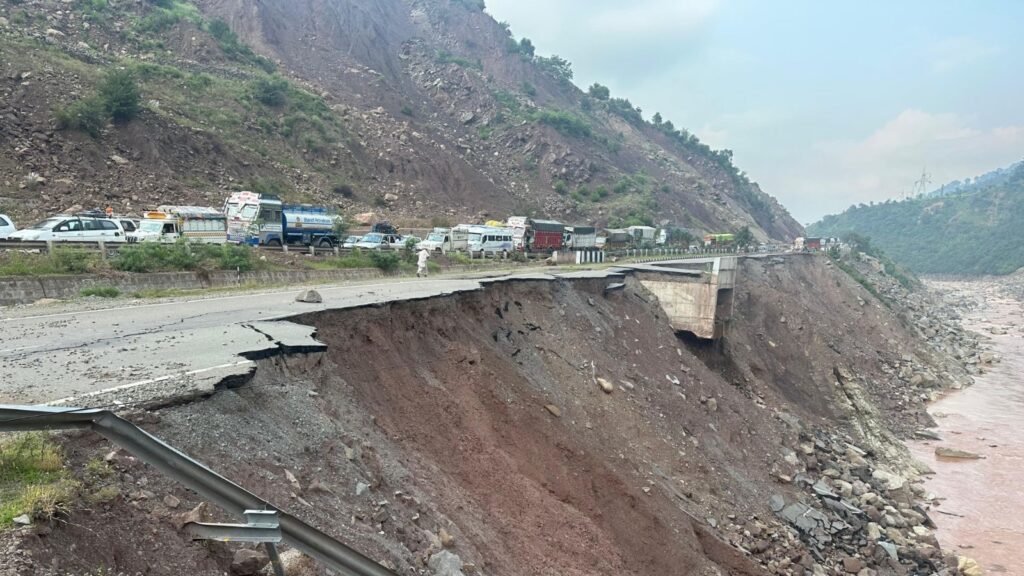
“I haven’t sold a single crate in the last two days because there are no customers coming. The graph that was going upwards is now steadily falling. The crate that was selling for ₹1000 is now going for just ₹500–600,” said 29 year old Umar Farooq Shah, a farmer from Sopore Kashmir.
Farooq’s family, like many other farming households in Kashmir, depends entirely on agriculture as their sole source of income. “This loss has dealt a severe blow to their livelihood, leaving them financially vulnerable and uncertain about the future,” Farooq said, while talking to FoEJ Media.
Kashmir accounts for 70- 80 per cent of India’s total apple production. With the region’s produce unable to reach markets across the country, farmers are staring at massive financial losses, threatening their livelihoods and pushing many towards debt.
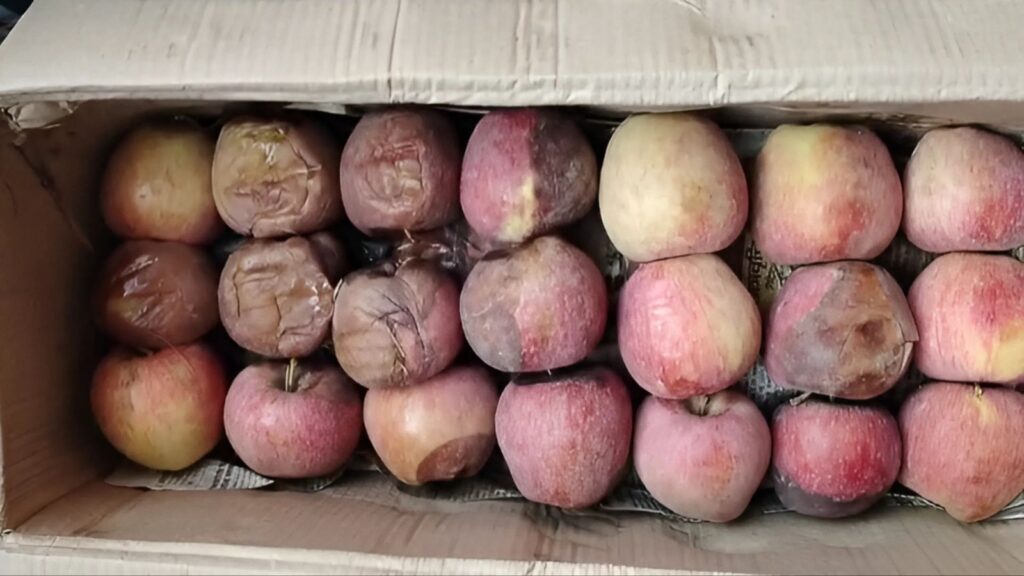
“Most people had taken loans either from banks or from private parties during the apple harvest process. Now, with this situation, we are bound to become financially unstable,” grief stricken Farooq said.
The losses aren’t limited to just apples, the nearly 20-day closure of the Srinagar-Jammu National Highway has also led to a sharp spike in freight charges. This surge in transportation costs has further deepened the financial strain on farmers, pushing many to the brink of economic instability.“The freight cost to Delhi, which used to be ₹90 earlier, has now shot up to ₹240–₹250,” Farooq revealed.
“The loss is cyclical”
Losses among apple farmers have disrupted both the transportation of produce and access to markets.Hamza Shah, a farmer from Sopore in Kashmir, was among those affected. He laments that months of hard work have gone in vain — a loss whose repercussions, he fears, will follow him well into the future.
“The loss is cyclical. Farmers begin working as early as March — we spend heavily on fertilizers and pesticides to protect the trees from disease. Then there are the labour costs for harvesting and transporting the apples. And just when it was time to sell the produce, everything got ruined. This isn’t just a one-time setback — the impact of this loss will carry into the future as well.” Shah said
Omar Abdullah Expresses Dismay
Omar Abdullah expressed his dismay over the prolonged closure of the highway, urging the central government to hand over control to the Jammu and Kashmir administration if it is unable to ensure its timely restoration
“The highway falls under the domain of the central government. If they can’t handle it, then let them hand it over to us. We waited patiently, but nothing happened,” said Mr Abdullah.
Reviving Kashmir’s Apple Heritage
Apples — locally known as choonth — have deep roots in global history and Kashmiri identity. Originating from Central Asia, the fruit reached Europe via the Silk Road and was later introduced to the Americas by European settlers. Sacred to Aphrodite in Greek mythology and central to the Christian story of Eden, the apple has long symbolized beauty, temptation, and knowledge.
Kashmir has cultivated apples for centuries, with historical references from Kalhana’s Rajatarangini and Chinese traveller Hiuen Tsang. Emperors like Jahangir and Sultan Zain-ul-Abidin promoted its growth, and today, apple farming sustains over 7 lakh families in the region.
Kashmir Yields 17 Lakh Metic tonnes Annually, Contributing 75% of India’s total Apple Output
The Valley produces 17 lakh metric tonnes annually, contributing 75% of India’s total apple output. Shopian, Pulwama, and Anantnag are key districts. While Red and American Delicious dominate for their high yield and fast growth, Kashmir’s native pride — the Ambri apple — is disappearing. Known for its rich taste and fragrance, Ambri suffers from low productivity and slow maturity, making it less viable for modern growers.
However, hope lies in Lal-Ambri, a hybrid of Ambri and Red Delicious. Horticulturists believe this variety could revive Kashmir’s apple heritage — if supported by strong government backing and scientific innovation.


