


When Prime Minister Narendra Modi stood before the nation to celebrate 150 years of Vande Mataram, he wasn’t merely honoring a song — he was reviving an ideological tool. What Modi hails as “national pride” is, in reality, a political instrument of Hindutva, a divisive hymn long weaponized to define who belongs to India — and who does not.
In his carefully choreographed praise, Modi does what he does best: transforms a cultural relic into a test of loyalty. Refuse to sing Vande Mataram, and you are instantly cast as anti-national — a familiar script in the playbook of the ruling establishment.
The Hidden Story of a “Patriotic” Song
Bankim Chandra Chatterji wrote Vande Mataram in the 1870s, not as a resistance song against British colonialism but as a literary expression of Hindu revivalism. He was, after all, a bureaucrat in the colonial service — a loyal subject of the British Empire. His novel Anandamath, where the song first appeared, glorifies Hindu ascetics who take up arms not against the British but against Muslim rulers. The British, in Bankim’s narrative, appear almost as benevolent liberators restoring “order” after supposed Muslim tyranny.
This is the ideological root of the song — a fusion of religion and nationalism that defines the motherland as a goddess to be worshipped. The “mother” in Vande Mataram is Durga, not a secular personification of India. For Muslims, Christians, Sikhs, and others who do not worship Hindu deities, such imagery is alienating. It turns patriotism into theology and citizenship into ritual devotion.
From Bankim to Savarkar: The Birth of Hindu Nationalism
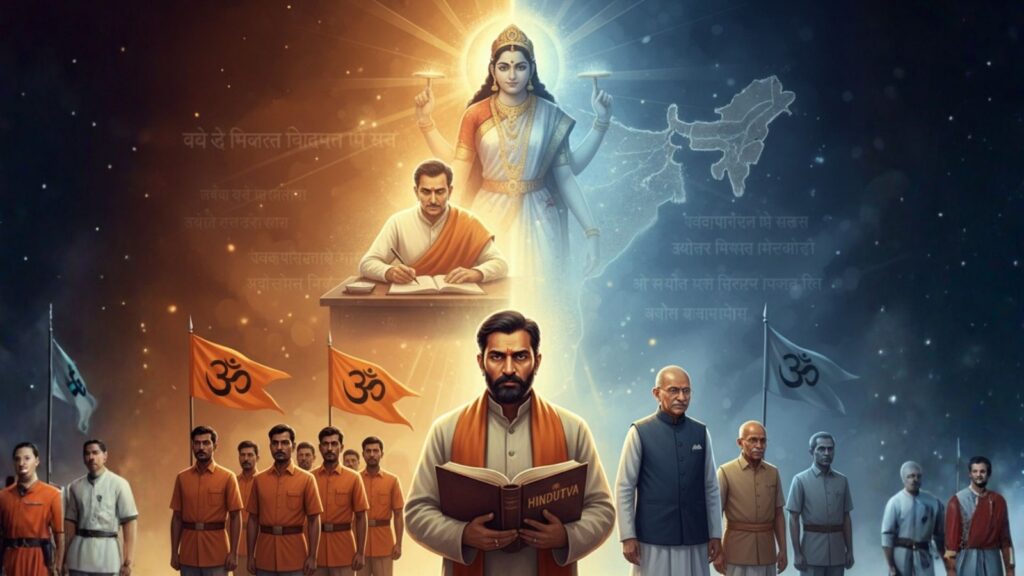
Bankim’s militant religiosity deeply influenced early Hindu nationalists. Vinayak Damodar Savarkar, the ideological father of the RSS, drew inspiration from Anandamath in articulating his concept of Hindutva. The idea that India’s identity was fundamentally Hindu — that true sons of the soil must regard it as both “holy land” and “motherland” — came directly from this line of thought.
The RSS and its offshoots would later turn Vande Mataram into a rallying cry, a litmus test of “true” nationalism. In the process, they stripped it of any artistic or literary context and transformed it into an ideological weapon.
Even Mahatma Gandhi, while acknowledging its poetic beauty, warned that it carried religious overtones that could offend others. Maulana Azad, Nehru, and other Congress leaders shared this concern. It is why the Constituent Assembly, in 1950, officially recognized only the first two stanzas — the rest were deemed too sectarian to represent a secular republic.
Congress’s Half-Hearted Compromise
The Congress’s partial adoption of Vande Mataram was a political compromise, not an endorsement. It tried to balance the emotional attachment many Hindus felt with the secular spirit of the freedom struggle. But Modi’s India has no interest in nuance or historical context. His regime thrives on symbolic warfare — renaming cities, rewriting textbooks, reinterpreting history — all to impose a singular cultural identity.
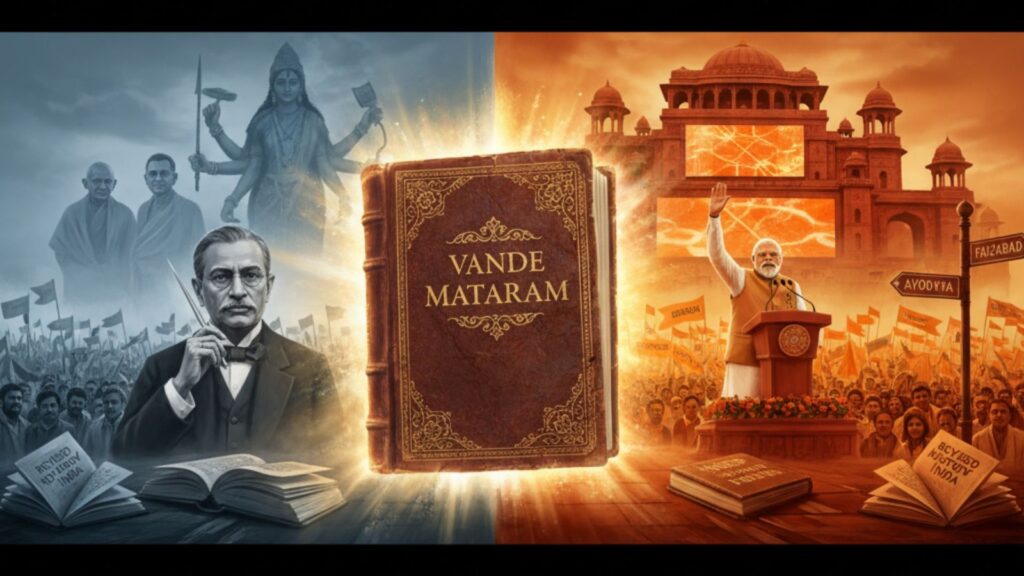
The celebration of Vande Mataram is part of this broader cultural project. It is about reclaiming history to serve the ideological needs of the present. When Modi invokes Bankim Chandra, he isn’t paying homage to literature; he’s paying tribute to a Hindu nationalist precursor.
Modi’s Cultural Nationalism: The Politics of Exclusion
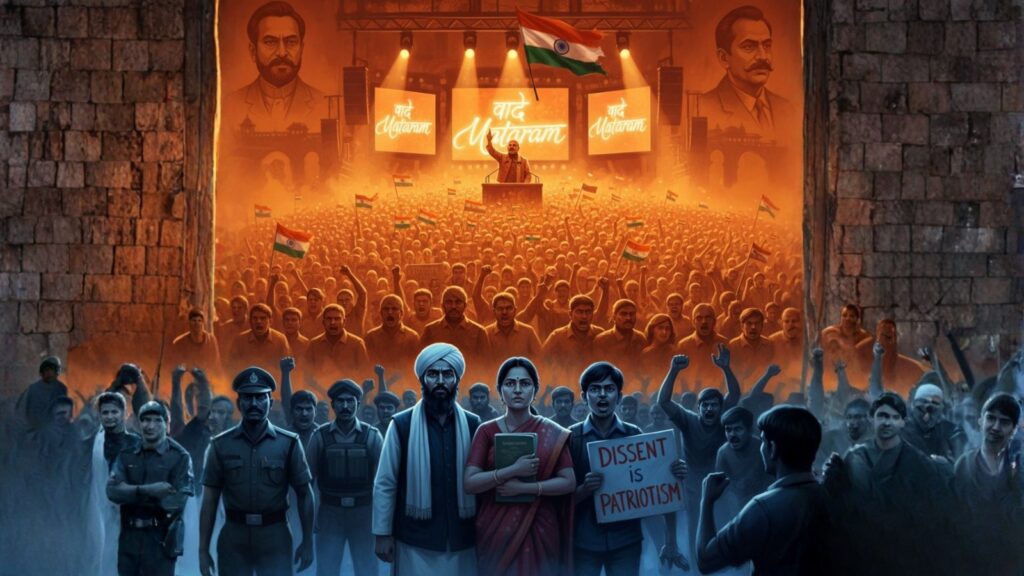
In today’s India, patriotism has become performative. You don’t have to believe in justice or equality — you just have to chant the right slogans. Modi’s politics thrives on such symbolism. By elevating Vande Mataram to a near-sacred status, he turns dissent into blasphemy. Those who refuse to sing it — often Muslims or secular-minded citizens — are publicly shamed, sometimes violently targeted, as if love for one’s country must now pass through a religious test.
This is not nationalism. It is sectarian loyalty disguised as national pride.
Modi’s invocation of Vande Mataram fits into the same pattern as his glorification of Savarkar, his silence on hate crimes, and his celebration of religious majoritarianism. It is the continuation of an ideological project that seeks to redefine India’s identity — not as a pluralistic civilization, but as a Hindu Rashtra.
A Song That Divides a Nation
The tragedy of Vande Mataram is not just its origin but its appropriation. A song that could have remained a historical artifact of its time is now a political sword used to carve divisions. It is exclusion dressed as emotion, devotion mistaken for patriotism.
True nationalism does not demand uniformity. It celebrates differences, it unites people across faiths and languages. Vande Mataram, as it stands today, does the opposite. It divides India into believers and outsiders — an “us versus them” framework that echoes the very colonial mentality it was supposed to transcend.
Modi: The Divider in Chief
In celebrating Vande Mataram with state pomp, Narendra Modi cements his place as the divider-in-chief of modern India. His politics thrives on memory wars — transforming culture into conflict, history into weaponry.
India’s strength has always been its diversity, not its uniformity. A nation that forces its citizens to worship a goddess in the name of patriotism has already betrayed its own secular soul.
Vande Mataram should remain a chapter in literary history, not a test of citizenship. To elevate it as national idealism is not pride — it is shame. It reminds us not of freedom, but of how deeply the idea of India is being rewritten by those who fear its pluralism.
(The views expressed in this opinion piece are those of the author and do not necessarily reflect the views of FoEJ Media.)


