


I did not witness the debate between Javed Akhtar and Shamail Nawi in person. I encountered it later, mediated through the antiseptic distance of YouTube—where applause is flattened, silence is edited out, and tragedy becomes a timestamp. That distance proved useful. It allowed the emotions to cool and the arguments to reveal themselves naked, without the seduction of immediacy.
And yet, as the exchange unfolded, I grew restless.
Both men were articulate. Both were sincere. And still, something essential was missing. The debate circled the abyss, gestured toward it, even shouted into it—but never fully descended. The deepest implications were invoked but not confronted. The foundations were shaken, yet never excavated.
What follows, then, is not a recap. It is an arbitration. Not a narration of what was said, but a judgment on what ought to have been said—and what the debate ultimately exposed about belief, disbelief, and the metaphysical cost of each.
This debate was never about data or doctrine. It was about orientation—two fundamentally different ways of standing inside reality.
On one side stood protest: moral outrage aimed upward.
On the other stood postulate: metaphysical order aimed downward.
The clash was not between faith and reason, but between moral intuition and ontological explanation.
Javed Akhtar did not arrive with premises neatly stacked toward a conclusion. He arrived with an accusation.
His argument was not: “God does not exist because X.”
It was: “If God exists, He is morally unacceptable.”
By invoking the image of the suffering child—bombed, starved, buried under rubble—Akhtar weaponized the strongest human intuition we possess: that innocent suffering is intolerable. This was not cheap rhetoric. It was existential protest. It was Job without revelation.
And it worked—emotionally.
But here is the first question Javed Akhtar never answered, and which the debate failed to press him on:
On what basis is suffering “intolerable” in a godless universe?
If the universe is the product of blind forces, then pain is not a moral scandal—it is a mechanical outcome. Fire burns. Plates shift. Stronger tribes eliminate weaker ones. Children die not unjustly, but irrelevantly.
To say “this should not be” is already to assume a standard of how things ought to be.
Where does that “ought” come from?
Javed Akhtar’s protest presupposed:
- that some lives ought not to be harmed,
- that injustice is objectively wrong,
- that reality has violated a moral expectation.
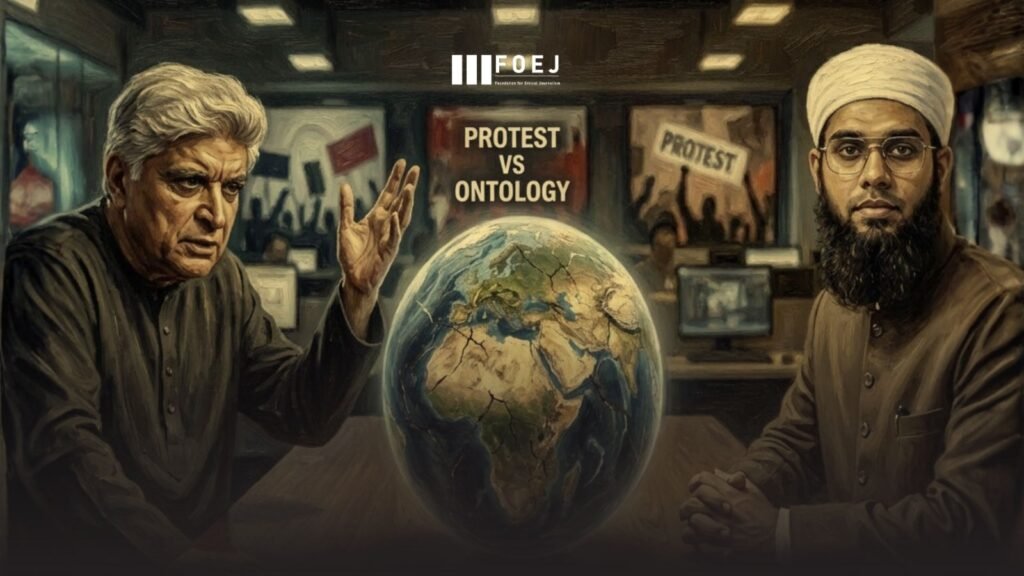
But expectations require a normative framework. A universe of atoms has none.
This is the paradox at the heart of Javed Akhtar’s position:
He uses a moral compass to indict a universe he claims has no moral north.
If the heavens are empty, then his accusation has no addressee—and worse, no foundation. The scream echoes, but it condemns nothing.
Shamail Nadwi responded not with protest, but with structure.
He refused to reduce God to a cosmic bureaucrat micromanaging tragedies. Instead, he placed God where classical theism has always placed Him: as the ground of being itself.
His central move was correct and philosophically necessary:
God is not a cause within the universe.
God is the reason there is a universe.
By invoking free will, stable natural laws, and contingency, Shamail Nadwi shifted the debate from emotional immediacy to ontological necessity. He asked a different question:
What must reality be like for anything at all—good or evil—to exist?
Here, Shamail Nadwi won the philosophical high ground.
But he lost something else.
When asked why children die, he answered in terms of causal consistency and metaphysical constraints. Logically sound—but existentially bloodless. The audience did not want a theorem; they wanted recognition of pain. He gave them scaffolding, not shelter.
Yet this is not a philosophical failure so much as a rhetorical imbalance. The logic stood. The empathy lagged.
If we step away from the microphones and the moral theatre, a colder question emerges—one that neither applause nor outrage can dissolve:
What must be true for reality itself to make sense?
Here, theism does not merely survive. It dominates.
- The Scandal of Existence
The universe exists. That is not a scientific explanation; it is a metaphysical shock.
Science explains behavior after existence. It cannot explain existence itself. No equation answers the question: Why is there something rather than nothing?
Consider this:
- Every object is contingent.
- The universe is a collection of contingent objects.
- A collection of contingents does not become necessary by aggregation.
An infinite regress of explanations explains nothing—just as an infinite chain of borrowed books does not explain who owns the library.
Theism posits what reason demands: a Necessary Being, whose essence is existence itself.
Atheism offers no rival explanation—only silence.
- The Fingerprint of Intent
The laws of physics are not merely permissive of life; they are precisely calibrated for it.
If gravity were marginally stronger, stars would collapse.
If marginally weaker, they would never ignite.
If the cosmological constant varied infinitesimally, the universe would either tear itself apart or collapse instantly.
Calling this “luck” is not scientific humility—it is metaphysical desperation.
We do not infer intelligence because we are religious.
We infer intelligence because it is what explains precision.
- The Mystery of the “I”
Materialism tells you that you are a biochemical machine. But machines do not experience guilt. Algorithms do not weep at funerals. Neurons fire, but they are not about anything.
And yet your thoughts are about the world.
This “about-ness”—intentionality—is fatal to materialism. No amount of matter explains meaning.
A mindless universe cannot produce minds that search for truth.
A reality grounded in Mind can.
- The Borrowed Capital of Moral Outrage
Here lies the decisive irony.
The atheist’s loudest weapon—the accusation of injustice—only works if justice is real.

But justice is not a molecule. It is not an evolutionary trick. It binds even when disobeyed. It condemns even when ignored.
If there is no God:
- Gaza is not evil—only unfortunate.
- Slavery is not wrong—only outdated.
- Murder is not immoral—only maladaptive.
By protesting injustice, the atheist smuggles in a transcendent moral law—and then denies the Lawgiver.
He borrows God’s moral currency to argue against God.
This is not courage. It is contradiction.
The Final Verdict
The debate revealed something profound:
The question of God does not endure because of ignorance.
It endures because meaning refuses to die.
Atheism offers coherence at the price of significance.
Theism offers significance grounded in coherence.
Without God:
- reason floats,
- morality dissolves,
- protest becomes noise,
- and the very question “Why?” evaporates.
We do not choose God because He comforts us.
We choose God because without Him, even despair has no meaning.
God is not the answer to a gap in knowledge.
God is the condition that makes knowledge, morality, and protest possible at all.
And that is why, long after debates end, arguments fade, and videos stop trending—the question of God returns.
Not as a relic of fear, but as the unavoidable demand of reason itself.


