



When the “Nari Shakti Vandan Act” (106th Constitutional Amendment) was passed almost unanimously in a special session of the country’s new Parliament House in September 2023, the ruling party declared it a “revolutionary event” and a “new dawn of women’s consciousness.” A grand propaganda machine created an atmosphere that half of India’s population, long marginalized, had received their rights overnight. But basic rule of political science is this, when the ruling party presents a right with a grand celebration, its fine print must be read first. Today, as 529 civil society leaders, academics, bureaucrats, and former trade union leaders, including Aruna Roy, retired IAS officer Aditi Mehta, and advocate Gyanendra Kumar, under the banner of the National Coalition for Women’s Reservation (NCWR), are demanding its immediate implementation in the monsoon session, a harsh truth has been revealed to the nation, this landmark bill was, in fact, a historic, structural fraud perpetrated against women. The coalition clearly alleges that women’s hopes have been put on hold due to the “artificial and false association with delimitation.”
The Constitution (131st Amendment) Bill, 2026, the Delimitation Bill, 2026, and the Union Territories Laws Bill, recently introduced in Parliament, have fully justified this fear. The government, using the delayed census as a pretext, is stubbornly intent on increasing the number of Lok Sabha seats from 543 to 850 based on the old 2011 census, and linking it to women’s reservations. Against this background, it becomes clear that the 106th Amendment was not a revolutionary step, but a weave of ‘chronology’, designed so that credit could be taken while the structure of power remained untouched.
Preserving the ‘Patriarchal Status Quo’ and the Mathematics of Male Dominance
Suhas Palshikar, a leading scholar of Indian political science, has clarified in his theory of (Electoral Hegemony and Ideological Co-optation) that the contemporary ruling party does not reject public aspirations, but rather co-opts them in a way that preserves its core power structure. The Women’s Reservation Act is a living example of this principle. If the BJP government truly intended to achieve gender justice, it could have immediately implemented this law by reserving 33 percent (181 seats) for women within the current Lok Sabha (543 seats). But there was a very large political risk in taking that route the conflict of interest for male MPs. If 33% of the current seats were reserved for women, the political careers of at least 180 current male MPs (including prominent leaders of the ruling party) would face an immediate halt to their political careers. To avoid this potential rebellion within the party, a clever way out was found, Increasing the number of seats. The government’s underlying agenda is to increase the number of Lok Sabha seats to 850. Thus, the seats of currently occupying male MPs would be secured, women would be given their 33% share from the increased seats. Political scientists call this “no-loss accommodation”. That is, so men do not have to give up their comfortable chairs of power women’s rights were held hostage until new seats were installed in the Parliament building. This is not women’s political empowerment, but a deliberate strategic move to maintain the patriarchal status quo.
Historical and Constitutional Inconsistencies
The argument of the BJP and its legal advisors that a logical and geographical allocation of seats is impossible without a census and a new delimitation is completely hollow in the light of constitutional history. India has several legislative examples where landmark social reforms were implemented immediately, without any national delimitation.
When former Prime Minister Rajiv Gandhi’s visionary vision under the 73rd and 74th Constitutional Amendments (1993), and later during the P.V. Narasimha Rao government, provided 33% (now 50%min many states) reservation for women in Panchayats and local municipal bodies, no nationwide new census or special Delimitation Commission was awaited. The rotation system was implemented based on the then-available census data. The result is before us today—more than 1.5 million elected women are leading at the grassroot level in the country. If this was technically possible at the grassroots level, how did it become ‘impossible’ for Parliament and Legislative Assemblies?
Under Articles 330 and 332 of the Indian Constitution, SC and ST categories are entitled to reservations in the Lok Sabha and Legislative Assemblies in proportion to their population. Whenever new states (such as Jharkhand, Uttarakhand, and Chhattisgarh) were formed or seats changed, the Election Commission reserved seats based on immediate administrative orders and available data, without any comprehensive national delimitation. The Women’s Reservation Bill, passed in the Rajya Sabha in 2010 during the Manmohan Singh government, did not contain such a time-lock condition. It simply provided for reservations to be implemented through a rotational system within existing seats. The then BJP opposition also supported it. Then, what constitutional obstacle suddenly arose in 2023 that made it necessary to bind the reform in the uncertain chains of delimitation?
Attack on Federalism
A Dangerous North-South Imbalance
The most dangerous dimension of linking women’s reservations to delimitation relates to India’s federal structure. Viewed in light of the principles of “Majoritarian Democracy and Regional Imbalance” by renowned political scientist and India expert Christophe Jaffrelot, this move is a silent detonator for India’s unity and integrity. The simple and brutal rule of delimitation in India is: “The greater the population, the greater the seats.”
In the 1970s, the Indira Gandhi government imposed a freeze on delimitation through the 42nd Constitutional Amendment, which was later extended until 2026 by the Atal Bihari Vajpayee government through the 84th Amendment. Behind this was a very logical and progressive thought: states that followed the central government’s policies and performed well in population control, education, health, and family planning should not be punished.
Southern states (Tamil Nadu, Kerala, Karnataka, Andhra Pradesh, Telangana) have successfully controlled their populations, while northern Indian states (especially Uttar Pradesh, Bihar, Madhya Pradesh, and Rajasthan) continue to experience population growth.
Now, if delimitation is carried out under the new 2026 bills based on the 2011 or a future census, the balance in Parliament will be completely.
Representation of South India in the Lok Sabha could fall from the current 24% to around 20% or even less. The combined seats of large states like Uttar Pradesh and Bihar would exceed the total of many smaller states.
After delimitation 2026, the northern Hindi belt states could see a significant increase in Lok Sabha seats based on population ratio. For example, Uttar Pradesh’s seats could increase to around 140 or more. That would consolidate the region influence in central and national politics. Conversely, while the total number of seats in southern states may increase, their percentage share at the national level is expected to decline. Consequently, these states are expressing concern that their influence in national politics may diminish in the future.
The ruling party has used women’s reservation as a “human shield” to conceal this deep political and regional distortion. They know that if directly implementing this North-South imbalance would trigger a large movement across the country. so, they have put on the attractive mask of “women empowerment” so that anyone opposing this delimitation can be branded “anti-women.” This is the worst example of a “Strategic Smokescreen” in political science term.
Symbolic Politics
Professor Zoya Hasan has explained in several of her works that whenever right-wing or majoritarian governments are unable to deliver real economic and social rights, they resort to tokenism. Passing the Nari Shakti Vandan Act, but postponing its implementation to an indefinite future (which does not seem feasible before 2029 or 2034) is the height of credit politics. The government used posters saying “Respect for women, Modi’s guarantee” to win women’s votes in the 2024 general election and subsequent state assembly elections, but when it came time to implement that guarantee on the ground, it pushed the matter into bureaucratic procedural labyrinths. This underscores the crisis in modern democracy where the illusion of “Announcement is Implementation” is created. The advertising machinery is so strong that the public believes the work has been done, while in reality, the law simply lies in the files, like a dead letter.
Double Deprivation of Marginalized Women: Lack of a ‘Quota Within a Quota’
Another serious aspect of this debate, which has been pointed out by several NCWR constituents, is the absence of a specific quota within this reservation for OBC and minority women. Indian society is not homogeneous. The social challenges of an upper-caste, upper-middle-class urban woman are completely different from those of a rural, Muslim, Dalit, tribal, or OBC woman. If a ‘Quota Within a Quota’ provision is not included in this bill, there is a strong possibility that the full benefits of the 33% reservation will be limited to women from influential, privileged, and political families. The government deliberately ignored this complex social reality in order to undermine the principle of comprehensive social justice within Parliament. This is a narrow framework of “inclusion” that polishes only the surface, while leaving caste and class inequalities at the foundation intact.
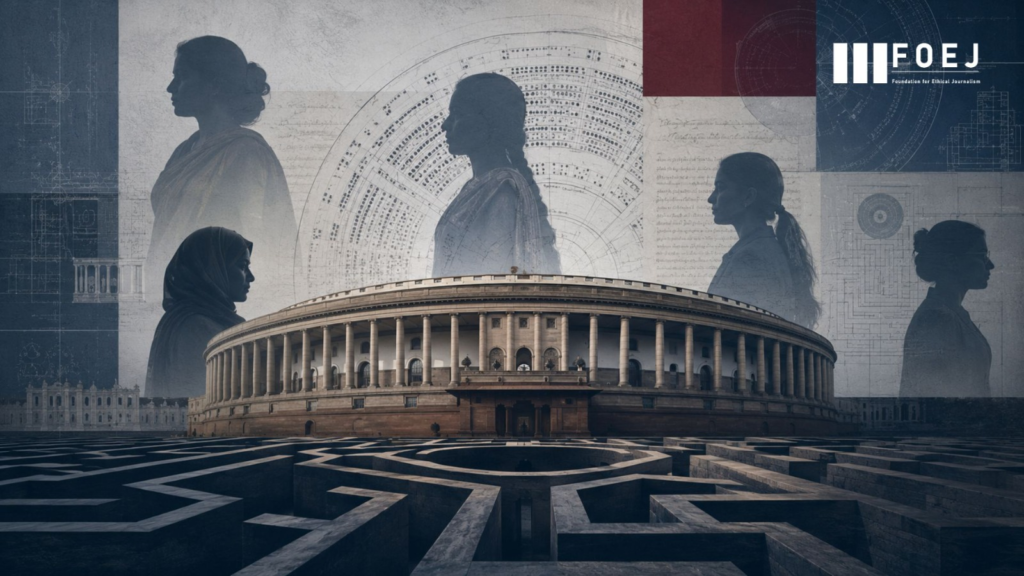
Breaking the labyrinth of delays is the only path to justice. This campaign, launched by the NCWR and 529 vigilant civil society leaders across the country, is not merely a demand for a legislative amendment, but a fight to save the soul of Indian democracy. Their argument that the Women’s Reservation Act be immediately delinked from the census and delimitation requirements is completely academic, constitutional, and morally undeniable. If the government is truly committed to “women power,” it should introduce a supplementary amendment bill in the upcoming monsoon session. Through that amendment, 33% of seats should be reserved for women within the current 543 seats by lottery or rotation system, without waiting for any delimitation. If the government refuses to do so and continues down the labyrinthine path of the Delimitation Bill 2026, it will be considered the biggest political betrayal in the history of the country. Half the population is in no mood to wait any longer. Justice delayed is justice denied. Parliament must now break the maze of procedural excuses, or history will write that India’s rulers (BJP) did not give rights to the women of the country, but only gave them a ‘illusion’.