



PUCL Condemns Police Harassment: The People’s Union for Civil Liberties (PUCL) has strongly condemned the Delhi Police’s harassment of human rights activist Nadeem Khan, accusing them of conducting a targeted witch-hunt.
Incident in Bangalore: On November 30, 2024, Delhi Police arrived at Nadeem Khan’s brother’s residence in Bangalore, attempting to detain him without a warrant, coercing him to travel to Delhi for questioning.
Violation of Legal Procedures: Despite no formal arrest warrant, police officers tried to pressure Khan into accompanying them to Delhi for investigation under an FIR filed that day.
Harassment Lasted for Hours: The police allegedly harassed Khan and his family for nearly six hours, violating legal norms by attempting to detain him without due process.
Details of the FIR: The FIR, numbered 0280/2024, involves charges under sections 196, 353(2), and 61 of the Indian Penal Code, which carry a maximum punishment of less than three years.
Legal Concerns: PUCL raised concerns that the FIR does not justify an arrest as per the Supreme Court’s 2014 ruling in the Arnesh Kumar case, which prevents arrests for crimes with punishments under seven years.
Impact of Social Media Campaign: The PUCL believes that the FIR was instigated by a social media campaign targeting Khan, particularly after his recent exhibition highlighting hate crimes and Supreme Court rulings.
Police Raid at APCR Office: On November 29, 2024, 20-25 police officers arrived at the APCR office without legal documents, questioning the security guard and showing hostility towards lawyers seeking an explanation.
PUCL’s Demands: PUCL has called for the immediate quashing of the FIR against Khan, an end to the harassment of his family, and compensation for the distress caused. It also demands a new FIR against the police officers involved.
APCR’s Advocacy for Justice: The Association for Protection of Civil Rights (APCR) has been at the forefront of legal battles to protect civil liberties, focusing on issues like police brutality and unlawful demolitions in the wake of communal violence.
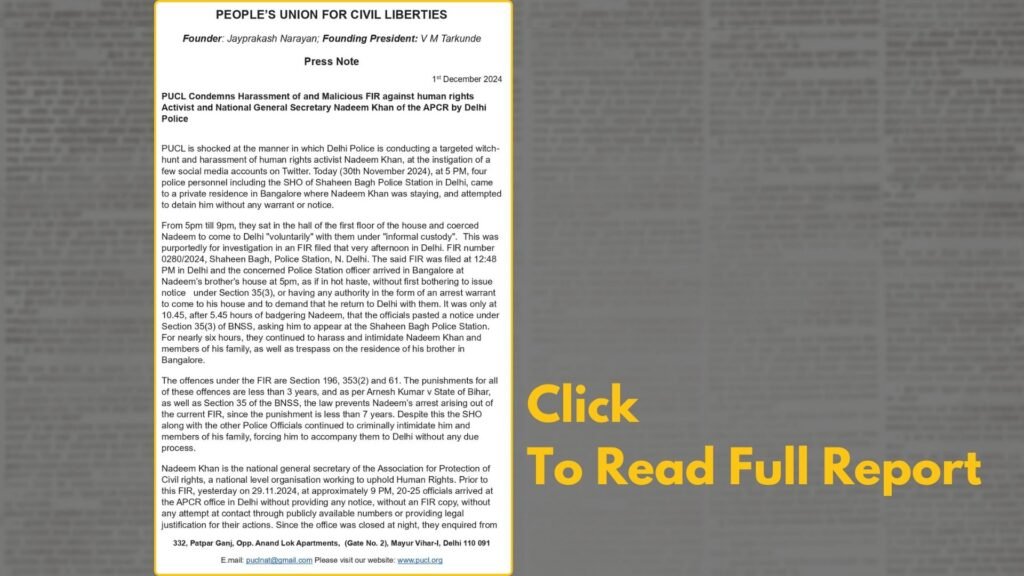
The People’s Union for Civil Liberties (PUCL) in a Press Release dated 1.12.24 has expressed strong condemnation of the recent actions of the Delhi Police against Nadeem Khan, a human rights activist and the National General Secretary of the Association for Protection of Civil Rights (APCR).
“PUCL is shocked at the manner in which Delhi Police is conducting a targeted witch- hunt and harassment of human rights activist Nadeem Khan, at the instigation of a few social media accounts on Twitter,” The Press Release reads.
PUCL has accused the police of harassing and attempting to illegally detain Khan in a clear case of targeted “intimidation”, following the filing of an FIR on November 30, 2024.
According to the PUCL, a group of Delhi police officers arrived at a residence in Bangalore on the evening of November 30, where Khan was staying. Four police officers, including the Station House Officer (SHO) of Shaheen Bagh Police Station, reportedly attempted to take Khan into custody without providing any warrant or prior legal notice. The officers, PUCL claims, coerced Khan to “voluntarily” return to Delhi with them for questioning related to the FIR, which had been registered just a few hours earlier.
The incident, which lasted for over five hours, took place at the residence of Khan’s brother. The police officers are said to have occupied the living room for an extended period, refusing to leave and applying pressure on Khan to accompany them to Delhi. Despite the absence of any formal arrest procedure, the police allegedly insisted on Khan’s immediate presence at Shaheen Bagh Police Station for further investigation into the FIR filed against him.
“From 5pm till 9pm, they sat in the hall of the first floor of the house and coerced Nadeem to come to Delhi “voluntarily” with them under ‘informal custody,’” the Press Release further adds.
The Press Release further reveals that the FIR, numbered 0280/2024 and registered at Shaheen Bagh Police Station, lists charges under sections 196, 353(2), and 61 of the Indian Penal Code. These charges are typically associated with offenses that carry a punishment of less than three years. PUCL has raised concerns about the lawfulness of the police actions, pointing out that such offenses do not warrant an arrest under the principles established by the Supreme Court in the case of Arnesh Kumar v. State of Bihar (2014), which prevents arrests for crimes where the punishment is less than seven years.
“The offences under the FIR are Section 196, 353(2) and 61. The punishments for all of these offences are less than 3 years, and as per Arnesh Kumar v State of Bihar, as well as Section 35 of the BNSS, the law prevents Nadeem’s arrest arising out of the current FIR, since the punishment is less than 7 years,” The Press Release Reveals.
According to PUCL, the police actions violated established legal norms and constituted criminal intimidation and harassment. The organization claims that the police did not provide any valid reason for detaining Khan and instead continued to pressure him and his family, even after the legal limits for detention had been surpassed. It was only after 10:45 p.m., nearly five hours after the initial visit, that the police issued a formal notice under Section 35(3) of the BNSS, requesting Khan’s appearance at the Shaheen Bagh Police Station.
“For nearly six hours, they continued to harass and intimidate Nadeem Khan and members of his family, as well as trespass on the residence of his brother in Bangalore.,” the Press Release further adds.
In its statement, PUCL also emphasises the nature of the investigation, which it believes was initiated under the influence of a social media campaign targeting Khan and his work. The FIR follows a recent exhibition organized by Khan and the APCR, which focused on recent incidents of hate crimes, hate speeches, and the need for stronger legal safeguards against mob violence. The exhibition also featured recent judgments of the Supreme Court, including Tehseen Poonavala v. Union of India, which established guidelines for dealing with cases of mob violence.
The PUCL sees the FIR as an attempt to silence the APCR’s efforts in fighting hate crimes, mob lynchings, and other human rights violations in India. The organization contends that the charges against Khan are part of an effort to criminalize advocacy for civil liberties and human rights, and to suppress the exercise of free speech.
“The basis of this FIR is that Nadeem Khan was involved in putting up an exhibition highlighting recent incidents of hate crimes and hate speeches in India. The exhibition also displayed recent judgments of the Supreme Court like Tehseen Poonavala v Union of India where they have passed guidelines for dealing with cases of mob violence,” the Press Release adds.
The harassment of Khan by the police is not an isolated incident. On the night of November 29, 2024, the PUCL reports that 20-25 police officials arrived unannounced at the APCR office in Delhi. The officers reportedly did not present any legal documents, including a copy of the FIR or any arrest warrants, and instead began questioning the security guard about Khan and other members of the organization.
On 29.11.2024, at approximately 9 PM, 20-25 officials arrived at the APCR office in Delhi without providing any notice, without an FIR copy, without any attempt at contact through publicly available numbers or providing legal justification for their actions
When lawyers representing the APCR arrived at the office and inquired about the police’s actions, they were reportedly met with hostility. According to PUCL, the police officers refused to provide any explanation for their visit, and one of the officers, identified as Head Constable Yogesh of Shaheen Bagh Police Station, allegedly threatened the lawyers with dire consequences. PUCL claims the officers’ refusal to offer an explanation or provide any legal justification for their actions demonstrates the arbitrary and unlawful nature of the police conduct.
“The Head Constable also misbehaved with the lawyers and threatened them with dire consequences. Lawyers representing APCR also went to Shaheen Bagh Police Station to ask about the reasons for the police raid but received no answer.” the Press Release reveals.
In response to these developments, PUCL has called for immediate legal action. The organization is demanding that the FIR filed against Nadeem Khan be quashed, citing the lack of legal grounds for the investigation and the unlawful conduct of the police. Furthermore, PUCL has called for an end to the harassment of Khan and his family, insisting that compensation be provided for the distress caused by the police’s actions. The PUCL also demanded that a separate FIR be filed against the SHO of Shaheen Bagh Police Station and the other officers involved in the intimidation and harassment of Khan and his family.
Meanwhile, the PUCL has vowed to continue its efforts to protect human rights and civil liberties in India and to hold the authorities accountable for any violations of the law. The organization has called on the public to stand in solidarity with Nadeem Khan and the APCR, as they continue their work to fight for justice and the protection of fundamental rights.
What is APCR?
The Association for Protection of Civil Rights (APCR) is a non-governmental, non-profit organization dedicated to promoting a just and equitable society. The organization brings together a dedicated team of lawyers, social activists, and grassroots paralegals to bridge the gap between legal frameworks and the broader community.
APCR is at the forefront of defending the rights of marginalized communities, especially religious and ethnic minorities. The organization takes active steps in legal battles to uphold constitutional rights, working to ensure that those facing discrimination or violence receive justice.
APCR frequently files Public Interest Litigations (PILs) to address pressing issues such as police brutality, unlawful detentions, and violations of due process. Recently, the organization filed a PIL concerning police actions during the Sambhal violence, where excessive force was allegedly used against the Muslim community.
APCR’s Role in Sambhal Case
The Association for Protection of Civil Rights (APCR) has also been actively involved in responding to the violence that broke out in Sambhal, Uttar Pradesh, on November 24, 2024, during a contentious survey of the Shahi Jama Masjid. The unrest led to several deaths and injuries, primarily affecting the Muslim community, and has alleged serious accusations of police brutality.
APCR has reportedly filed a Public Interest Litigation (PIL) in the Allahabad High Court, demanding an independent investigation into the alleged police brutality during the violence. The organization asserts that the police actions infringed upon constitutional rights, particularly targeting the Muslim community, which made up the majority of both the victims and those arrested.
The PIL emphasizes allegations of excessive force used by the police, including indiscriminate firing that resulted in five fatalities. Eyewitness testimonies and video footage reportedly capture police officers encouraging their colleagues to open fire during the protests. The APCR argues that these actions breach fundamental rights guaranteed under Articles 14 (right to equality), 19 (freedom of assembly), and 21 (right to life and liberty) of the Indian Constitution.
APCR is allegedly calling for judicial oversight to prevent any instances of custodial torture and to guarantee transparency throughout the investigation process. The organization has specifically requested that CCTV footage from the Sambhal Police Station be preserved, believing it will provide crucial evidence to support their claims of police misconduct during the violence. By demanding these measures, APCR aims to ensure accountability and safeguard the rights of those affected by the incident.
Involvement in ‘Bulldozer Justice’
The Association for Protection of Civil Rights (APCR) has also been actively engaged in legal efforts challenging the practice of “bulldozer justice” in India, especially in cases where properties of individuals accused of crimes were demolished without following proper legal procedures.
APCR has reportedly offered legal assistance to survivors of arbitrary demolitions, including Rashid Khan and Mohammad Hussain, whose homes were demolished after incidents of communal violence. With the support of APCR, these individuals approached the Supreme Court, seeking justice for what they described as punitive demolitions, carried out solely based on allegations against their family members.
APCR’s Role in Bahraich Violence
APCR has filed a PIL contesting the Uttar Pradesh government’s decision to demolish properties connected to individuals accused of involvement in the Bahraich violence. The legal challenge was prompted by the government’s demolition notices, which gave affected individuals just three days to respond—a timeframe that APCR argued was inadequate and unjust.
However, despite working for Justice, the Association for Protection of Civil Rights (APCR) has been facing targeting by the government, especially due to its advocacy for marginalized communities and its legal challenges against state actions that are seen as unjust.