A 45-year-old homeless ragpicker who was tied up, doused in petrol and set on fire on a hillock in south Bengaluru’s Girinagar died at Victoria Hospital on Thursday, a day after the attack. Police have converted the case from attempt to murder to murder and formed special teams to trace the assailants. No one has been arrested yet.
The victim, identified as Syed Haji (named Syed Hazi Mohammad in some reports), son of Syed Mohammad, had no home, no phone and no identity documents. He collected scrap around Girinagar and Byatarayanapura, and residents told police he had earlier lived for several years in Padarayanapura.
The attack took place between 5 am and 6 am on Wednesday, November 18, at Eranna Gutte, a rocky, elevated patch behind Jain Hospital near Veerabhadranagar, within Girinagar police station limits. According to preliminary findings, his attackers bound his hands and legs with cloth, poured petrol over him and set him alight.
Badly burnt, Haji reportedly rolled down the slope towards the road in an attempt to save himself. Around 6 am, residents found him lying by the roadside and called the Namma 112 emergency helpline. A Hoysala patrol team reached the spot and shifted him to the burns ward at Victoria Hospital, the state-run hospital that houses the city’s main burns centre.
Doctors put his burns at around 60 per cent, with severe damage to his chest and lungs. Before he died, Haji told police that he had been tied up and set on fire by a group of people; several reports, citing police, put the number of attackers at two.
With no eyewitnesses and a victim who had no papers, family contacts or phone records to trace, investigators are relying on CCTV footage from the area and on local inquiries. Police have said they are examining whether other ragpickers may have been involved. No motive has been established. The body has been sent for a post-mortem examination.
Timeline
| When | What happened |
| Wed, Nov 18, 5–6 am | Haji is tied up, doused with petrol and set on fire at Eranna Gutte, Girinagar |
| Wed, ~6 am | Residents find him by the roadside and call Namma 112; Hoysala patrol takes him to Victoria Hospital |
| Wed, morning | Police register an attempt-to-murder case; Haji tells police he was tied up by a group |
| Wed–Thu | Police scan CCTV footage; special teams formed |
| Thu, Nov 19 | Haji dies at Victoria Hospital; case altered to murder; body sent for post-mortem |
What the reports agree on, and where they differ
Early coverage of the attack, much of it filed before Haji died, is consistent on the core facts: a 45-year-old homeless ragpicker, attacked before dawn on November 18 in Girinagar, tied with cloth, doused in petrol, treated at Victoria Hospital. Some details still vary and should be treated as unconfirmed until police issue a fuller statement:
| Detail | What reports say |
| Name | Syed Haji (ANI, Public TV); Syed Hazi Mohammad (IANS); “Syed H” (Daily Pioneer) |
| Burn extent | 60% (ANI, IANS); 70% (Asianet Newsable) |
| Number of attackers | Two (ANI); “a group” (victim’s statement as reported) |
| Exact spot | Eranna Gutte; hilly area behind Jain Hospital; near Veerabhadranagar — likely the same location described differently |
| Binding | Cloth (ANI); ropes (Daily Pioneer) |
The crime picture: Bengaluru and Karnataka
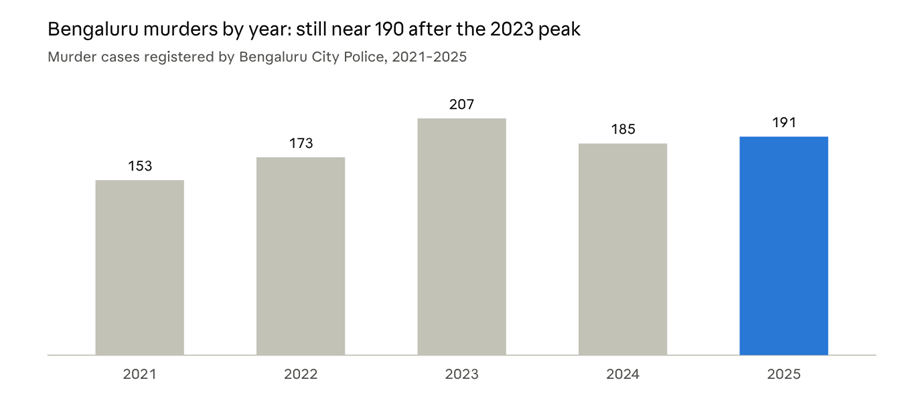
Bengaluru City Police annual data via Siasat/IANS (2021–2023) and Deccan Herald (2024–2025). 2023 is reported as 206 (NCRB), 207 (police, Jan 2024) and 217 (later police data).
Haji’s death adds to a murder count that has held fairly steady in Bengaluru. The city’s numbers climbed through 2023, then eased, and in 2025 street crimes such as robbery and chain snatching fell sharply while murders stayed roughly flat. NCRB’s Crime in India 2023 report credited the city’s police with a 91% charge-sheeting rate in murder cases, but also ranked Bengaluru third among metros for violent crime, behind only Delhi and Mumbai.
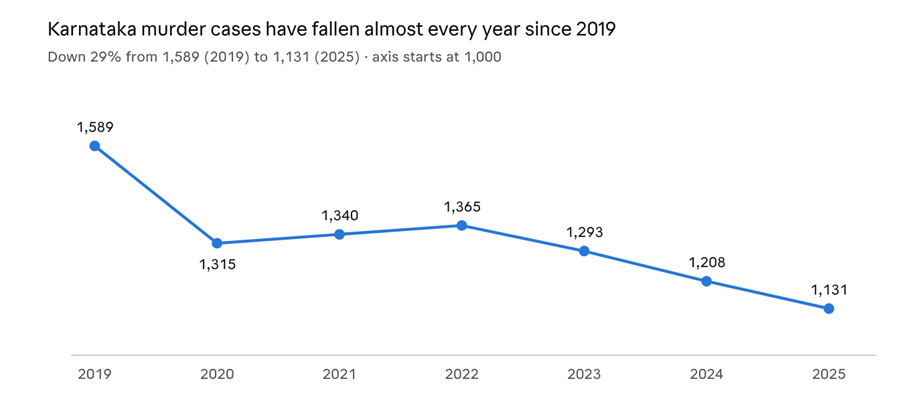
Karnataka Home Minister G. Parameshwara, statement to the Legislature, via Lokmat Times
Statewide, the trend is clearly downward. What neither series shows is who the victims are: NCRB does not separately record crimes against homeless people or waste pickers, so attacks like this one disappear into the general murder count.
Living on the street: Bengaluru’s homeless
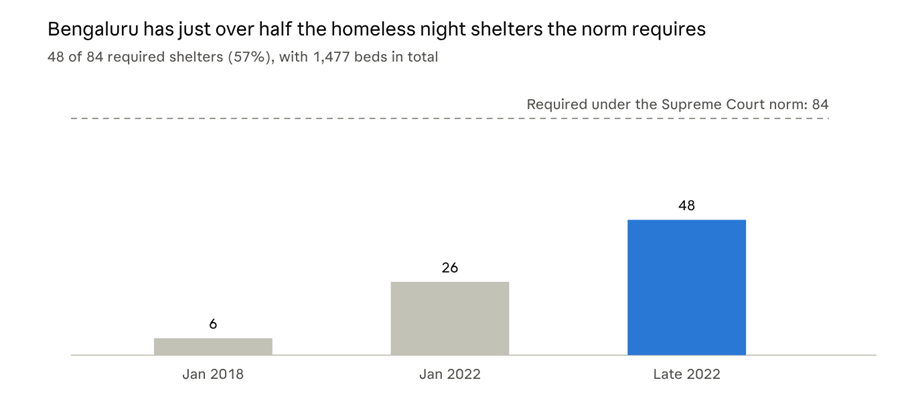
Deccan Herald, ‘Homeless in Bengaluru unaccounted, excluded’ (2022); norm = 1 shelter of 100 beds per lakh population, Supreme Court order of Jan 2010
Haji was one of thousands of people who sleep in the open in Bengaluru, and nobody knows exactly how many. A 2010 rapid survey by NGOs found at least 17,141 homeless people within city limits; the official 2013 count put it at just 1,218; a 2019 survey identified 5,109. Homelessness rose during Covid, but no data exists for that period.
The shelter gap is stark. Under the Supreme Court norm, the city should have 84 round-the-clock shelters. It had six in 2018, and only scaled up after the High Court pulled it up in 2021. The Bengaluru Homeless Survey found the largest concentration of homeless people in the West zone, where commercial activity is dense. Girinagar, where Haji worked, lies in the city’s south-west.
Without a shelter, a phone or ID papers, a homeless person attacked at dawn has no one to raise an alarm and no record that makes them easy to trace afterwards, a gap police are now running into in this case.
The people who sort the city’s waste
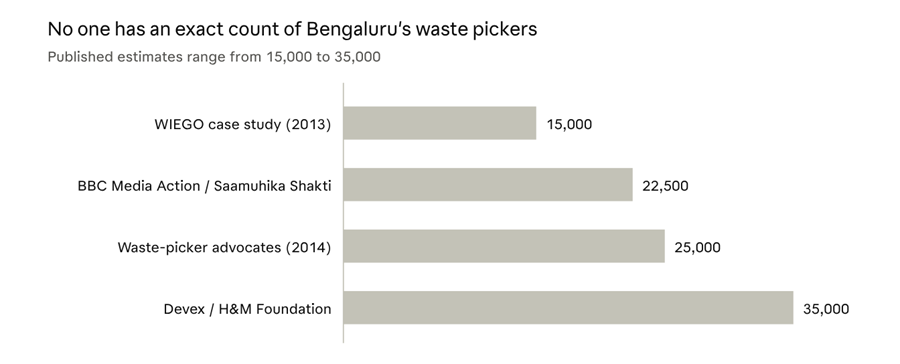
WIEGO (2013); Research World / BBC Media Action; Pinky Chandran et al. (2014); Devex (2023)
Waste pickers like Haji keep a large share of Bengaluru’s recyclables out of landfills: by one estimate they recover over 1,000 tonnes a day, about a third of the city’s waste. Bengaluru was the first Indian city to issue occupational ID cards to waste pickers, but those cards reached only a fraction of workers, and people with no fixed address are the hardest to enrol.
The work carries stigma. In a BBC Media Action survey of Bengaluru residents, more than half described waste pickers as dirty, and 56% said they should not be allowed into residential societies. Violence within the trade is also documented: in past cases a homeless ragpicker was stabbed to death in his sleep on a footpath in KG Halli, and in Mumbai in 2023 one ragpicker set another on fire after a clash.
For burn victims, Victoria Hospital’s Mahabodhi Burns Centre is the main public option in the city; doctors there have reported around 200 burns admissions a month.