



Bilkis Bano, the survivor of one of the most notorious crimes of the 2002 Gujarat riots, has said she will challenge a Supreme Court order that suspended the life sentences of two men convicted of gang-raping her and murdering seven members of her family, and released them on bail.
The order, passed on October 28 by a bench of Justices M.M. Sundresh and Prasanna B. Varale, became public only in mid-November after it was uploaded. Bano said she learnt of it from the press. “I still cannot believe that once again, for the second time, an order has been passed by the Supreme Court without calling me up and without hearing me,” she said in a statement on Monday.
The two men — Bipinchand Kanaiyalal Joshi and Pradip Ramanlal Modhiya — are among the 11 men convicted in 2008. They will remain free while their appeals against conviction are heard. No similar relief has been reported for the other nine, who returned to prison in January 2024.
“I am scared once again”
Bano’s central objection is procedural as much as personal: the order was passed without notice to her, the victim and the original complainant. It is the second time she has learnt from the media that men convicted of attacking her had been let out. In 2022, she told the court she had not been informed of the Gujarat government’s remission decision either.
“How could the honourable Supreme Court simply suspend the sentence of the men who did this to me? How could they not even inform me?” she asked. “I am scared once again. For myself, my family, and my children.”
She said she had slowly rebuilt her life and begun to find peace, and that the order had brought “familiar fears” back. She credited public support for carrying her through 24 years of litigation, and said she would fight on for her children, for her daughter Saleha, who was three when she was killed, and “for women everywhere”.
What the court said
The bench gave three reasons in a short order: the two men had been in prison for more than 17 years, one of them has a severe disability, and their appeals raise questions of fact and law that remain to be decided. Bail will be on conditions set by the trial court, and the appeals will be listed for hearing in due course.
“Having heard the parties, suffice it to state that the appellants have been under incarceration for a period of more than seventeen years, and also the fact remains that one of the appellants has a severe handicap,” the order says.
| Side | Who | Argument |
| Convicts | Senior advocates Siddharth Luthra and Sonia Mathur | More than 17 years served; one appellant was not named in the original FIR and was implicated about three years after the attack; one is severely disabled |
| State | Additional Solicitor General Raja Thakre | Trial court and Bombay High Court both weighed the evidence; the offences are grave |
The appeals challenge the Bombay High Court’s May 2017 judgment, which upheld all 11 convictions and life sentences. Suspending a sentence pending appeal does not set aside a conviction: Joshi and Modhiya remain convicted men.
A 24-year case
In March 2002, days after the Godhra train fire set off violence across Gujarat, Bano fled her village of Randhikpur in Dahod district with her family. She was five months pregnant. A mob attacked the group on the road; Bano was gang-raped, and seven relatives were killed, among them her three-year-old daughter, Saleha.
Gujarat Police first investigated the case. In December 2003 the Supreme Court handed it to the Central Bureau of Investigation, and after Bano reported threats it moved the trial out of Gujarat to Maharashtra. A special court in Mumbai convicted all 11 accused in January 2008 and sentenced them to life. In 2019 the Supreme Court ordered Gujarat to pay her Rs 50 lakh and provide a government job and housing.
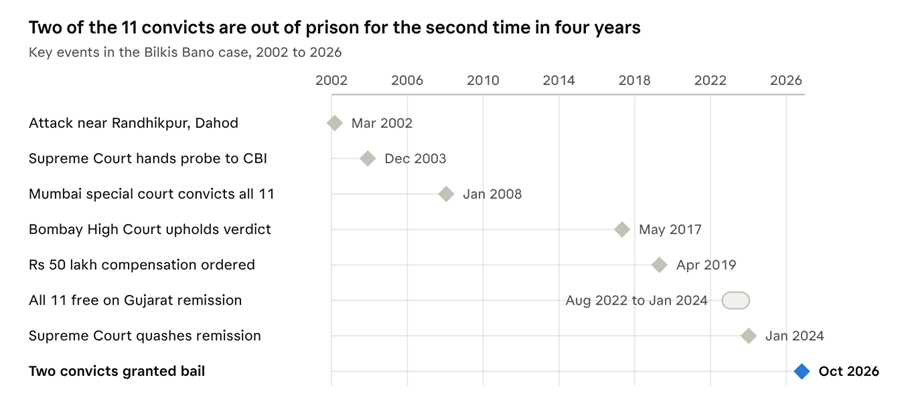
Court records as reported by PTI, The Week, Onmanorama and The Leaflet · 2002 to 2026
Their lawyers told the court the two men had spent more than 17 years in custody in all. The 17 months between the 2022 remission and the 2024 surrender were spent outside prison.
Freed, returned, and freed again
This is the second time Joshi and Modhiya have walked out of prison before completing their sentences. On August 15, 2022, India’s 75th Independence Day, the Gujarat government granted remission to all 11 convicts. Their release from Godhra sub-jail, where relatives and members of right-wing Hindu groups greeted them with sweets and touched their feet, drew outrage across the country.
Bano petitioned the Supreme Court in November 2022, saying the release had “shaken the conscience of society”. On January 8, 2024, a bench of Justices B.V. Nagarathna and Ujjal Bhuyan quashed the remission orders. It held that Gujarat was not the “appropriate government” to decide remission, because the trial had been held in Maharashtra, and criticised the state for acting in concert with a convict.
The court refused the convicts’ requests for more time, and all 11 surrendered at Godhra sub-jail shortly before the midnight deadline on January 21, 2024. Bano said at the time that she could “breathe again”. The Supreme Court later rejected Gujarat’s plea to remove its critical remarks from the judgment, and dismissed a review petition filed by one of the convicts.
The wider reckoning
Bano’s case has become the best-known test of whether the 2002 violence would be answered in court. The riots began on February 28, 2002, the day after 59 people died when a train coach carrying Hindu pilgrims was set on fire at Godhra. Most of those killed in the violence that followed were Muslims.
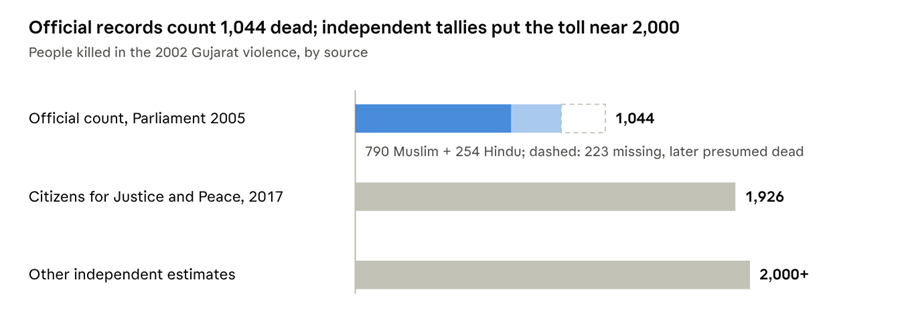
Union home ministry figures given in Parliament, May 2005; Citizens for Justice and Peace (2017); human-rights group estimates
The gap between the counts has never been closed. In 2009, Gujarat officials said the missing would be added to the official toll once seven years had passed; rights groups, including Citizens for Justice and Peace, argue that even the revised count is too low.
Narendra Modi was Gujarat’s chief minister at the time. Survivors and rights groups have long accused his government of failing to stop the violence, or of enabling it. A Supreme Court-appointed Special Investigation Team found “no prosecutable evidence” against him and 63 others in 2012, and in June 2022 the Supreme Court upheld that finding, dismissing a challenge by Zakia Jafri, whose husband, former MP Ehsan Jafri, was killed in the violence.
What comes next
The two men’s appeals against conviction will now be heard on their merits; no date has been set. Bano has said she will fight the order but has not said by what route; a plea to recall the bail, on the ground that the victim was not heard, is one option open to her.


