



Israel’s security cabinet has told the military to step up readiness for a possible strike on Iran, public broadcaster KAN reported late on Wednesday, November 11. The order comes from a caretaker government that lost the October 27 election and is no longer leading coalition talks. KAN warned that the directives could lead the IDF into actions capable of triggering a war, though details on the scope of any operation remain thin. The broadcaster said the instructions surfaced only after opposition leader Gadi Eisenkot publicly urged restraint. The cabinet last met in person on October 5, three weeks before the vote, and is due to meet again on Sunday, November 15, according to Yedioth Ahronoth.
Eisenkot: a caretaker backed by 46 MKs should wait
Eisenkot, a former IDF chief of staff who now leads Yashar, posted his warning on X on Wednesday. He argued that sending forces into action without a direct threat that cannot wait could badly damage Israeli democracy and public trust in state institutions. He also urged Netanyahu not to put security chiefs in a constitutional bind over whose orders to follow. His leverage is arithmetic. In a letter reported by Ynet, he reminded Netanyahu that only 46 Knesset members still back him as prime minister. President Isaac Herzog handed Eisenkot the mandate on November 8 after factions holding 67 seats recommended him.
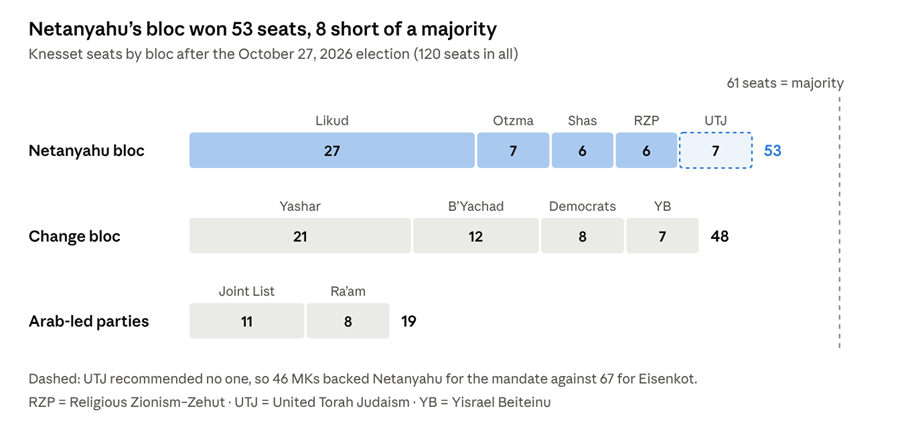
Seats: Israel Hayom, Central Elections Committee count, Oct. 29, 2026 · Recommendations: President Herzog’s office, Nov. 2026
Eisenkot’s 67 includes the Arab-led parties, and some partners in his own camp refuse to rely on them. That leaves him needing a broader unity deal or a minority government; on Monday he and Avigdor Liberman agreed to open talks with the ultra-Orthodox parties.
The army chief has pushed back twice
IDF Chief of Staff Eyal Zamir has again opposed action Netanyahu wants against Iran, Channel 12 reported on Tuesday, November 10, citing several unnamed sources. Zamir reportedly called the plan ill-advised, warned it could set off a confrontation when restraint was needed, and pointed to President Trump’s reluctance to join another round of fighting.
It is the second such clash in three weeks. On October 25, two days before the vote, Channel 12 reported that Zamir had demanded a detailed discussion and signed legal authorization from the political leadership before carrying out an undisclosed Iran-linked operation. Defense officials feared it could escalate and derail the election. Netanyahu called that report baseless, and Defense Minister Israel Katz said Israel had no intention of attacking Iran before the election. Avigdor Liberman has since said he will question the other security chiefs about the pre-election episode.
Washington is not on board
Netanyahu has spent two weeks pressing Trump to resume the war, and so far without success. He reportedly urged strikes right after the November 3 US midterms in a call on October 31, and the Financial Times reported that he now calls Trump almost daily. Yedioth Ahronoth described a weekend call as a shouting match; Netanyahu’s office called that fake news.
Trump has moved the other way. After meeting Qatar’s prime minister on November 9, he said renewed US strikes looked unlikely and that Gulf allies oppose a new campaign. Secretary of State Marco Rubio said Washington is not preparing to resume strikes. US forces did carry out limited strikes near the Strait of Hormuz, including on Qeshm Island, on November 3 and 6, which officials described as small and defensive.
The domestic backdrop has shifted too. Democrats won both the House and Senate on November 3, a result NBC News and others read as a rebuke to Trump; the campaign turned largely on living costs. Tehran, for its part, has warned that any renewed US attack could bring Iranian strikes on American bases beyond the Middle East.
How we got here
The war is nine months old and has never fully stopped. The US and Israel opened it on February 28 with nearly 900 strikes in the first 12 hours; Supreme Leader Ali Khamenei was killed, and Iran retaliated against Israel, US bases and Gulf states.
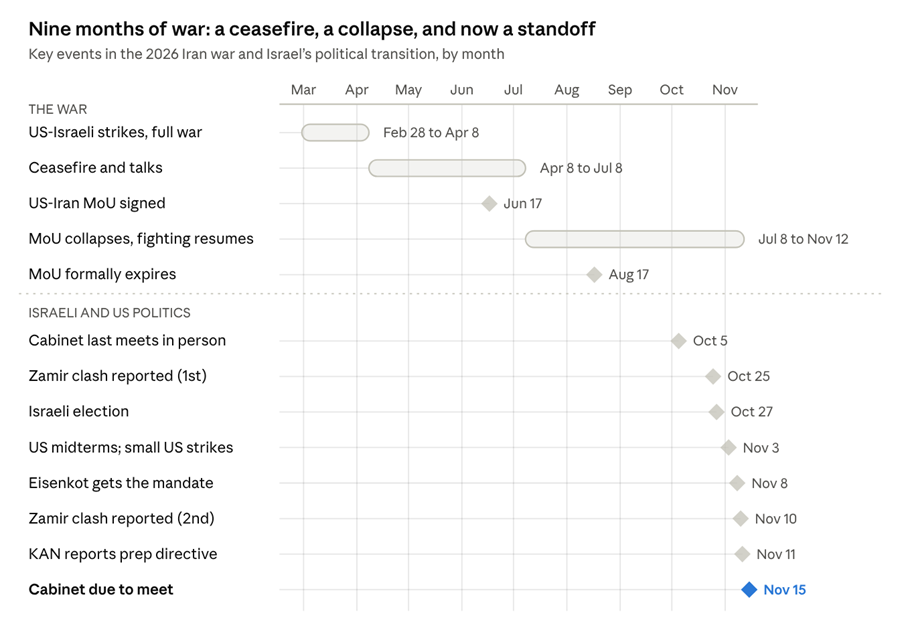
Dates: CRS, Britannica, Al Jazeera, Times of Israel, Anadolu, JNS · Feb 28–Nov 15, 2026
The June deal described in early reports as a framework agreement was a US-Iran memorandum of understanding, signed June 17. It extended the April ceasefire by 60 days, lifted the rival blockades and let Iran sell oil freely. It unraveled within weeks: after Iranian attacks on shipping in Hormuz, Trump declared it over on July 8, and it formally lapsed on August 17. Qatar-mediated talks have stalled since, with sporadic strikes on both sides.
What to watch
The security cabinet’s Sunday meeting is the next marker. It should show whether the directive goes beyond raising readiness, at a moment when the army chief, the incoming coalition and Washington are all urging restraint. The second clock is coalition talks. Until they produce a government, the cabinet that issued the directive stays in charge. Coalition steps per Basic Law: The Government, as reported by JNS and Al Jazeera · deadlines counted from Nov 8, 2026


