



The Centre has pushed its deadline for clearing India’s legacy dumpsites to December 2027, 14 months past the original target. As of 11 November 2026, 1,139 lakh tonnes (about 114 million tonnes) of old waste still sit on 4,632 acres (roughly 19 sq km) across 1,205 sites, according to Swachh Bharat Mission dashboard figures reported by The Indian Express.
Swachh Bharat Mission-Urban (SBM-U) 2.0, launched on 1 October 2021, was meant to clear every legacy dumpsite within its five-year term ending 1 October 2026. The mission itself has been extended to March 2027. Officials told the newspaper that most remaining sites should be cleared by then, while some will need nine more months.
Where things stand
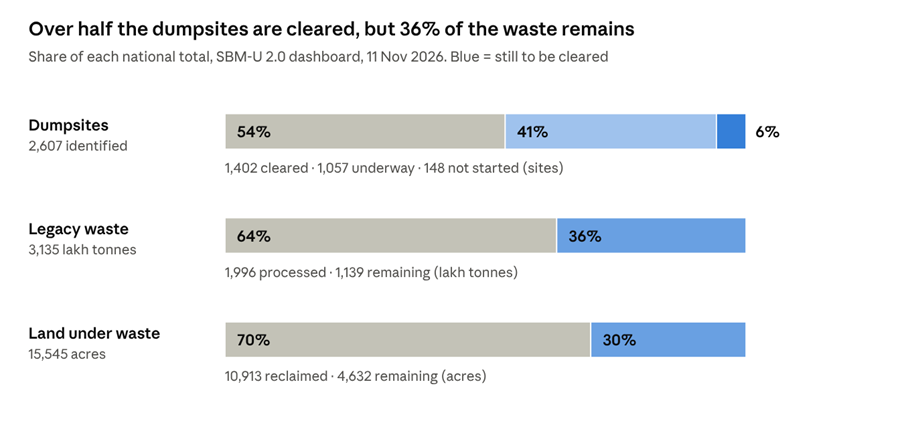
SBM-U 2.0 dashboard as reported by The Indian Express, 11 Nov 2026 · waste processed and land reclaimed = totals minus the remaining figures
The site count flatters the progress. Smaller dumps were cleared first, so the 1,205 sites still open hold the heaviest loads: when the Centre launched its Dumpsite Remediation Accelerator Programme in November 2025, just 214 sites held about 80% of all pending waste. And 148 sites have recorded no work at all, a year from the new deadline.
A deadline that keeps moving
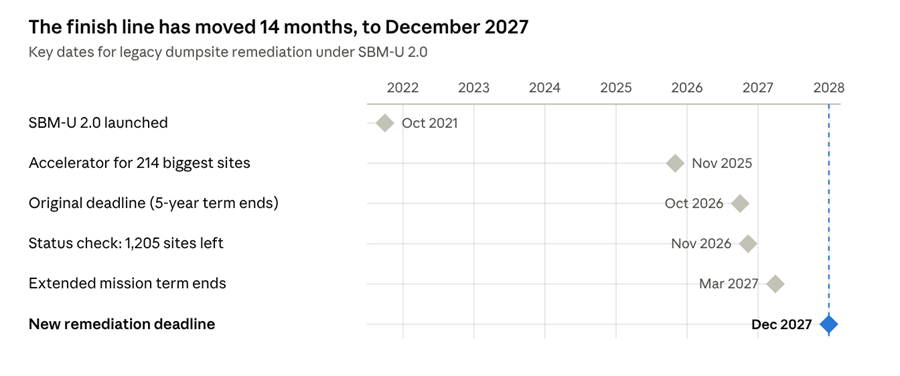
MoHUA / PIB announcements; The Indian Express, Nov 2025 and Nov 2026
The target was set when SBM-U 2.0 began: “Lakshya Zero Dumpsite” within five years. With the clock running down, the Housing Ministry launched the Dumpsite Remediation Accelerator Programme (DRAP) in November 2025, aimed at 214 sites in 202 cities holding about 8.8 crore tonnes. Even then, the official goal was zero dumpsites by October 2026. That date has now passed with 46% of sites still open.
The pace problem
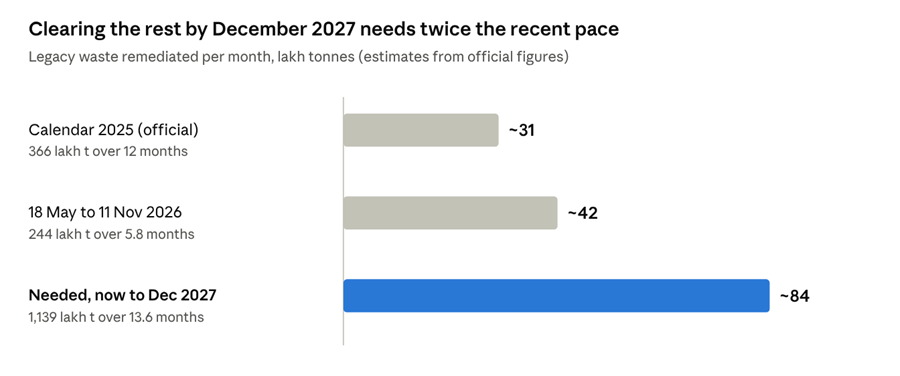
2025: MoHUA (3.66 crore tonnes remediated Jan–Dec 2025). Recent: SBM-U dashboard via CSE/Down To Earth (175.2 MT done, 18 May 2026) and The Indian Express (~199.6 MT done, 11 Nov 2026). Needed: 1,139 lakh t over the 13.6 months to 31 Dec 2027. Rates are our calculations.
The arithmetic is unforgiving. Clearing 1,139 lakh tonnes in about 13.6 months means roughly 84 lakh tonnes a month, double the recent rate and nearly three times the 2025 average.
The target has also been growing. In May 2026 the dashboard counted 270.2 million tonnes in total, with about 95 million left, per a Centre for Science and Environment analysis. By November the total was 313.5 million and the backlog 113.9 million. So the backlog rose by about 19 million tonnes in six months even as some 24 million were processed, apparently because newly surveyed sites and quantities were added. A deadline measured against a moving baseline is hard to hit.
Delhi’s three garbage mountains
Speaking at the Swachh Survekshan Awards on 11 November, Union Housing Minister Manohar Lal said Bhalswa’s legacy waste would be gone by 31 December, though fresh garbage is still being dumped there and will be processed separately. Okhla, he said, is almost clear. Ghazipur needs another year, and among big cities the real difficulty lies in Chennai and Mumbai.
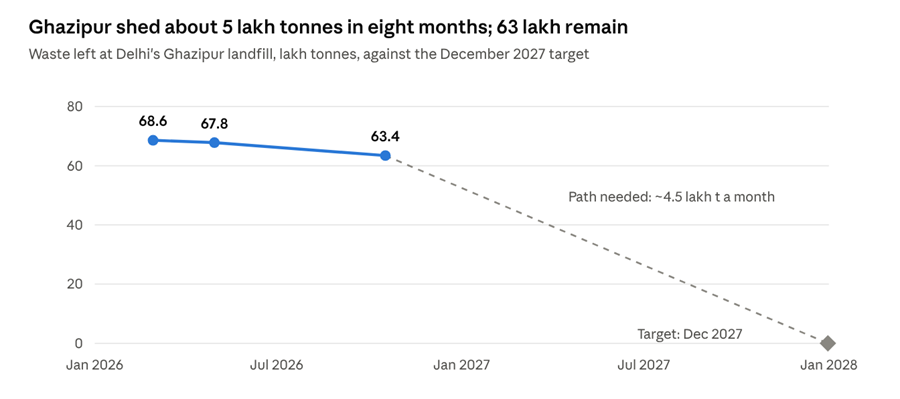
MCD figures via ThePrint/PTI (Feb and Oct 2026); April 2026 drone survey via NewKerala/ANI · path needed = our calculation
Ghazipur is the hard one. Its remaining stock fell only from 68.6 to 63.4 lakh tonnes between February and October 2026, while the three Delhi sites together still receive about 5,858 tonnes of fresh waste a day. Delhi’s urban development minister has ordered daily processing at Ghazipur raised to 12,000 tonnes.
| Landfill | Legacy waste left | Current target | Earlier targets missed |
| Ghazipur | 63.43 lakh t (Oct 2026) | Dec 2027 | Dec 2024 |
| Bhalswa | Over 10 lakh t (Oct 2026) | 31 Dec 2026 (Union minister); Feb 2027 in MCD’s revised plan | Jun 2022, Dec 2023, Mar 2024, 2025, Dec 2026 |
| Okhla | “Almost clear” (Union minister, Nov 2026) | Dec 2026 | Dec 2023, Jul 2026, Oct 2026 |
Bhalswa shows both sides. Under the accelerator programme, which the minister personally adopted, about 99 lakh tonnes had been remediated by July 2026 and 43 of its 70 acres reclaimed by May. Yet in October the MCD moved its deadline for a sixth time, citing a change of contractor.
Mumbai and Chennai: the hard cases
BMC via Free Press Journal and Waste Recycling magazine; Greater Chennai Corporation via DT Next and The Logical Indian · dates differ by site; Perungudi remaining = residual found in a June 2025 drone survey
Mumbai. Deonar, in use since 1927, is the single largest problem: over 1.85 crore tonnes in mounds up to 40 metres high. The BMC’s ₹2,368 crore bioremediation tender drew no bids for weeks in 2025 and its deadline was pushed repeatedly; officials noted that four monsoon months a year eat into any 36-month contract. At the closed Mulund dump, only 69% of 70 lakh tonnes had been processed by mid-2025 after three extensions.
Chennai. Progress is real but uneven. At Kodungaiyur, about 72% of 66.5 lakh tonnes has been removed, with a further 12.3 lakh-tonne project budgeted. At Perungudi, most of the roughly 30 lakh tonnes is done, but a drone survey found 5.5 lakh tonnes still in place. Both sites still take thousands of tonnes of fresh city waste every day.


