



A Dhubri tribunal has cleared a Muslim woman of being an illegal migrant, 28 years after police first questioned her citizenship. Her win is real, but the numbers around it show how many others are still caught in the same system.
A 28-year wait ends in Dhubri
A Foreigners Tribunal in Assam’s Dhubri district has ruled that Sakina Bibi, a Muslim woman from Shernagar village, is an Indian citizen. The order rejects the state’s long-held suspicion that she entered India from Bangladesh after 25 March 1971, the cut-off date under the Assam Accord.
The ruling was passed in April 2026 by Kirti Kamal Das, Member of the 9th Foreigners Tribunal, Dhubri, but has only now come to public notice. Sakina Bibi, wife of Nur Islam, had neither the education nor the money to fight a citizenship case on her own, according to the Mumbai-based rights group Citizens for Justice and Peace (CJP), which supported her defence.
Her case began in 1998, when the Superintendent of Police (Border), Dhubri, recorded doubts about her nationality. It was later re-registered and finally transferred to the 9th Foreigners Tribunal.
How she proved it
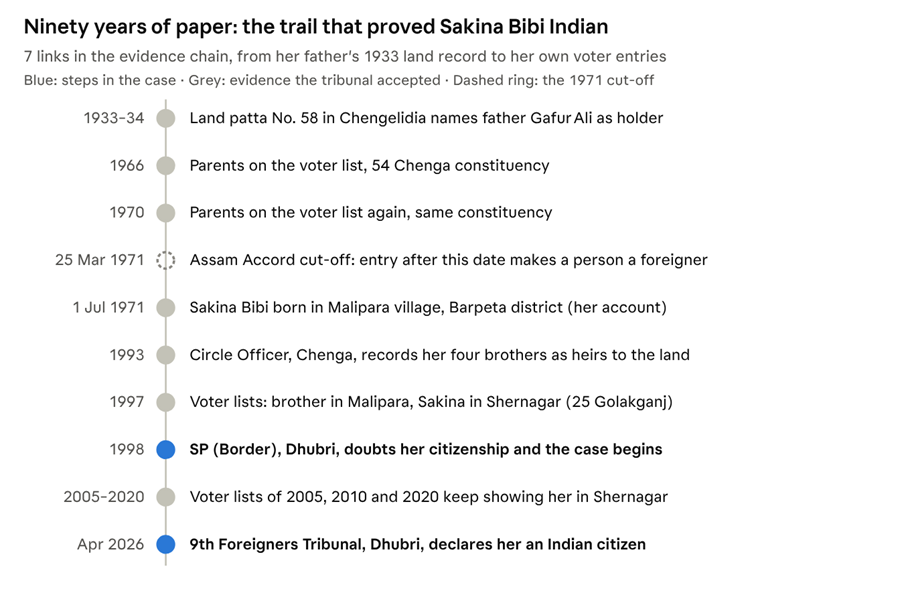
Sakina Bibi told the tribunal she was born on 1 July 1971 in Malipara village, under Tarabari police station in Barpeta district, to Gafur Ali and Rahaton Nessa. She testified herself, filed 26 documents (voter lists, land records and revenue receipts) and called her brother Sarbesh Ali as a witness to confirm the family line.
Source: tribunal order as reported; CJP. Dates of birth and residence are as stated in her defence.
The case turned on her father. The defence traced Gafur Ali, also recorded as Abdul Gafur, in Assam back to 1933 through an Annual Khiraj Patta, a land revenue document, for Patta No. 58 in Chengelidia village, then in Kamrup district. Kaseruddin Ahmed, a land records official, told the tribunal that the Deputy Commissioner/Settlement Officer had allowed Gafur Ali and one other person to hold that land in 1933.
What the tribunal decided
The paper trail went on after Gafur Ali’s death. A 1993 order of the Circle Officer, Chenga Revenue Circle, entered the names of his four sons, Jobbar Ali, Sattar Ali, Jafar Ali and Sarbesh Ali, in the land records. Certified voter lists from 1966 and 1970 showed both parents as voters in the Chengelidia area under the 54 Chenga Legislative Assembly Constituency. Later lists from 1997 and 2005 placed her brother in Malipara, and lists from 1997, 2005, 2010 and 2020 showed Sakina Bibi at her husband’s home in Shernagar, under the 25 Golakganj constituency.
Not every document held up. The tribunal gave no weight to a linkage certificate from the Roumari Pathar Gaon Panchayat, because the Panchayat Secretary could not back up what it said. It ruled that the land records and the witnesses’ evidence were enough on their own to prove her parentage.
The legal test was hard. Under Section 9 of the Foreigners Act, 1946, it is the accused person, not the state, who must prove they are not a foreigner. Member Das noted this, but found that the Assistant Government Pleader had not challenged any of the defence evidence. The order concluded that her father “was an original inhabitant of State of Assam” and not someone who had entered illegally.
The final line of the order reads: “This Tribunal is of the opinion that the OP named above is not a foreigner/illegal migrant of any stream. Hence, this reference is answered in negative.” Copies go to the District Commissioner, the Senior Superintendent of Police (Border) and the Election Officer in Dhubri, so official records can follow the ruling.
The bigger picture: thousands declared every year
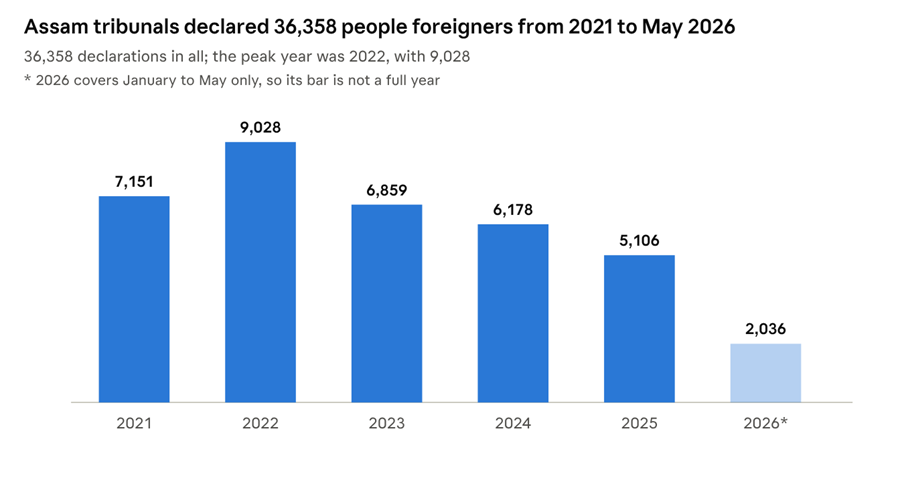
Sakina Bibi got out. Many people in the same system do not.
Source: Assam minister Atul Bora’s written reply in the Assam Assembly, reported by The Pioneer, 9 July 2026
The running total has climbed steadily. Official figures put the number of people declared foreigners since 1985 at about 1.17 lakh by March 2019, 1.29 lakh by October 2019, 1.43 lakh by December 2021 and 1.59 lakh by December 2023. On Republic Day 2026, Assam’s Governor said that close to 4.35 lakh cases had been referred to the tribunals by 31 October 2025, and nearly 1.7 lakh people had been declared foreigners.
A backlog that takes decades
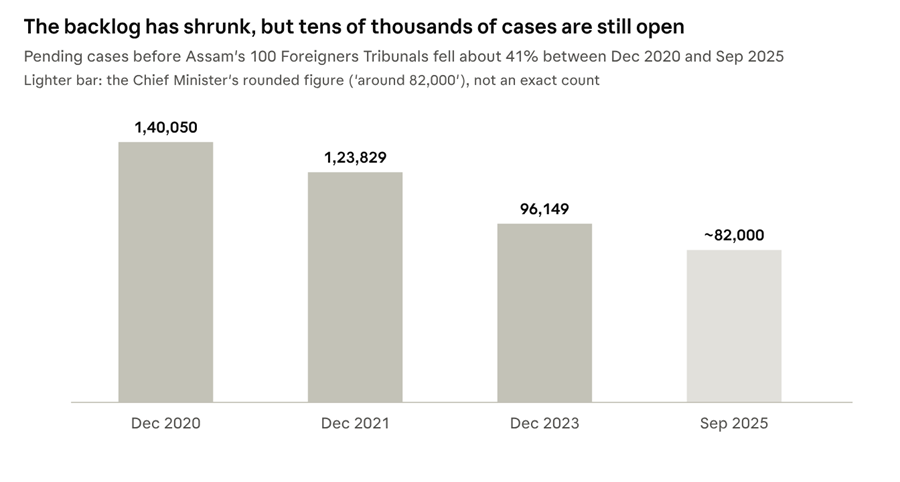
Sakina Bibi’s case took 28 years, and it was not unusual. Many of the cases now being heard in Dhubri go back to police references from the late 1990s.
Sources: MHA replies in Lok Sabha (2021) and Rajya Sabha (Feb 2022); CM Himanta Biswa Sarma in the Assam Assembly (Feb 2024); CM’s statement on 9 Sep 2025
The backlog has come down, but slowly. Every pending case is a person whose citizenship is in doubt. Under Assam’s rules, people marked as doubtful (“D”) voters cannot vote until a tribunal clears them. The state had 96,987 D-voters in early 2024.
Most people never get to argue their case
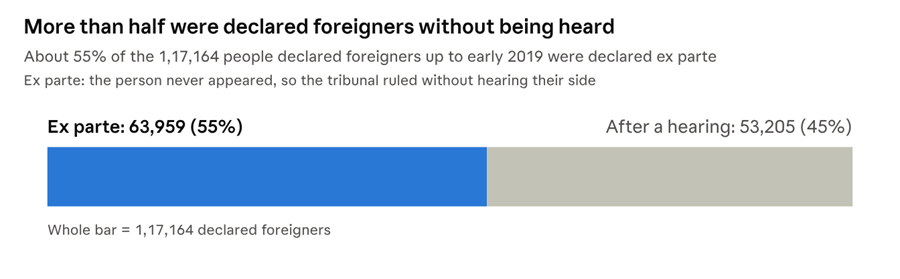
Sakina Bibi had a hearing. She appeared, filed papers and brought a witness. Many people do not get that far.
Sources: MoS Home G. Kishan Reddy in Lok Sabha, July 2019 (63,959 ex parte; 1,17,164 total). The two counts end a few weeks apart, so the share is approximate.
A large share of rulings are made ex parte, when the person named does not turn up. Lawyers and researchers say the reasons are usually practical, not proof of guilt: a notice that never reached the right house, a family that cannot pay a lawyer, a breadwinner away doing migrant work, or people who cannot read the notice. Because Section 9 puts the burden of proof on the accused, staying away often means losing.
Declared, then stuck
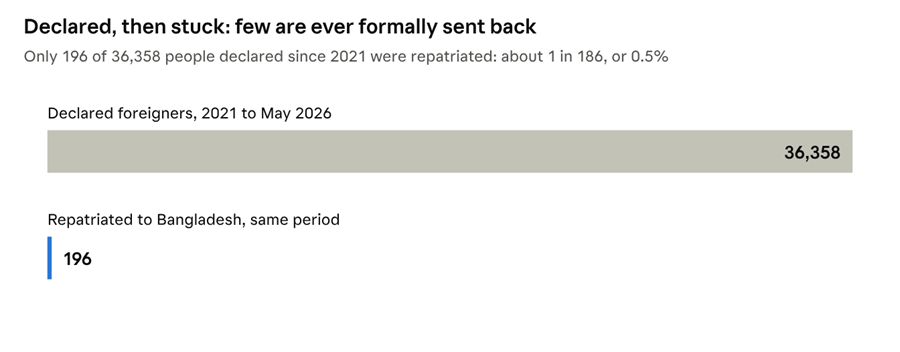
Being declared a foreigner rarely ends in a formal return to Bangladesh, which has to accept the person as its own citizen.
Source: Assam minister Atul Bora’s written reply in the Assam Assembly, reported by The Pioneer, 9 July 2026
The longer-run picture is similar. Of the nearly 1.7 lakh people declared since 1985, the Governor said in January 2026 that 467 had been repatriated. People who are declared but not sent back can face detention in a holding centre, appeals in the High Court, or, since 2025, informal “pushbacks” across the border carried out without any agreed process. The Chief Minister has said that more than 30,000 people have been pushed back from Assam over the years. Those figures have not been independently verified.
Dhubri: a border district under notice
Dhubri sits on the India-Bangladesh border, and citizenship cases there fall most heavily on poor and socially marginalised families.
- Shernagar, Sakina Bibi’s own village. In August 2022, CJP reported that the Assam Border Police had served tribunal notices on almost every household in Shernagar, Moisha and Ramraikuti. The group said the families who received them were among the poorest in the area.
- Soulmari. A month later, a new wave of notices reached Soulmari Part I, a char (river island) village that floods every year.
- Agomoni police station. Scroll.in reported in 2022 that at least 150 families in this one police station area had received notices that year, most of them Desi Muslims, a community the Assam government officially recognises as indigenous. A border police officer said about 450 notices had gone out across Dhubri, many tied to cases from 1997-98, and that roughly 18,000 suspected-foreigner cases were pending in the district.
- Even the dead. In 2023, CJP documented a family in the Agomani area that received a suspected-foreigner notice for a relative who had already died.
Sakina Bibi’s case, which started in 1998, fits that pattern of decades-old references being revived. CJP has won several similar cases at Dhubri’s tribunals, including those of Jarina Bibi (March 2025), Akurbhan Bibi, and an elderly Shernagar couple, Naseruddin Sheikh and Jakira Bibi. The group says it secured 19 such outcomes in Assam in 2025.
What has changed since 2025
The state is moving around the tribunals. On 9 September 2025, the Assam cabinet approved a standard operating procedure under the Immigrants (Expulsion from Assam) Act, 1950. It lets District Commissioners and Senior Superintendents of Police give a suspected migrant 10 days to prove citizenship and then order expulsion, without referring the case to a Foreigners Tribunal. Chief Minister Himanta Biswa Sarma called the tribunal route slow and cumbersome. Critics, including lawyers and rights groups, say the new process removes the hearing and appeal that saved people like Sakina Bibi.
The Supreme Court has tightened ex parte rulings. On 13 July 2026, in Sabitri Dey @ Swasthi Dey v Union of India, a bench of Justices Vikram Nath and Sandeep Mehta set aside a batch of ex parte tribunal opinions and sent them back for fresh hearings. The court kept the Section 9 rule that the accused must prove citizenship, but held that:
- a tribunal must check that the notice was properly served, that the grounds were disclosed, and that the state’s material actually supports its conclusion;
- a person’s absence is not, on its own, proof that they are a foreigner;
- Articles 14 and 21 of the Constitution protect every person, not only citizens, so the procedure must be fair.
Sakina Bibi’s order shows what the tribunal process can do when a person is able to show up, find documents going back to the 1930s and get legal help. The data shows how many people cannot.