



The Supreme Court said on Wednesday it will take up a contempt plea against the Tamil Nadu government after the Karthigai Deepam was lit at its customary mandapam on Tuesday, and not at the disputed Deepathoon pillar atop Thiruparankundram hill in Madurai, where the court had allowed a one-time lighting.
For the second festival in a row, a court order to light the lamp at the stone pillar has gone unimplemented. Last year it was a Madras High Court direction; this year it was an interim order of the country’s top court.
What happened in court on Wednesday?
The matter was mentioned before a bench of Justices Aravind Kumar and Vipul M Pancholi. Counsel for the state acknowledged that the lamp could not be lit at the designated spot on November 24, and asked the bench to take on record a status report on the events.
The report, filed by Madurai District Collector Nishant Krishna, who was the court-appointed nodal officer, says the district administration had finished every arrangement needed to carry out the November 20 order. The sticking point, according to the state, was the temple itself: the Board of Trustees of the Arulmigu Subramaniya Swamy Temple declined to authorise the team proposed for the task and instead resolved to light the Karthigai Mahadeepam at its traditional location.
Senior advocate Guru Krishna Kumar, appearing for the petitioner who had sought the lighting at Deepathoon, called the outcome deeply regrettable and accused the authorities of deliberately sidestepping the court. He told the bench that:
- the state had told the Madras High Court that prohibitory orders were in force and that custom did not allow lighting at the disputed spot;
- the state had kept assuring the High Court, up to the last moment, that it would comply with the Supreme Court;
- the flame could have been carried up to the Deepathoon and lit there.
He asked the court to start contempt proceedings on its own and also flagged the review petition the state has filed against the November 20 order. When he said the petitioners would file a contempt petition, the bench replied: “File it, and then we will see.”
The bench said it would hear the contempt plea and examine the status report. It listed the main case, the state’s challenge to the Madras High Court ruling, for final hearing in January 2027.
The road to the contempt plea
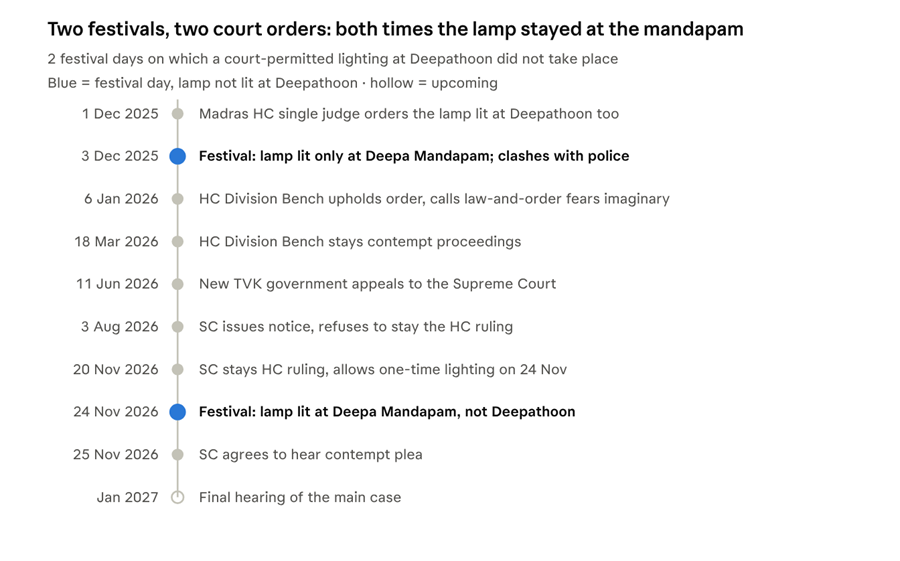
Compiled from The News Minute, LiveLaw, ThePrint, Deccan Herald, The Federal and SC Observer reports · Dec 2025 to Jan 2027
The pattern is the same across both years: a court allowed the lighting at the pillar, and on the festival evening the lamp went up only at the mandapam.
What the November 20 order said
On November 20, the same bench stayed the Madras High Court’s ruling but, as a one-time measure, allowed a limited team authorised by the temple administration, together with government officials, to light the lamp at Deepathoon on November 24. The Collector was named nodal officer and told to file a compliance report within three days of the festival. The court made clear that this interim permission did not decide the customary rights claimed over the spot.
On the day, a temple-authorised team escorted by police lit the lamp at the Deepa Mandapam near the Uchi Pillaiyar temple at the foot of the hill at around 6 pm. Protests and scuffles with police followed. The temple board said the mandapam was chosen because of its sacred alignment with the presiding deity, and Law Minister R Nirmal Kumar said the lamp had been lit at its traditional place. The BJP called the episode a deceptive act and warned of consequences.
Long appeals, short compliance windows
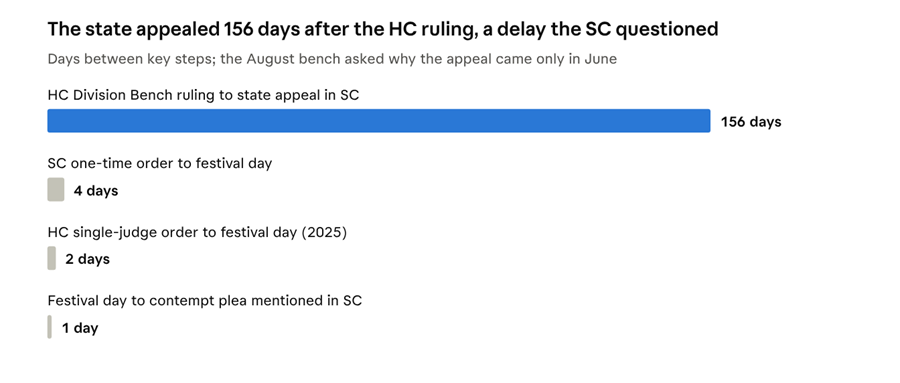
Day counts computed from order and filing dates in LiveLaw, The News Minute and Deccan Herald reports
The authorities have twice had only days between a court order and the festival to act on it, while the state’s own appeal took over five months to reach the Supreme Court.
Who is saying what
| Party | Position |
| Petitioners (devotees seeking lighting at Deepathoon) | The lamp must be lit at the pillar; a 1996 High Court order lets the temple light lamps elsewhere on the hill away from the dargah; non-compliance was deliberate. |
| Tamil Nadu government (TVK-led) | No established custom of lighting at Deepathoon has been proved; the existing practice should continue to avoid law-and-order trouble; has sought review of the November 20 order. |
| Temple Board of Trustees | Did not authorise the proposed team; chose to follow custom at the Deepa Mandapam. |
| Dargah committee | Told the Supreme Court the High Court judge inspected the site without notifying it, and that it was made a party only on November 19. |
| Supreme Court | The November 20 permission was interim and one-time; customary rights will be decided at the final hearing. |
A dispute a century old
Thiruparankundram hill holds the Arulmigu Subramaniya Swamy Temple, revered as the first of Lord Murugan’s six abodes, and the Hazrat Sultan Sikandar Badshah Dargah, a 14th-century shrine. The Deepathoon is an old stone lamp pillar on the hill’s lower peak, roughly 15 metres from the dargah. The Karthigai Deepam has for about a century been lit at the Deepa Mandapam lower down.
| Year | Ruling |
| 1920 | A Madurai civil court decree holds that the hill belongs to the temple, except for the areas linked to the dargah. |
| 1931 | The Privy Council restores that decree. It settles ownership but says nothing about rituals or where the Deepam is lit. |
| 1996 | The Madras High Court says the temple alone lights the Deepam, ordinarily at the mandapam near Uchi Pillaiyar, with liberty to consider other spots at a set distance from the dargah. |
| 2014 | Justice M Venugopal dismisses a devotee’s plea to light the lamp at Deepathoon. |
| 2025 | Justice G R Swaminathan directs that the lamp also be lit at Deepathoon. |
The current round began in November 2025, when the temple’s Executive Officer restricted lighting at the pillar. Justice Swaminathan’s December 1 order was not carried out on the festival day, December 3, and activists clashed with police. In January 2026, a Division Bench of Justices G Jayachandran and K K Ramakrishnan upheld his order and called the state’s law-and-order fears imaginary. Contempt proceedings followed in the High Court, and in March a Division Bench stayed them.
After the TVK government led by Vijay took office, it appealed to the Supreme Court on June 11, which kept the position of the earlier DMK government. In August the court issued notice but refused to stay the High Court ruling, asking why the state had waited months to appeal. It also tagged the case with a Hindu Dharma Parishad petition seeking an Archaeological Survey of India takeover of the hill.