



The Supreme Court on Monday, 23 November 2026, refused to hear a contempt petition over the demolition of a roughly century-old mosque in Saharanpur, Uttar Pradesh, and sent the record to the Allahabad High Court instead. The petition, filed by Imran Ahmad against UP Chief Secretary Shashi Prakash Goyal, alleged the demolition broke the safeguards the Court laid down in its November 2024 “bulldozer justice” judgment. A bench of Chief Justice Surya Kant, Justice Joymalya Bagchi and Justice V. Mohana said facts must first be proved before the High Court. If the High Court finds the Supreme Court’s directions were violated, “necessary consequences will follow,” the bench said.
The order follows the Court’s July 2026 decision to send every pending bulldozer contempt case to the High Courts. It confirms that the 2024 safeguards will now be enforced, case by case, in state courts.
Inside the courtroom
The bench’s position was that contempt cannot be judged until the facts are proved. Advocate Fozia Rahman, for the petitioner, argued the demolition plainly breached the 2024 judgment and that the Court’s own authority was at stake.
CJI Kant asked how contempt was maintainable at all. He told counsel to “first go and establish your right” in the High Court, adding that the 2024 principles might well help her succeed there. When Rahman pressed that the judgment was not being followed, he replied that the Court was “quite sure the High Court will implement our order.”
Justice Mohana put the practical limit plainly: not every action that breaks a Supreme Court judgment can come straight back to the Supreme Court. A demolition dispute needs a factual inquiry, she said, and the apex court cannot hold one.
| Side | Argument |
| Petitioner | Demolition breached the 2024 judgment; the dignity of the Court’s order is at stake, so the Supreme Court should act directly |
| Bench | Breach is a question of fact; prove it in the High Court first, then return if relief is refused |
| Outcome | Contempt record transferred to the Allahabad High Court; consequences to follow if a violation is found |
The Saharanpur case: from complaint to the Supreme Court
The mosque stood inside the Saharanpur District Collectorate complex, on land the administration says belongs to the government. The Wire reports officials examined it only after a 2025 complaint by Bajrang Dal activist Vikas Tyagi. Authorities cited encroachment and security concerns.
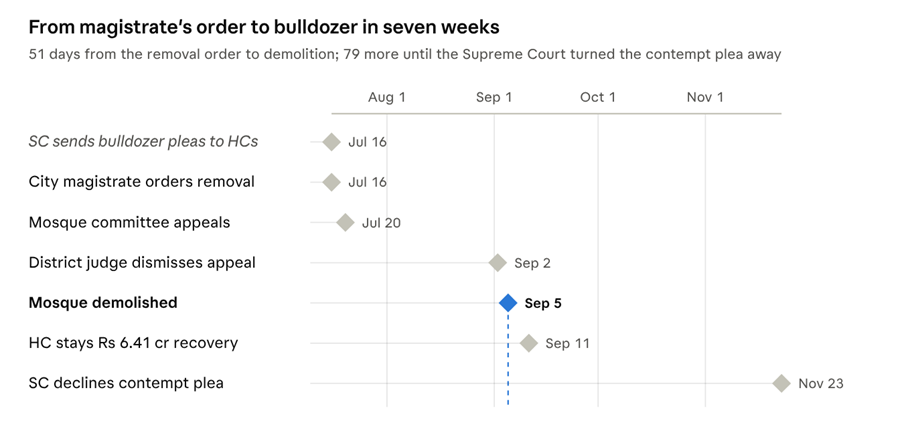
The mosque committee argued the magistrate’s July order only directed vacating the premises, not demolition. Congress MP Imran Masood said the mosque dated to 1911 and remained registered in revenue records in private names. The demolition followed the district judge’s dismissal of the appeal, which the BJP cites as proof of due process and opposition parties call overreach.
On 11 September, Justice Rohit Ranjan Agarwal of the Allahabad High Court gave the state three weeks to reply to a writ petition by advocate Mohammad Tanveer Ahmad. He also stayed recovery of Rs 6.41 crore in damages imposed on the mosque management.
The November 2024 judgment at the heart of the plea
On 13 November 2024 the Supreme Court ruled that the executive cannot demolish a person’s home or property only because they are accused or convicted of a crime. The state, it said, cannot act as judge, declare someone guilty and then bulldoze their house. It laid down pan-India steps that must come before any demolition:
- Notice: a prior show-cause notice, returnable within the time set by local municipal law or 15 days from service, whichever is later.
- Hearing: a personal hearing before a designated authority, with minutes recorded.
- Reasoned order: the final order must record the owner’s case, the findings, whether the construction can be regularised, whether all of it must go, and why demolition is the only option.
- Time to appeal: after the order, the affected party must get time to challenge it before the proper forum.
Penalties. Violations invite contempt and prosecution. Officers found responsible must restore the demolished property at their own cost and pay damages.
Exceptions. The safeguards do not cover unauthorised structures in public places such as roads, streets, footpaths, land beside railway lines or water bodies, or cases where a court has ordered demolition. That second exception may matter in Saharanpur, where the demolition followed orders of local courts (see the timeline below).
July 2026: the Court sends all bulldozer contempt cases to High Courts
The Saharanpur order applies a policy the Court set on 16 July 2026. That day, the same CJI-led three-judge bench declined a batch of contempt petitions and relegated them to the relevant High Courts. It said each case raised multiple questions of fact that could not be settled in contempt proceedings in Delhi.
Before that, the Court had treated such petitions case by case. It sent some to High Courts but issued notice and granted stays in others. One example was the partial demolition of the Madni mosque in Kushinagar, UP, where it called the alleged action “egregious contempt” and sought the officials’ response.
The July order kept the Supreme Court’s interim protections alive while the High Courts hear the cases. Verdictum reported that the High Courts were asked to decide within four months.
The debate. In July, Senior Advocate Huzefa Ahmadi, arguing a plea over mosque demolitions in Somnath, urged the Court to act directly where affidavits made violations obvious. Commentators at Supreme Court Observer noted a structural gap: in D.K. Basu (1997) the Court expressly let High Courts punish breaches of its arrest guidelines as contempt, but the bulldozer judgment built no such local route. They also flagged an early sign of trouble. On 20 July, a Division Bench of the Allahabad High Court split on a bulldozer case, giving two views on the same safeguards.
The Court’s answer is that High Courts are constitutional courts bound by Article 141 to apply its law, and are better placed to test the facts.
The bigger picture in numbers
India publishes no official data on demolitions or evictions, so the best counts come from civil-society trackers. They show demolitions rising sharply in the years before the Supreme Court stepped in.
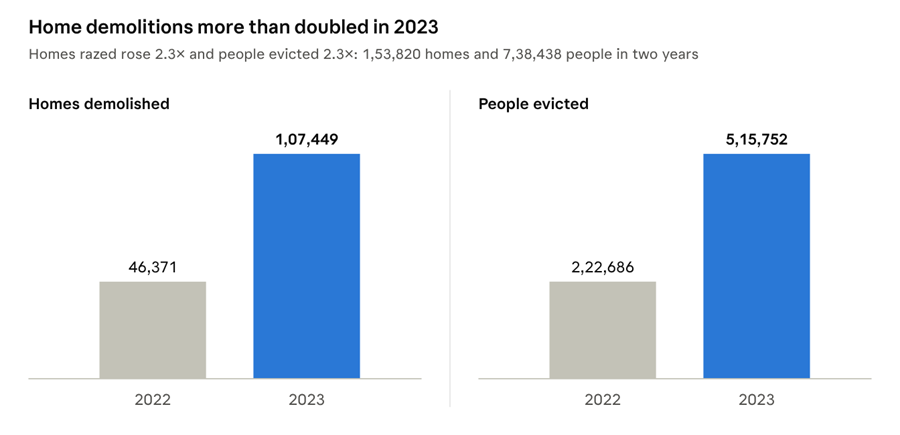
Housing and Land Rights Network, Forced Evictions in India: 2022 & 2023 (March 2024), via ThePrint and Sabrang India · all state-led evictions, not only punitive ones
HLRN counts every state-led eviction, not only punitive ones: 58.7% of people evicted in 2022–23 lost homes to slum clearance, encroachment removal and beautification drives, and 35% to infrastructure projects. It also flagged demolitions being used “as a punitive measure”, the practice the 2024 judgment targeted.
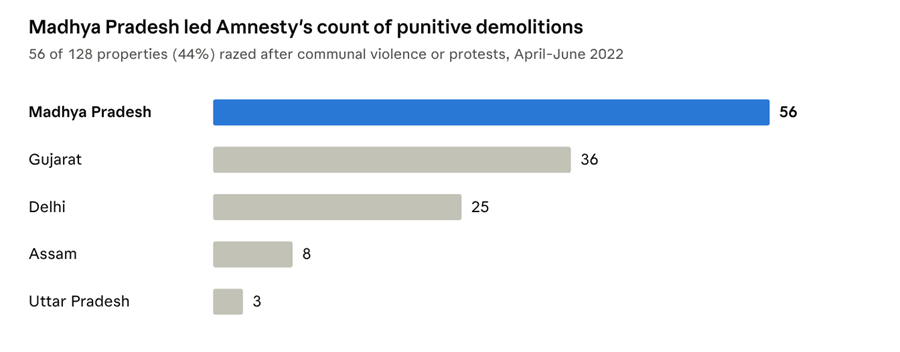
Amnesty International, Bulldozer Injustice in India (Feb 2024), state-wise counts via Scroll · 128 properties, April–June 2022
Amnesty studied demolitions that followed communal violence or protests. It found the 128 properties, mostly Muslim-owned homes, shops and places of worship, were razed without due process, affecting at least 617 people. Uttar Pradesh’s low count reflects that three-month window only; it does not cover the years since.
What happens next
The dispute now moves entirely to the Allahabad High Court, which will run two tracks:
- The writ petition against the city magistrate’s and district judge’s orders, where the state was told in September to file its reply and the Rs 6.41 crore recovery stays on hold.
- The transferred contempt record, where the court must decide whether officials followed the 2024 safeguards, and whether the court-order exception applies.
If the High Court finds a breach, the 2024 judgment says officers can be made to rebuild at their own cost and pay damages. If it refuses relief, the petitioner may return to the Supreme Court, as the CJI expressly allowed.