



The Supreme Court on Monday suspended the life sentence of Irfan Siraj Pada, one of the 31 men convicted for the 2002 burning of the Sabarmati Express at Godhra, and released him on bail. The court cited two reasons: he suffers from a serious heart condition, and he has already spent well over 17 years behind bars while his appeal has sat undecided in the top court since 2018. Pada becomes at least the eleventh Godhra convict the Supreme Court has let out on bail since 2022 , even as the main appeals, including the Gujarat government’s demand to restore death sentences, remain unresolved more than 24 years after the fire.
The order
A bench of Justice MM Sundresh and Justice Prasanna B Varale heard the plea in Irfan Siraj Pada v. State of Gujarat.
- Ground: The application was moved mainly on medical grounds, Pada has serious cardiovascular disease.
- State’s stand: Counsel for Gujarat accepted that the medical condition described by Pada’s lawyer was factually correct. The State called the case a very serious one but did not oppose suspension on health grounds.
- Time served: LiveLaw reports more than 17 years in custody; Bar & Bench puts it at over 18 years.
- Sentence: Life imprisonment, upheld by the Gujarat High Court in 2017. His appeal against conviction is still pending.
The order comes shortly after the same court suspended the sentences of two men convicted in the Bilkis Bano gang-rape case, another prosecution arising from the 2002 Gujarat violence.
What happened at Godhra
On the morning of February 27, 2002, coach S-6 of the Ahmedabad-bound Sabarmati Express was set on fire near Godhra railway station in Gujarat. The coach was carrying kar sevaks returning from Ayodhya. 59 people were killed, according to most court records and news reports. The Gujarat government’s Nanavati Commission later concluded that the fire was not an accident and that the coach had been deliberately set ablaze. The burning set off communal riots across Gujarat in which around 1,200 people, most of them Muslims, were killed.
From the trial court to the High Court
Of about 130 people accused, 94 stood trial for murder and conspiracy. On March 1, 2011, a special SIT court accepted the prosecution’s case that the burning was a planned conspiracy, not an accident.
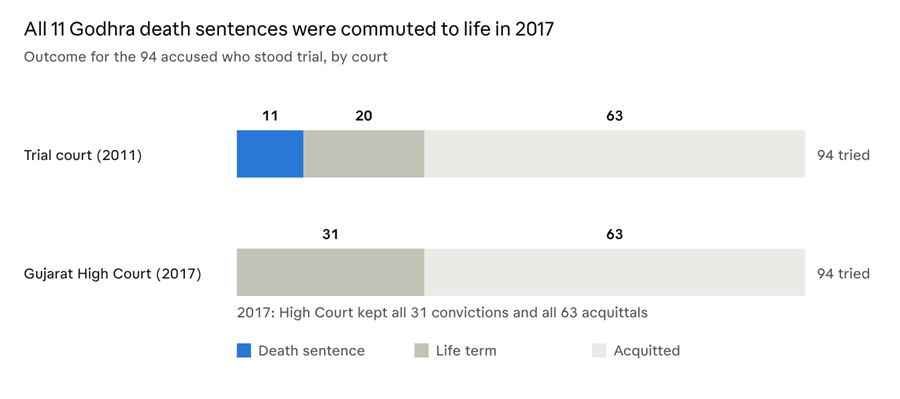
Source: Special SIT court verdict (March 1, 2011); Gujarat High Court judgment (October 9, 2017), as reported by LiveLaw, Deccan Herald and The Tribune
In October 2017, the Gujarat High Court upheld every conviction but spared the 11 men on death row, saying the evidence, while enough to convict, did not justify the death penalty. It also held that the State and the Railways had failed to maintain law and order, and ordered ₹10 lakh compensation for each victim’s family. Among those acquitted at trial was Maulana Umarji, whom the prosecution had named as a key conspirator.
24 years in the courts
The case has now spent almost as long waiting in the Supreme Court as it took to reach a trial verdict.
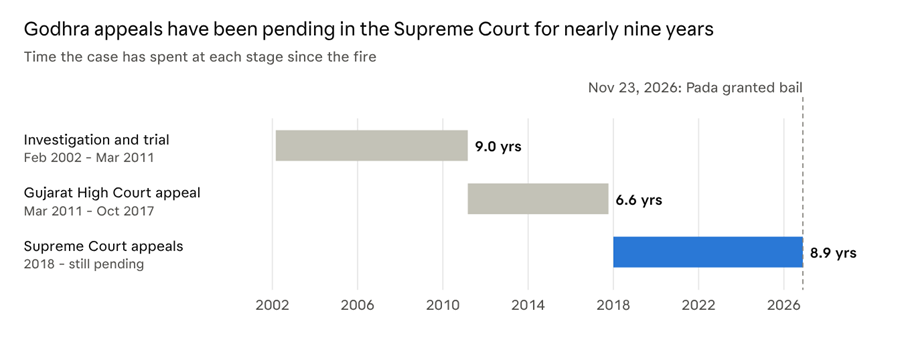
Source: court dates as reported by LiveLaw, Deccan Herald and The Tribune; Supreme Court stage counted from 2018, when the appeals were filed
That delay is central to today’s order. When an appeal against conviction is not heard for years, courts increasingly weigh how much of the sentence a prisoner has already served.
Who has been granted bail, and who hasn’t
Pada’s release is part of a pattern that began in 2022. The court has generally granted bail where a convict has served 17 years or more and had a limited role, and refused it where the State showed a direct part in the burning.
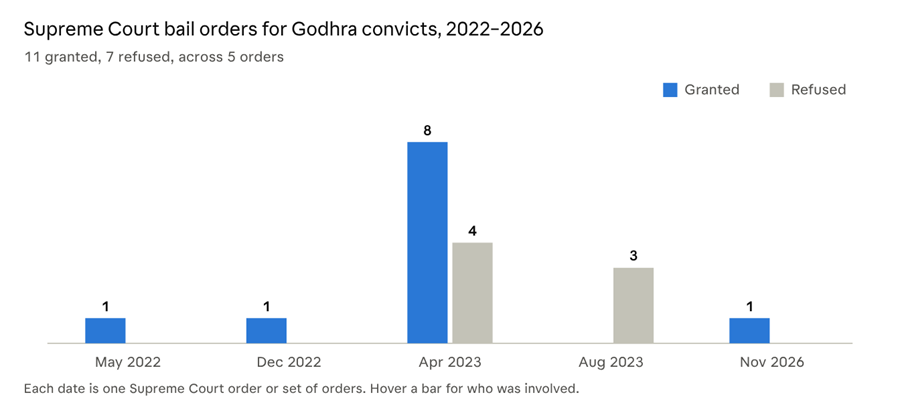
Source: Supreme Court orders as reported by LiveLaw, Deccan Herald, The Tribune and Onmanorama
- May 13, 2022: Abdul Raheman Dhantiya got six months’ interim bail because his wife had terminal cancer and his daughters were mentally challenged. In November 2022 it was extended to March 31, 2023.
- December 2022: Farook was bailed after 17 years in jail; his role was limited to throwing stones at the train.
- April 21, 2023: Eight life convicts were released bdul Sattar Ibrahim Gaddi Asla, Yunus Abdul Hakk Samol, Mohammad Hanif Abdulla Moulvi Badam, Abdul Rauf Abdul Majid Isa @ Dhesli, Ibrahim Abdulrazak Abdul Sattar Samol @ Bhano, Ayub Abdul Gani Ismail Pataliya, Soheb Yusuf Ahmed Kalandar and Suleman Ahmad Hussain @ Tiger Peer Musalman. The court refused four others after Solicitor General Tushar Mehta pointed to their specific roles.
- August 14, 2023: A three-judge bench turned down three more, noting that this was not the killing of a single person and that the incident was very serious.
Where the appeals stand
Two sets of appeals have been before the Supreme Court since 2018: the convicts are challenging their convictions, and the Gujarat government is challenging the High Court’s decision to commute the 11 death sentences. In February 2023 the State told the court it would press for the death penalty for those 11.
The hearing has been repeatedly delayed. In January 2025 Justice JK Maheshwari remarked that the matter had been adjourned at least five times over the previous year, and the court said it would allow no more adjournments. Final arguments finally began on May 6, 2025, when the bench rejected the convicts’ objection that the State’s plea for death sentences could only be heard by a three-judge bench. Counsel had told the court the full hearing would need at least two weeks.
No final verdict has been reported. Until one comes, the convicts’ fate acquittal, life imprisonment, or a return to death row for 11 of them — remains open, and bail pleas like Pada’s will continue to be decided case by case.