The leaders of the world’s three largest nuclear powers will sit down together for the first time on November 19, on the sidelines of the APEC summit in Shenzhen. President Donald Trump wants to talk about Iran and about limits on nuclear weapons. Russia’s war in Ukraine will not be formally on the table, and US officials say they expect no agreement.
The meeting
The White House confirmed the plan on Friday, November 13. White House spokeswoman Olivia Wales said the president’s China visit would end with a meeting of the American, Chinese and Russian presidents. Trump will also hold a separate bilateral meeting with Xi in Shenzhen, but there will be no one-on-one session with Putin. The two will appear together at summit events and at the trilateral meeting. Moscow and Beijing had not commented publicly on the meeting as of Friday.
The setting is significant for Beijing. This is the third time China has hosted APEC, after Shanghai in 2001 and Beijing in 2014. APEC’s 21 member economies account for roughly 62% of global output and about half of world trade. By hosting all three leaders, Xi gets a chance to show off China’s growing diplomatic weight.
Trump’s trip has two legs:
| Stop | Events |
| Manila, Philippines | ASEAN summit; meeting with President Ferdinand Marcos Jr. |
| Shenzhen, China | APEC leaders’ meeting (Nov 18–19); bilateral with Xi; trilateral with Xi and Putin (Nov 19) |
Elon Musk is expected to travel with Trump for parts of the Shenzhen visit because of his large business interests in China. Officials said he will not attend the formal meeting with Xi or the trilateral session.
Nuclear arms control: no rules left
Nuclear arms control is the one agenda item the White House has spelled out. Wales said Trump wants to discuss cutting nuclear weapons worldwide, and called their spread especially dangerous.
The backdrop is stark. New START, the last treaty limiting US and Russian nuclear forces, expired on February 5, 2026, after 15 years in force. It had capped each side at 1,550 deployed strategic warheads and 700 deployed missiles, submarines and bombers. Its expiry left the world’s two largest arsenals without legal limits for the first time in more than five decades.
In September 2025, Putin offered to keep observing those limits informally for one more year if Washington did the same. Trump first called the idea a “good idea,” but on the day the treaty lapsed he turned it down. He said he wanted experts to work on “a new, improved and modernized Treaty” instead, and one that includes China.
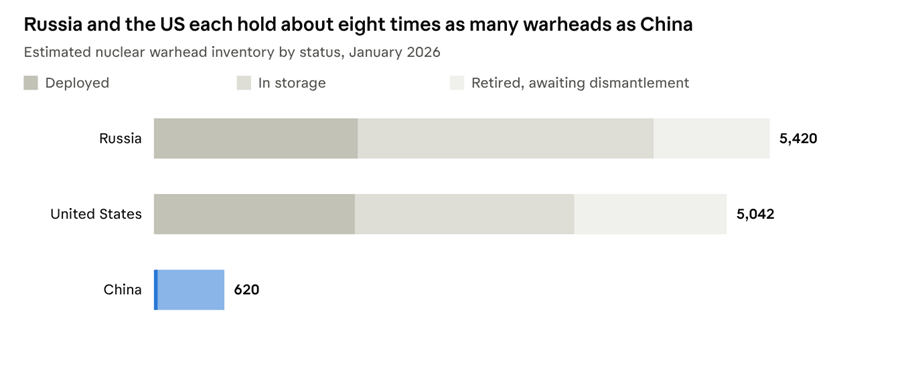
Source: SIPRI Yearbook 2026 (estimates as of January 2026). Russia’s split between storage and retired warheads is derived from SIPRI’s total inventory (5,420) and military stockpile (~4,400).
That goal runs into the size gap shown above. SIPRI estimates China’s arsenal at about 620 warheads, up 20 in a year, consistent with the Pentagon’s estimate of more than 600. That is small next to the roughly 5,000-plus each held by the US and Russia. SIPRI notes that even if China passes 1,000 warheads by 2030, it would still have only about a quarter of either country’s current stockpile. Beijing has never joined US–Russian arms control and has shown no interest in caps on its smaller force.
A senior US official told RFE/RL it was time for China to “step up to the adults’ table,” while admitting: “We do not expect to get to any kind of agreement.” The official described Shenzhen as the hoped-for start of a productive conversation.
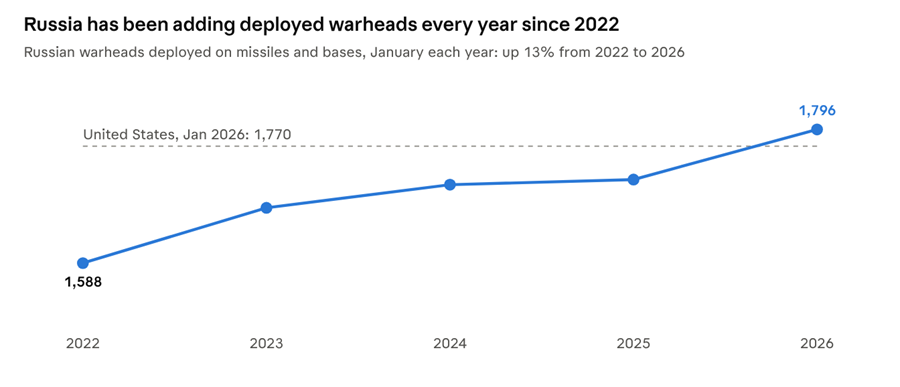
Source: SIPRI data as reported by Kyiv Post, June 2026. SIPRI counts differ from New START’s treaty rules, so these figures are not directly comparable with the treaty’s 1,550 cap.
The numbers are moving the wrong way. Across all nine nuclear-armed states, SIPRI counted about 4,012 deployed warheads in January 2026, roughly 100 more than a year earlier. Russia accounted for the largest increase. Between 2,100 and 2,200 warheads sit on high alert, nearly all of them American or Russian. Rose Gottemoeller, the former US chief negotiator on New START, warned when the treaty expired that without even an informal extension, Russia could race ahead by loading extra warheads onto its missiles.
Iran: the war hanging over the summit
Iran is the most immediate issue Trump brings to Shenzhen. The United States and Israel launched strikes on Iran on February 28, 2026, and the conflict has run for more than eight months since, through a ceasefire, a US naval blockade and a return to fighting in July. Russia and China both keep close ties with Tehran.
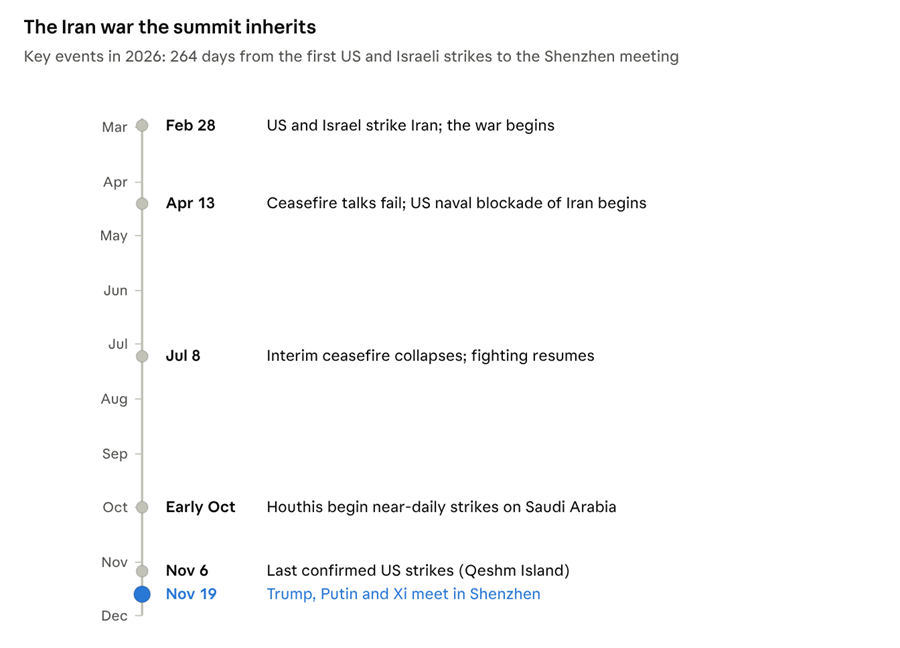
Sources: Wikipedia (2026 Strait of Hormuz campaign), CBS News live coverage, GlobalSecurity.org Iran War update (Nov 12), White House. Positions are proportional to dates.
Since the ceasefire broke down, Iran has launched at least 613 missiles and drones, according to a count by the Jewish Institute for National Security of America as of November 4. Iranian-backed Houthi forces in Yemen have hit Saudi Arabia almost daily since early October. The last confirmed US strike hit air defense positions on Iran’s Qeshm Island on November 6.
A senior US official confirmed Trump will raise Iran in the three-way talks, but would not say whether Washington will ask Moscow and Beijing to help end the war or rein in Tehran’s activities in the region.
Rubio sets the bar. Speaking to the Federalist Society’s National Lawyers Convention in Washington on November 13, Secretary of State Marco Rubio defined victory simply: “Victory means [Iran] can’t have a nuclear weapon. One way or another.” He accused Iran’s clerical leaders of pursuing an expansionist ideology, sponsoring terrorism and arming groups across the region, including Hezbollah in Lebanon and militias in Iraq. He argued that Iran’s missile work and uranium enrichment had brought it closer to being able to build a bomb, despite Tehran’s denials that it wants one.
Rubio said economic pressure had weakened the Iranian government and made further military action less urgent. That matches his comments in Paris three days earlier, when he called a return to major US strikes “highly unlikely” while saying US forces stood ready. He still insisted that stopping an Iranian bomb was essential: “Nothing is half a world away anymore.”
Will Moscow and Beijing help? Mark Katz, professor emeritus at George Mason University and a nonresident senior fellow at the Atlantic Council, said Trump may hope to get Putin and Xi to press Iran to halt attacks by its own forces and by the Houthis. He doubts it will work. “I don’t think that Putin or Xi will be willing to pressure Iran at all,” he told RFE/RL, arguing that Iran’s activities keep Washington distracted from countering Russia and China.
What to expect: very little, by design
Nobody involved is promising a breakthrough. Washington is presenting the meeting as a first step, and outside analysts are blunter.
| Who | Their view |
| Senior US official | No agreement expected; the meeting is meant to begin a conversation on arms control that may prove productive later. |
| Luke Coffey, Hudson Institute | Effectively “less of a trilateral meeting and more of a bilateral one,” with the US facing China and Russia, and Moscow as the junior partner. He sees little coming of it beyond lending Beijing and Moscow geopolitical legitimacy. |
| Mark Katz, George Mason University / Atlantic Council | Expects no meaningful agreement; the summit will “mainly provide a photo op” for all three leaders. |
For Xi, the host, the value may be in the optics: bringing the American and Russian presidents to a Chinese city shows off China’s diplomatic weight, whatever the talks produce.
Ukraine off the table, and the Starlink question
Russia’s full-scale invasion of Ukraine is approaching its fifth anniversary, but it will not be formally discussed in Shenzhen. A senior US official said the administration runs a “whole other track” of talks with Moscow and Kyiv, and that China has no part in it, so raising Ukraine at the trilateral would be out of place.
Ukraine is still shadowing the trip through Elon Musk. His company SpaceX runs the Starlink and Starshield satellite services that Ukrainian forces depend on, and those services have been disrupted twice this autumn.
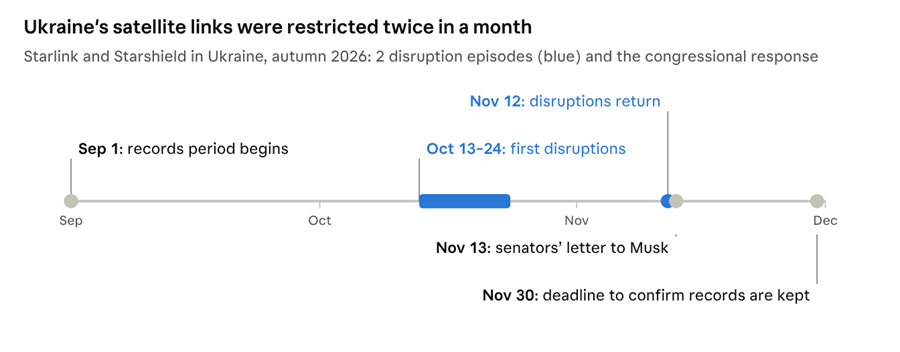
Sources: Shaheen–Coons letter as reported by the Wall Street Journal, Reuters, Bloomberg and Ukrinform (Nov 13–14, 2026). Positions are proportional to dates.
In a November 13 letter, Democratic senators Jeanne Shaheen and Chris Coons told Musk to preserve all SpaceX records on the disruptions, going back to September 1. That includes communications between Musk, SpaceX executives, the White House and the Pentagon. They gave him until November 30 to confirm the records are being kept.
The senators wrote that the outages hit communications used by Ukrainian forces, including systems for interceptor drones that defend cities against Russian attacks. On November 13, President Volodymyr Zelensky said speed limits on Starshield were still in force along the whole front line.
The senators also pointed to conflicting accounts of who ordered the restrictions. Reuters reported in October that an order to limit Starshield came from inside the White House; Rubio later disputed that, saying the decisions belonged to SpaceX and Musk. Musk says Ukraine’s military broke Starlink’s terms of service, which Kyiv denies. The senators called for a full accounting and more government oversight of critical national security systems. The pressure is likely to grow: Coons is expected to chair the Senate Foreign Relations Committee when the new Congress meets in January.