Two young men from north Kashmir walked free on November 5, 2026, after more than six years in judicial custody, when a special UAPA court in Sopore found the case against them could not be proved. Special Judge Feroz Ahmad Khan acquitted Huzaif Firdous Bhat of Choora, Sopore, and Ajaz Ahmad Khan of Najibhat, Kreeri, ruling that the police account of a 2020 weapons recovery was riddled with contradictions. “Suspicion, however grave, cannot substitute proof,” the court wrote (Kashmir Life).
Government data placed before Parliament shows that between 2019 and 2023, Jammu and Kashmir made 3,662 UAPA arrests and recorded just 23 convictions. In May 2026 the Supreme Court itself said a UAPA accused in J&K faces a 99% chance of acquittal at the end of trial.
The Case
The prosecution said the arrests came on September 16, 2020, at a joint police, Army (52 Rashtriya Rifles) and CRPF (53 Battalion) checkpoint near Kanispora on the Baramulla highway. Police said they stopped a white Maruti driven by Huzaif Firdous Bhat, with Ajaz Ahmad Khan as passenger, and found two grenades and 100 AK-47 rounds in a polythene bag under the driver’s seat, plus photocopied Lashkar-e-Taiba letterheads. They alleged the two were LeT overground workers moving the ammunition from Singhpora towards Baramulla town for an attack.
FIR No. 159/2020 was registered at Police Station Baramulla. The chargesheet invoked Sections 18, 23 and 39 of the UAPA and Sections 7/25 of the Arms Act. The accused pleaded not guilty and told the court they had been picked up from their homes at night, not at any checkpoint.
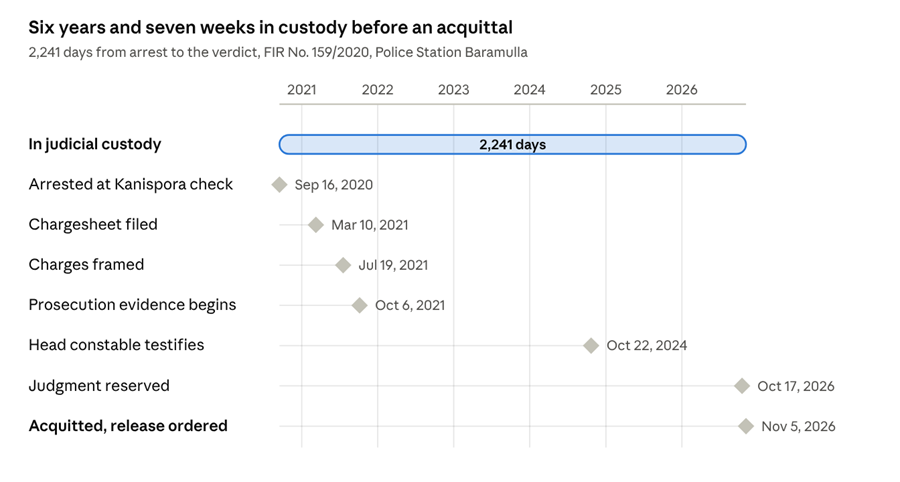
Dates from the judgment as reported by Kashmir Life, Nov 9, 2026 · 8 dates, Sep 2020 to Nov 2026
The prosecution cited 12 witnesses; some testified years after the event, one head constable only in October 2024. The 71-page judgment was pronounced on November 5, 2026.
What the Court Found
- Who searched the car is unclear. The lead inspector said he searched it himself; other police witnesses named two different officers, and two admitted the recovery did not happen in their presence.
- The witnesses disagreed on what was found. One put the ammunition at 100 rounds, another at 40; accounts differed on whether the material was linked to LeT or Jaish-e-Mohammad.
- The chain of custody broke. The original polythene bag was never produced. The seizure memo carried no identifying marks, batch numbers or weights. Items said to be in one packet reached court in several. The investigating DSP admitted he took no receipt when depositing them in the police store.
- Expert evidence was thin. The ammunition examiner did not know who sent the rounds, which fit both AK-47 and AK-56 rifles. The grenades were unsealed, and the certificate did not establish they were live.
- The ‘confession’ did not hold up. One signatory of the interrogation memo said he signed it at the DSP’s direction without knowing who drafted it; another said no confession was made before him. No recovery followed from the disclosure, and no terrorist contact was ever named.
On the Section 39 charge of supporting a terrorist organisation, the court held that an allegation of association, without independent evidence of intentional assistance, cannot sustain a conviction. Both men were acquitted and ordered released unless wanted in another case; seized property is to be dealt with after the appeal period expires.
Reaction: “Will accountability be fixed?”
Mirwaiz Umar Farooq, Kashmir’s chief cleric and Hurriyat chairman, posted on X on November 10 that it was deeply saddening the two had lost six years before the evidence was found unreliable. He said the case showed the indiscriminate arrest and prolonged detention of Kashmiri youth, asked whether anyone would be held to account for their wasted years, and urged the authorities to review the cases of thousands still in jail (The Wire).
Neither J&K Police nor the prosecution had commented publicly by November 10, and it is not yet known whether the state will appeal. The court’s order to hold the seized property until the appeal period ends keeps that option open. The J&K High Court has in the past dismissed government appeals against UAPA acquittals, including in a 2012 poster case decided in 2025.
The bigger Picture: arrests climb, convictions stay rare
Nationally, UAPA arrests rose by half between 2019 and 2023 while convictions stayed in the dozens. The Home Ministry’s December 2025 reply to the Lok Sabha put the five-year totals at 10,440 arrests and 335 convictions (The Wire).
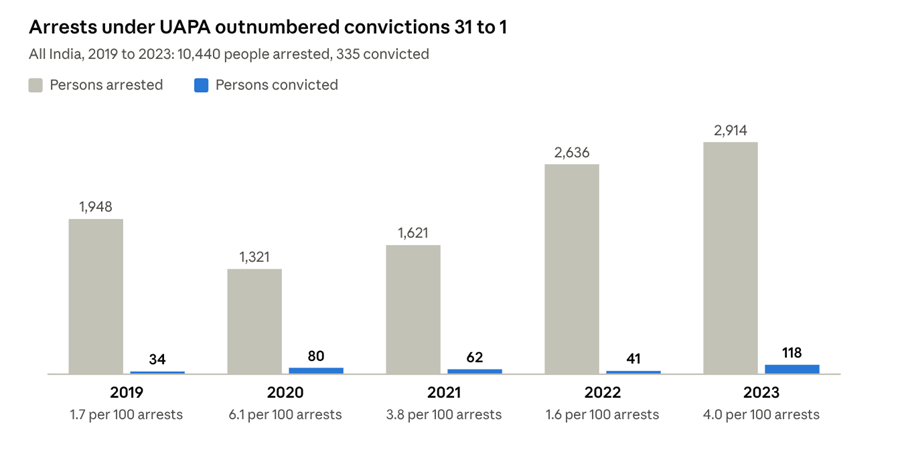
MHA written reply to Lok Sabha, Dec 2, 2025, from NCRB data, as reported by Kashmir Life and The Wire · 2019 to 2023
These ratios need care: a conviction recorded in 2023 may come from a case filed years earlier, so the yearly figure is not a true success rate. Still, the gap holds across every cut of the data. Between 2018 and 2022, 8,947 people were arrested, 6,503 charge-sheeted and 252 convicted, while courts quashed just two UAPA cases (Deccan Herald).
The deeper problem is that most trials never finish. By the end of 2021, 2,800 UAPA cases were awaiting trial and 172 had waited a decade or more (The Wire). Where trials do conclude, NCRB data shows more convictions than the arrest ratio suggests: in 2020, 27 of 128 completed trials ended in conviction, a rate of 21.1% (SabrangIndia). Even on that measure, roughly four in five completed trials ended in acquittal.
Jammu and Kashmir: a third of the arrests, a fraction of the convictions
J&K has led the country in UAPA arrests for five straight years, and its share of the national total has more than tripled. From 2019 to 2023 the Union Territory recorded 3,662 arrests and 23 convictions (Kashmir Life).
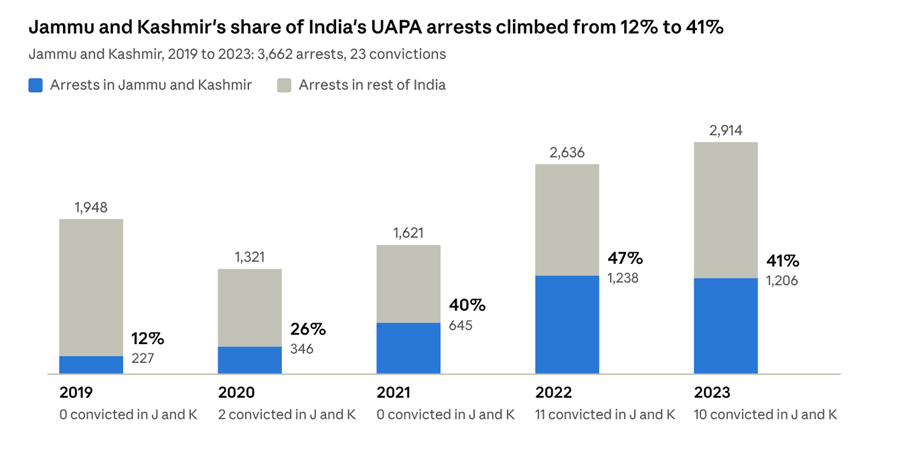
MHA written reply to Lok Sabha, Dec 2, 2025, from NCRB data, as reported by Kashmir Life · 2019 to 2023
The contrast with Uttar Pradesh, the next-largest user of the law, is sharp: UP made 2,805 arrests over the same years and recorded 222 convictions, almost ten times J&K’s tally from fewer arrests (The Quint). Judged by convictions per arrest, J&K’s best year was 2022, at under 1% — the figure the Supreme Court cited in May 2026.
What the data cannot show is how many people are in jail right now. The Home Ministry told Parliament that NCRB keeps no state-wise count of UAPA prisoners, so Mirwaiz’s “thousands” cannot be checked against an official number. An older snapshot from J&K Police, reported by The Kashmir Walla, put 884 UAPA cases under trial in the UT, 249 of them in north Kashmir districts including Baramulla and Sopore (The Kashmir Walla).
Why six years: the bail bar in Section 43D(5)
Under UAPA, an accused can stay in jail for the whole trial even when the case later collapses, because Section 43D(5) bars bail if the court finds the accusation “prima facie true” on the police case diary and chargesheet. At that stage the court does not test the evidence or hear the defence. Both Sopore accused stayed in judicial custody throughout; reports do not say whether they sought bail.
The Supreme Court is split on how far long custody can override that bar, and the question now sits with a larger bench:
| Date | Ruling | What it held |
| May 22, 2026 | Tasleem Ahmed v. State (Justices Aravind Kumar, P.B. Varale) | Defended the January ruling, referred the conflict to a larger bench, and freed two co-accused for six months meanwhile |
| May 18, 2026 | Syed Iftikhar Andrabi v. NIA (Justices B.V. Nagarathna, Ujjal Bhuyan) | Bail for a Kupwara man held nearly six years; Najeeb is binding; noted a 99% chance of acquittal for UAPA accused in J&K |
| Jan 5, 2026 | Gulfisha Fatima v. State (Justices Aravind Kumar, N.V. Anjaria) | Long custody is one factor, not an automatic ground; bail denied to Umar Khalid and Sharjeel Imam |
| 2021 | Union of India v. K.A. Najeeb (three judges) | Constitutional courts can grant bail despite 43D(5) when custody is long and the trial has no realistic end |
| 2019 | NIA v. Zahoor Ahmad Shah Watali | At the bail stage, courts check only whether the police material makes out a prima facie case |
As of October 2026, no larger bench had been constituted to hear the reference. Closer to home, the J&K High Court has said the right to a speedy trial survives even under UAPA, warning that years-long pendency can turn the process itself into punishment (Daily Excelsior).