



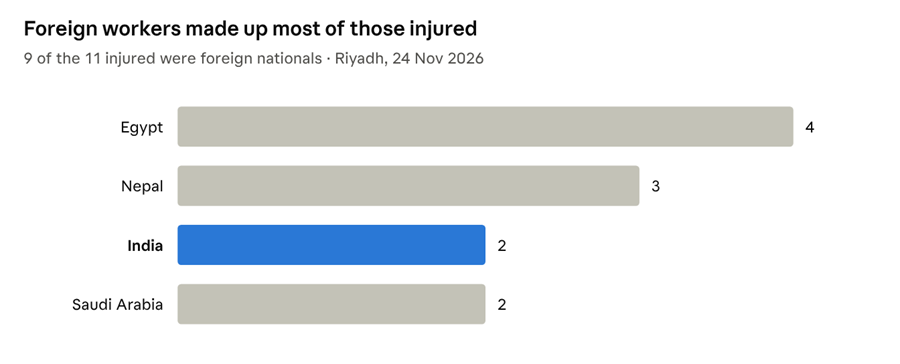
Two Indian nationals were among 11 people hurt when a Houthi drone struck a skyscraper in Riyadh’s King Abdullah Financial District (KAFD) on Tuesday, 24 November, according to Saudi Civil Defence. The tower houses the headquarters of the Public Investment Fund (PIF), Saudi Arabia’s sovereign wealth fund. It was the second time in under a week that the building had been hit.
India’s Ministry of External Affairs (MEA) condemned the attack on Wednesday, confirmed that two Indians were among the injured, and said the Indian Embassy in Riyadh was giving them and their families all possible help.
Who was hurt
What happened at the tower
Saudi Civil Defence released a photograph showing damage to the PIF Tower’s facade. Major General Turki Al-Maliki, spokesperson for the Saudi-led coalition in Yemen, said the drone had targeted the financial district. He called it a “cowardly” strike and said investigators were working at the site. In a post on X, he warned that the Houthis’ deliberate targeting of civilians and civilian sites would meet “a firm response”.
The coalition did not name the building, but three witnesses told AFP that the PIF skyscraper was hit. A fourth said a vehicle with a loudspeaker had warned pedestrians to take cover. No mobile-phone emergency alert went out before the strike. Police later blocked some entrances to the district.
The tower was already damaged. On Thursday, 19 November, an attack blamed on the Houthis blew out windows across seven to eight floors and buckled parts of the metal facade, Reuters reported. Nobody was reported hurt that time. KAFD is the showpiece of Riyadh’s bid to become a global financial centre, and PIF is central to the kingdom’s plans to diversify its economy.
India’s response
In its statement on 25 November, the MEA strongly condemned the strike and the continuing attacks on civilian, economic and energy infrastructure in Saudi Arabia. It said these attacks put civilian lives at risk, violate the Kingdom’s sovereignty and undermine regional security and stability.
New Delhi called for an immediate end to the attacks and reaffirmed its solidarity with Saudi Arabia. It said it backed the Kingdom’s efforts to protect its sovereignty, its territorial integrity and the safety of its citizens and residents.
The Indian Embassy in Riyadh separately urged Indians to follow local rules and regulations. The advisory came after Saudi Public Security warned that filming, publishing or sharing information about missile and drone interceptions or their impact sites could lead to legal action. Saudi authorities have repeated this warning several times in 2026. In October, the US Mission in Saudi Arabia said some Americans had been detained for photographing attack sites.
The stakes for India are high. About 2.7 million Indians live in Saudi Arabia, the largest expatriate community in the Kingdom, according to India’s Consulate General in Jeddah.
Third strike on the financial district this month
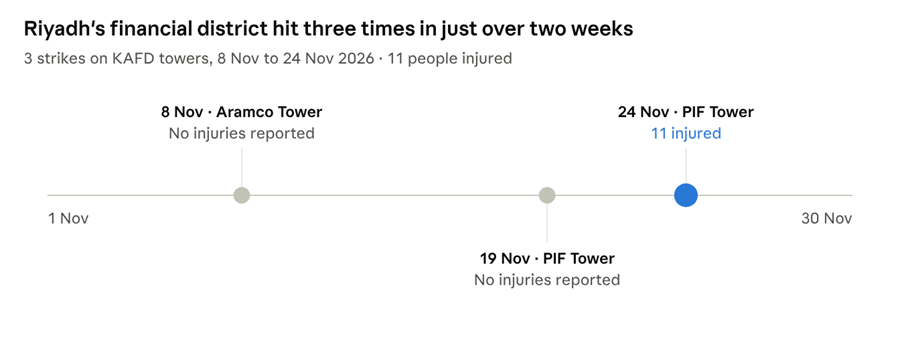
The 24 November strike was the first of the three to injure anyone. On 8 November, Saudi Arabia’s energy ministry said falling debris from an attempted attack had caused limited damage to Aramco’s office tower in the same district.
A near-daily barrage
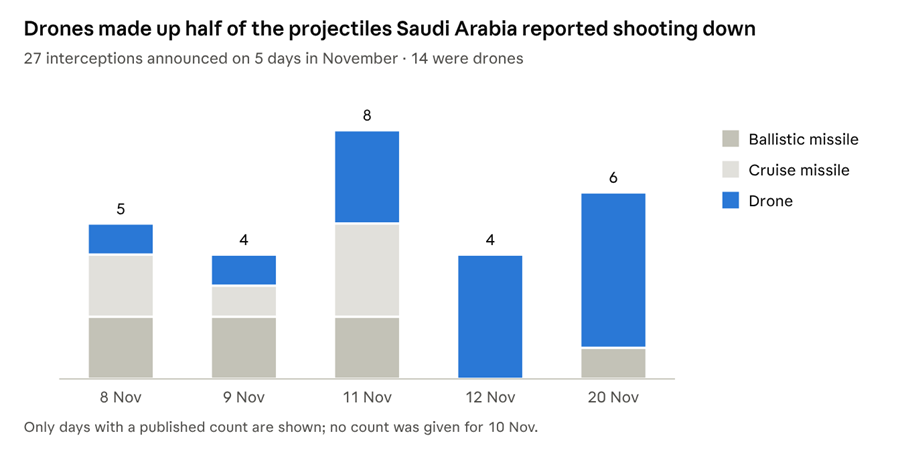
Since 7 November, the Houthis have reportedly launched attacks on Saudi Arabia every day, aimed at airports, oil pipelines and pumping stations, and military bases. The coalition does not publish a count every day. On 18 November, Saudi forces said they had destroyed 60 military targets across Yemen, including missile and drone sites.
Indians caught in the crossfire
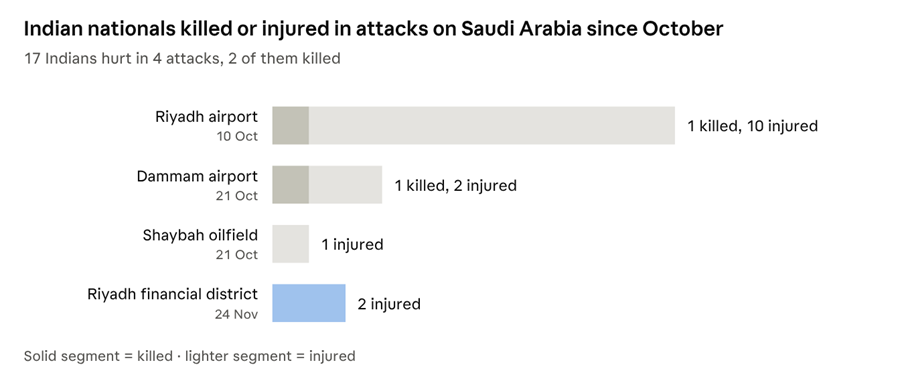
Sources: Indian Embassy Riyadh, MEA, Saudi GACA and Ministry of Energy, as reported by Gulf News, Khaleej Times and Onmanorama
The deadliest of these attacks hit King Khalid International Airport in Riyadh on 10 October. It killed at least 12 people and injured more than 300. One of the 11 Indians injured there later died. On 21 October, an Indian was killed at Dammam airport, and another was hurt when debris from an intercepted drone fell on the Shaybah oilfield. Saudi authorities did not publicly say who carried out the Dammam attack.
Regional condemnation
The UAE, Qatar, Kuwait, Lebanon, the United States and Pakistan also condemned the attack.
- UAE: expressed solidarity with Saudi Arabia
- Qatar: called it a “flagrant violation of Saudi sovereignty”
- Kuwait: warned that attacks on civilian and economic sites threaten lives and risk further escalation
- Pakistan: said such incidents could raise regional tensions and set back efforts to restore peace
Why the Houthis are targeting Saudi Arabia
The Saudi-Houthi conflict had been mostly frozen under a UN-brokered truce since 2022. It flared up again in July 2026. On 13 July, Yemeni government forces, working with Saudi Arabia, struck Sanaa International Airport. The Houthis then abandoned the truce and declared a naval blockade on the Kingdom. The fighting is part of the wider 2026 Iran war, which began in February.
The Houthis describe their strikes on Saudi airports, oilfields and office towers as retaliation for coalition airstrikes in Yemen. Analysts say the group wants to raise the cost of Riyadh’s support for Yemen’s internationally recognised government, and to damage the Kingdom’s image of stability. The Wall Street Journal reported on 5 November that the Houthis were demanding $51 billion from Saudi Arabia to end the conflict.
The group has signalled more attacks. On 20 November, its military spokesman, Yahya Saree, told workers at the Al-Shuqaiq power plant to evacuate. He also warned cargo companies and civilians that Saudi airspace was no longer safe.