



The Supreme Court on Wednesday issued notice to the Delhi Police on fresh bail petitions filed by former JNU scholars Umar Khalid and Sharjeel Imam, accused in the 2020 North-East Delhi riots “larger conspiracy” case under the Unlawful Activities (Prevention) Act (UAPA). The two moved the top court after the Delhi High Court refused them bail on September 30.
A bench of Chief Justice of India Surya Kant, Justice Joymalya Bagchi and Justice V. Mohana did not grant the interim bail the petitioners asked for. Instead, it directed that the matters be placed before the CJI on the administrative side so that a three-judge bench can be constituted, in view of a pending reference on how courts must read the landmark Union of India v. K.A. Najeeb ruling on bail in UAPA cases.
The outcome means the fate of the two men, both in custody since 2020 with their trial yet to begin, is now tied to a larger constitutional question: can long incarceration without trial override the UAPA’s strict bar on bail?
Inside the courtroom
Senior Advocate Kapil Sibal, appearing for Khalid, pressed hard for interim release, telling the bench his client has been in custody for more than six years. Senior Advocate Siddharth Dave made the same request for Imam.
The bench said it would first hear the State before deciding any interim prayer. When Sibal pointed out that the bench which made the May 22 reference had itself granted interim bail to co-accused in the same conspiracy case, the CJI’s reply was brief: “Not today.” Justice Bagchi added that since an interim prayer had been made, the other side must be allowed to respond.
Dave argued that the reference order had no bearing on these petitions, because they were filed under the liberty granted by the Supreme Court’s own January judgment, which allowed the two to seek bail again after one year. Solicitor General Tushar Mehta, for the Delhi Police, countered that the reference arose from the very same FIR.
The CJI then made an unusually candid remark. Najeeb, he noted, was his own judgment, and two benches now disagree on what it means. He said he felt “little embarrassed” at being told what he had said, and that the conflict required him to apply his mind.
When Sibal sought an early date, the CJI said the bench had “done our homework” and that the main case itself, not just the interim plea, would be listed.
Six years and counting
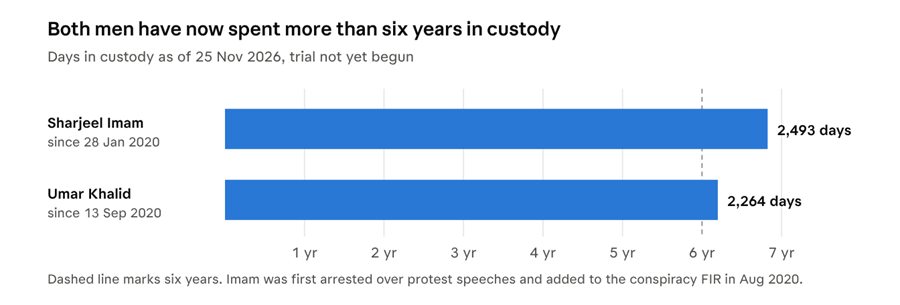
Arrest dates: Tribune, USCIRF, The Quint; days computed to 25 Nov 2026
The chargesheet in FIR 59/2020 names 18 accused, and the prosecution has cited more than 900 witnesses, 47 of them protected. Imam’s petition says not one witness has yet been examined, which is why the petitioners argue the Supreme Court’s second condition for renewed bail, completing the examination of protected witnesses, cannot realistically be met before the one-year bar lapses on January 5, 2027.
How the case got here
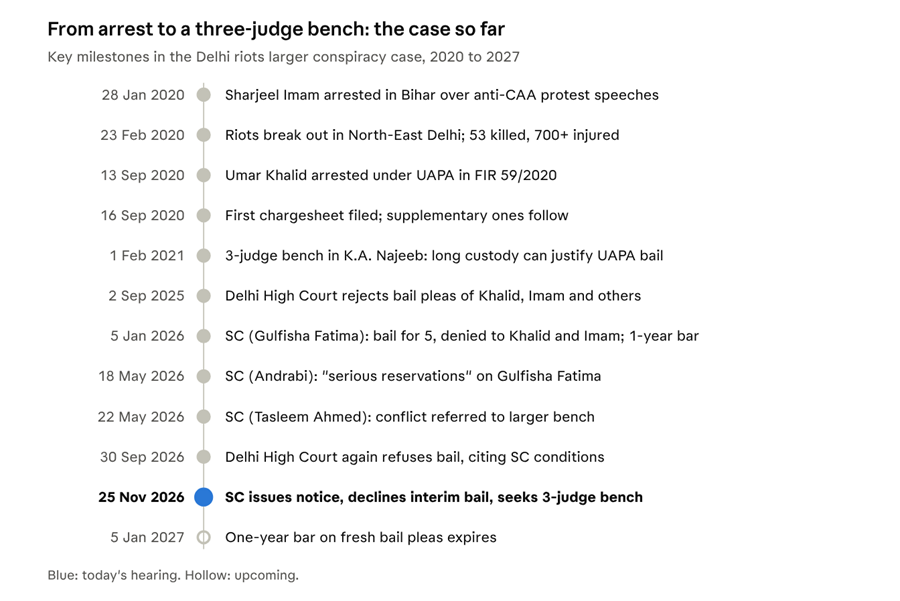
Compiled from PTI, SC Observer, LiveLaw, Bar & Bench reports
In its January 5 ruling, a bench of Justices Aravind Kumar and N.V. Anjaria described Khalid and Imam as the “ideological drivers” of the alleged conspiracy and held that they stood on a “qualitatively different footing” from the five co-accused it released, including Gulfisha Fatima. It allowed the two to renew their bail plea once the protected witnesses had been examined or after one year, whichever came first. Relying on those conditions, the Delhi High Court said on September 30 that granting bail now would amount to modifying a Supreme Court order.
The legal tangle: four rulings, one question
At the heart of the dispute is Section 43D(5) of the UAPA, which bars bail if the court finds the accusation “prima facie true”. The question is how far long pre-trial custody can override that bar.
| Ruling | Bench | Date | What it said |
| Union of India v. K.A. Najeeb | 3 judges, incl. then-Justice Surya Kant | Feb 2021 | Prolonged custody with no early end to trial can justify bail despite UAPA’s statutory rigours, under Article 21 |
| Gulfisha Fatima v. State | Justices Aravind Kumar, N.V. Anjaria | Jan 5, 2026 | Najeeb is a principled safeguard, not a time-based formula; bail for 5, refused to Khalid and Imam |
| Syed Iftikhar Andrabi v. NIA | Justices B.V. Nagarathna, Ujjal Bhuyan | May 18, 2026 | “Serious reservations” on Gulfisha Fatima; says it and Gurwinder Singh departed from Najeeb, which is binding on smaller benches |
| Tasleem Ahmed v. State | Justices Aravind Kumar, P.B. Varale | May 22, 2026 | Defends Gulfisha Fatima, refers the “perceived conflict” to a larger bench; grants 6-month interim bail to Tasleem Ahmed and Khalid Saifi |
The Andrabi bench went further than doctrine. It noted that UAPA conviction rates between 2019 and 2023 ranged from roughly 1.5% to 4%, and warned that Najeeb could not be diluted by trial courts, High Courts or smaller Supreme Court benches. The Tasleem Ahmed bench answered that one two-judge bench cannot unsettle another’s ruling through strong observations; the proper course is a reference.
That reference is now waiting on a bench to be formed, and it is the reason Wednesday’s hearing went no further. It also explains the CJI’s discomfort: the judgment being fought over was one he authored.
The numbers behind the debate
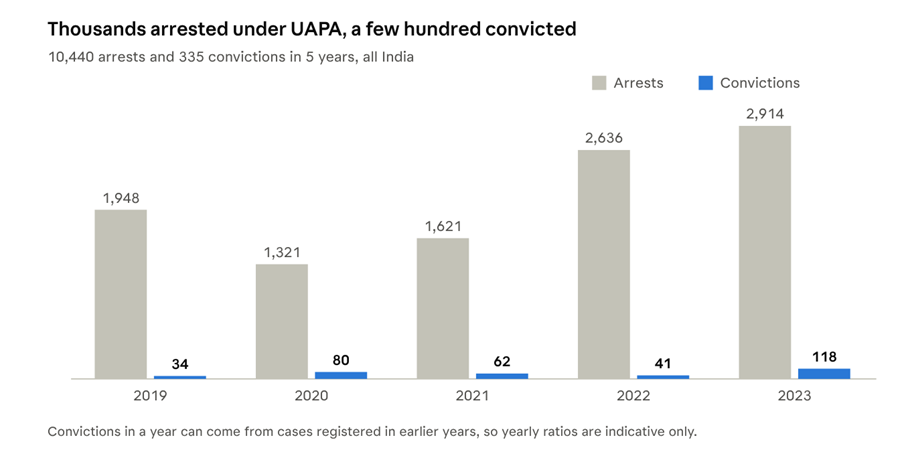
NCRB data tabled in Lok Sabha, Dec 2025 (via The Wire, Bar & Bench, The Quint)
These figures sit behind the argument that, under UAPA, the long wait before trial is often the real punishment. Jammu and Kashmir accounted for 3,662 of the arrests but only 23 convictions; Uttar Pradesh recorded 2,805 arrests and 222 convictions, the highest of any state. The government told Parliament that NCRB does not track how many UAPA accused are currently in jail or for how long.