Iran’s Islamic Revolutionary Guard Corps (IRGC) said on Saturday, 21 November, that it had shot down a US MQ-9 Reaper drone over the Strait of Hormuz using a newly deployed air defence system. It called this the 58th MQ-9 brought down by Iranian forces since the war began. Washington has not confirmed the loss.
In the same 24 hours, Houthi-run Al Masirah TV reported fresh air strikes on Yemen’s Taiz governorate. Riyadh also had a third straight night of emergency alerts, two days after a Houthi missile damaged the Public Investment Fund (PIF) tower, the capital’s tallest building.
Taken together, these reports show that the 2026 Iran war and Yemen’s reignited civil war are now one connected front stretching from Hormuz to the Red Sea.
Strait of Hormuz: Iran claims its 58th Reaper
The IRGC Aerospace Force said it intercepted the drone in the early hours of Saturday. Iran’s state broadcaster IRIB and the semi-official agencies Tasnim and Mehr carried the claim. The statement credited a “newly deployed” advanced air defence system but gave no details on where or how the interception happened. The United States has not commented, and the claim cannot be independently verified.
The MQ-9 Reaper is a long-endurance drone that the US military uses for surveillance and targeted strikes. Each one costs about $30 million. Iran’s count of downed Reapers has climbed steadily since the US-Israeli strikes of 28 February. Tehran called a Reaper downed over Khomein on 1 September the 50th. The Iranian Army, separate from the IRGC, also said on 18 November that it shot down an MQ-9 east of the strait.
The strait itself remains contested. Iran has largely blocked it since February, and the interim ceasefire collapsed on 8 July. A second US naval blockade of Iranian ports has been in force since 14 July.
Yemen: eight strikes on Mocha, more on al-Shamayatayn
Al Masirah reported eight air strikes on Mocha district and separate strikes on al-Shamayatayn, both in Taiz governorate. No casualties or damage were reported in this round.
Both districts have been hit repeatedly this week. The Houthis took the Red Sea port of Mocha in September. The Sanaa-based Health Ministry, which the Houthis run, said a Saudi strike on a hotel there on 19 November killed at least nine civilians. Houthi media also reported a strike on a Mocha power station on 20 November. Houthi-run outlets said strikes on al-Shamayatayn on 16 and 19 November killed civilians. None of these tolls has been independently verified.
The Saudi-led coalition says its operations are continuing in Sanaa, Saada and Taiz. It is targeting ballistic missile and drone capability, military sites and workshops. On Friday, 20 November, it carried out what it called a “special operation” against Hodeidah port, which it says is used to smuggle Iranian weapons. A journalist in Sanaa described the campaign as the heaviest air strikes of the war.
On the ground, the Houthis have the momentum. Yemen’s civil war reignited in July. Since then, the Houthis have encircled Taiz city, where residents report shortages of water and fuel. They have also pushed toward Aden, the government’s last major stronghold. Two Western officials told Reuters that Saudi Arabia expects the air campaign to last up to six months.
Saudi Arabia: Riyadh under alert for a third night
Authorities issued emergency alerts in Riyadh and lifted them soon after, for the third night in a row. Early on Saturday, the coalition said it intercepted three Houthi ballistic missiles aimed at the capital. Later that day, it said it destroyed a drone headed for southern Saudi Arabia, but did not name the province targeted.
The alerts follow the 19 November strike on the PIF tower. The 385-metre building in the King Abdullah Financial District houses Saudi Arabia’s sovereign wealth fund. The missile blew out windows across seven or eight floors and bent part of the facade. Civil Defence said nearby buildings were damaged and no one was hurt. It was the second hit on the district this month: an Aramco building there was damaged on 8 November.
The Houthis have threatened Jeddah and other Red Sea ports, as well as the Shuqaiq power station in the south-west. They have also told airlines that Saudi airspace is unsafe. The United Nations warned that the escalation could cut aid supply routes inside Yemen.
In charts
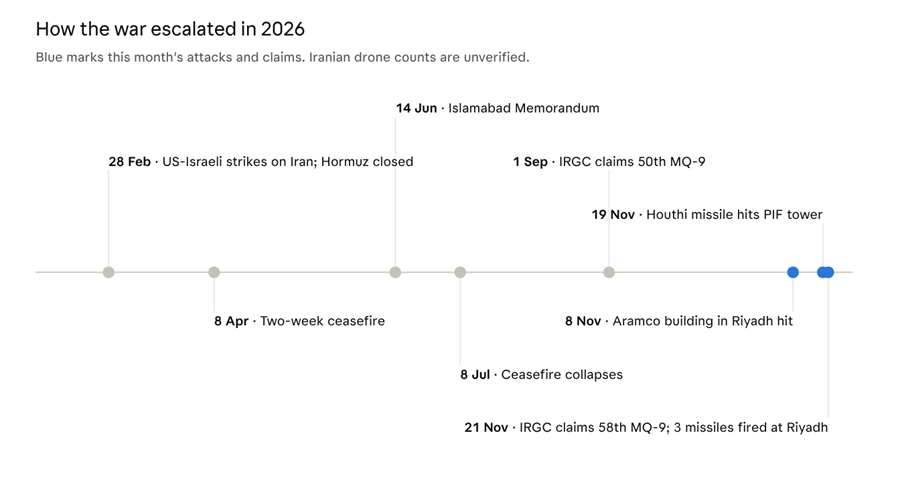
Sources: hormuz.now timeline, IranWire, Reuters via HNGN, Al Jazeera · Feb–Nov 2026
Three of this year’s eight turning points have come in the last two weeks, all aimed at Riyadh or US drones. Yemen’s civil war reignited in July, alongside the collapse of the US-Iran ceasefire.
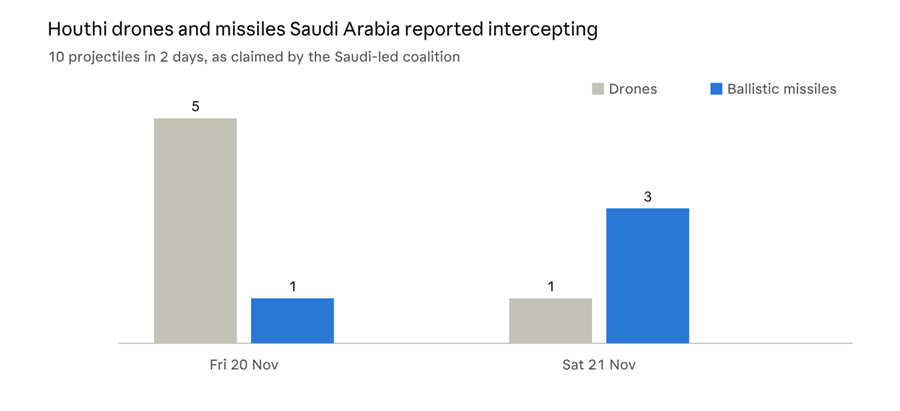
Saudi-led coalition statements via Reuters and Al Jazeera/AFP · 20–21 Nov 2026
The mix shifted from drones on Friday to ballistic missiles aimed at Riyadh on Saturday. Saudi Civil Defence issued 13 emergency alerts from Thursday onward.
What it means
The two wars are escalating together. Iran keeps pressing on US surveillance assets over Hormuz. Meanwhile, its Houthi allies are carrying the fight to Saudi Arabia’s financial heart while advancing on the ground in Yemen. Riyadh is answering with its heaviest air campaign of the war and is betting on months of bombing to strengthen its allies before any talks. No ceasefire track is active: on 12 November, President Trump said the US does not need a deal with Iran.
Much of today’s reporting rests on one side’s word. The drone count comes from the IRGC, the Yemen strike reports from Houthi-run media, and the interception figures from the Saudi-led coalition. Read each figure as a claim unless another source confirms it.