Disappearance of Cash
On 8 November 2016, the Government of India announced the demonetisation of all ₹500 and ₹1,000 banknotes of the Mahatma Gandhi Series. It also announced the issuance of new ₹500 and ₹2000 banknotes in exchange for the demonetised banknotes. Prime Minister Narendra Modi said that this decision would curtail the shadow economy, increase cashless transactions and reduce the use of illicit and counterfeit cash to fund illegal activity and terrorism.
The announcement of demonetization was followed by prolonged cash shortages in the market, leading to a job crisis while many deaths were also reported of people rushing on exchange counters.
The demonetization successfully removed the cash dependency from the Indian market in an attempt to reduce corruption and black money from circulation, while also successfully transitioning towards a new digital economy, where the money could only be seen reflected in numbers on the screens.
Appearance of QR machines
In the rising technological era, the Quick Response (QR) codes have been a monumental addition to the whole ‘operationally efficient’ technology apparatus. These little black-and-white squares invented in a Japanese auto factory in 1994 are now a multi-billion-dollar global infrastructure. The global daily scans are estimated somewhere between 26 million and 58.3 million in 2026.
UPI technology (2016) enables quick payments via a simple QR code scan, propelling seamless financial transactions. Demonetisation, Digital India, and a zero Merchant Discount Rate for UPI transfers in business transactions have led to a significant adoption of QR technology across the nation. The covid pandemic further accelerated the use of QR codes in India, posing it as the new mode of contactless transaction and other seamless services across various online and offline platforms.
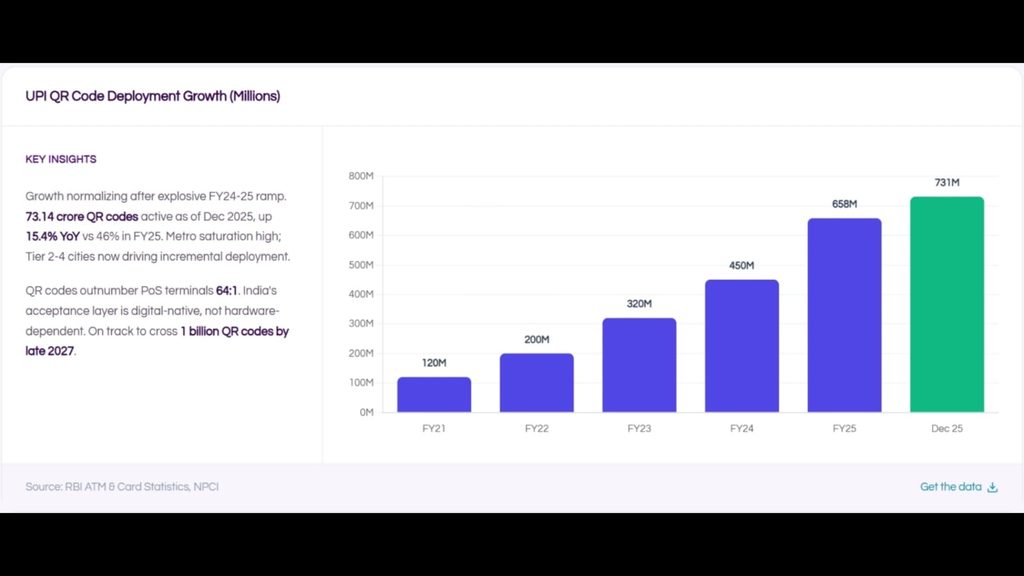
UPI, introduced as part of Government of India’s digital payments initiative has been successful towards simplifying merchant payments and reducing the dependence towards cash, while at the same time complicating methods of communication and general discussion between merchants and the customers.
Despite the rising popularity and the rapid growth rate, these QR machines remain a heavily underexplored category in terms of cultivating a distinct authoritarian customer behaviour.
“It is not coincidental that democracy is struggling at the same time when digital tech is on the rise” remarked Dr. Carissa Véliz, in a panel discussion on the Wonderstruck Podcast with Elizabeth Rovere, published on Youtube.
The disappearance of cash from the economy and rising use of digital payment methods, poses a significant threat to democracy in the same manner the Véliz argued. The capacity for charity towards the needy, poor and the beggars has been continuously shrinking as the reliance on digital payments is on the rise. The tendency of QR machines in producing a severance between communities and the declining dependency of individuals in an inter-communal setting culminates in an authoritarian, code like structure, undermining the complex human relationship between individuals of a community.
Disappearance of Community and the rise of Immunity
Roberto Esposito, articulated in his seminal work Immunitas: The Protection and Negation of Life, that the etymology of the word community traces back to the Latin word munus, which signifies a duty, an obligation, or a mandatory gift given to others. Community, therefore, is not a cozy gathering of shared identities; it is a profound, demanding exposure to the other. It is the inescapable obligation that binds the members of a society together, often at the cost of their own individual sovereignty.
While on the other hand, its (community’s) antithesis Immunity, by contrast, is the exemption from this burden. In the socio-political sense, the immune subject is one who is freed from the obligations of the munus.
By mapping Esposito’s biomedical paradigm of immunization onto the body politic of the fragmented communities due to the rise of technology in the country, the immunization does not appear as a necessary function to guard the body from the outside, against what Esposito argued in his work, but as a restrictive, non-generative effect of a function of vulnerability due to minimized group feeling among the individuals of the community.
This emerging immunological apparatus does not guard the community from the outside but from itself, in the same manner that the QR works in an inter-communal setting.
From QR machines to a loss of culture and politics
As we have already argued above, the severance of communication between communal subjects produces alienated individuals, generally guarding their individual sovereignty in full force. Communication demands a compromise over this individual sovereignty as the ego acts as an immunitary function in this context.
As argued by the socio-cultural anthropologist—Talal Asad, ‘culture is a historically constructed category shaped by power relations and discursive processes’. Communicated through various forms of symbolic communication and language, this discursive category and its embodiment in the discussions has mostly been alive in shops and dhabas where the shopkeeper and the customers used to engage in various discussions pertaining to politics and society over at the counter while bargaining.
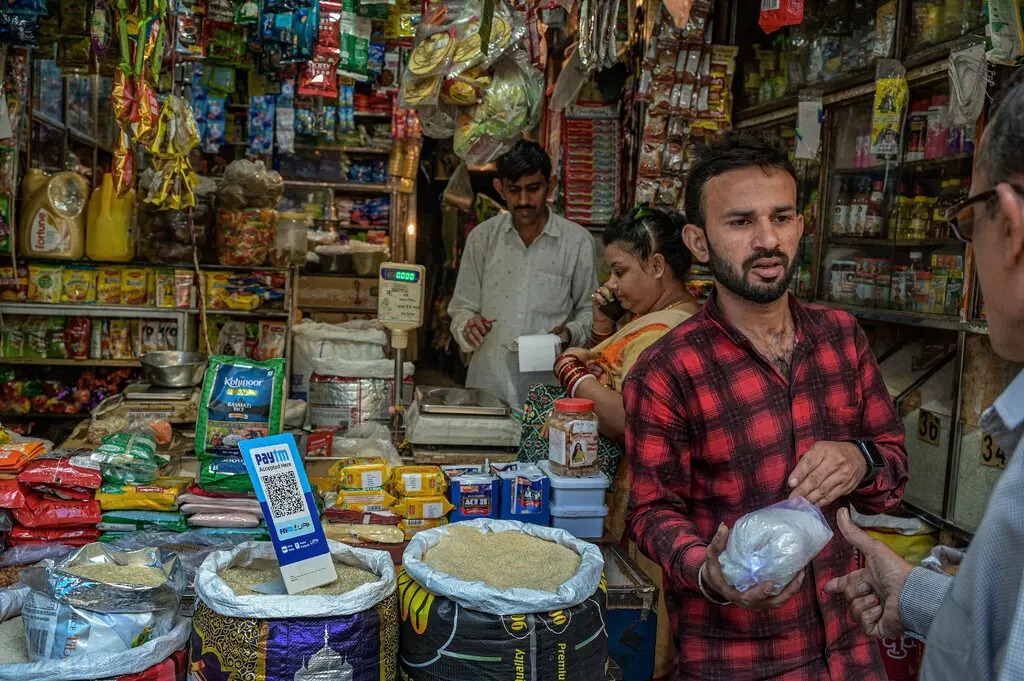
The lost capacity of bargaining, communication and charity are the very forms of life that makes the human beings distinct from a tech bot, in this case the QR machine, which acts as a mediatory device between two individuals, reducing human interaction, altruistic relationships and the ability to produce a culture at the stake of individual sovereignty.
Solution
Mohalla associations, dhabas and neighbourhood markets could adopt shared collection codes for common causes such as festivals, repairs or medical aid, where the act of scanning is tied to a visible, collective purpose. The transaction here becomes a public gesture rather than a private settlement, restoring a measure of group feeling.
The preservation of the counter as a space of conversation should be reasserted. Merchants and policymakers can treat the QR not as the end of an exchange but as its final step, leaving bargaining, discussion and exchange of news intact before payment. Besides payment, the communication should add and encourage the retention of the lost practices, so that efficiency does not become the sole measure of a good transaction.