Iran opened a military training centre for women volunteers at Tehran’s Azadi (Freedom) Square on Tuesday, 10 November. Authorities say its purpose is to prepare women to help defend the country if the United States mounts a ground invasion.
At the inauguration, women carrying assault rifles rappelled down a training tower, scaled walls and rode a zipline, while instructors coached newcomers on pistols and rifles. Photos and video from the event, distributed by the Associated Press and Iran’s WANA news agency, spread widely on social media.
The centre sits in the western part of the square and belongs to “Janfada” (Sacrifice for Iran), a state-run nationwide campaign that mixes military drills with emergency-relief and logistics training. A light-weapons instructor told WANA the planned courses include rappelling, ziplining, Kalashnikov handling and sniper-rifle shooting.
Part of a wider mobilisation drive
The Azadi Square centre is the newest site in a campaign that has grown from a sign-up drive into organised training. Janfada began on 29 March, a month into the US-Israeli air war on Iran. On 18 September, hundreds of thousands marched through central Tehran in its largest parade, chador-clad women carrying rifles beside men and teenagers; organisers put the marching column at 313,000.
On 1 October, Mehr reported the campaign’s first military course just for women, held at Tehran’s Imam Hossein Square. Women are exempt from compulsory military service in Iran but may volunteer. Campaign spokesperson Sasan Zare says women make up 32% of registrants.
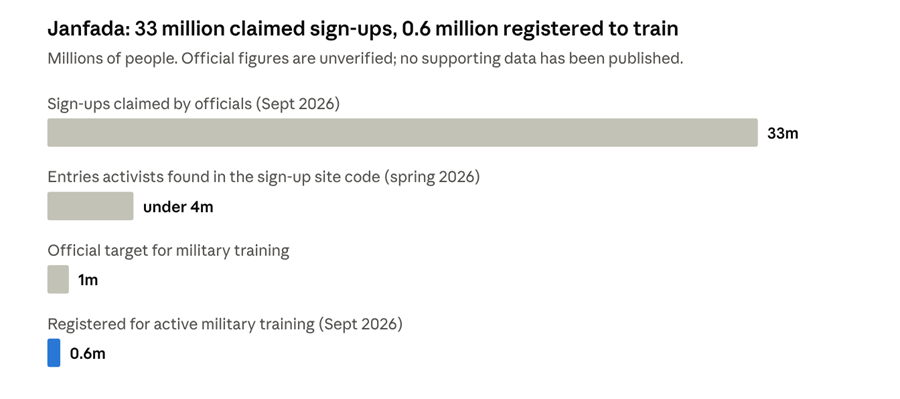
Sources: Al Jazeera (33m claim, activists’ count, 18–20 Sep 2026); IRIB via AP/Al Jazeera (600,000 registered, 1m target, 18 Sep 2026)
Officials say more than 33 million people have signed up, over a third of the population, but have published no evidence. Activists who inspected the registration website’s code found fewer than four million entries; signing up needed only a phone number. Far fewer are training: Tehran’s IRGC chief said more than 600,000 had enrolled for active training, against a target of one million, to be organised into 1,000 “national resistance battalions”.
Analysts such as Ali Alfoneh of the Arab Gulf States Institute see the campaign partly as an effort to rebrand the Basij militia, long associated with crushing protests. The IRGC wants training stations in at least 14 Tehran squares and in all 31 provincial capitals.
Echoes of April’s ‘Daughters Devoted to Iran’ rally
Women have been central to the state’s wartime messaging all year. On 17 April, during the ceasefire that paused the fighting that month, thousands of women and young girls joined a rally called “Daughters Devoted to Iran” at Enghelab Square in central Tehran, state broadcaster Press TV reported.
Participants chanted against the United States and Israel, pledged allegiance to Iran’s new Supreme Leader and said they were ready to defend the country. The event was timed to Iran’s Girls’ Day, which marks the birth anniversary of Fatima al-Masumeh, daughter of the seventh Shia Imam.
The new leader, Mojtaba Khamenei, was chosen by the Assembly of Experts on 8 March. His father, Ayatollah Ali Khamenei, was killed in US-Israeli strikes on 28 February, the war’s first day; it is the first time the post has passed from father to son.
Tehran: no talks until Washington answers seven conditions
Iran’s top security official, Mohsen Rezaei, Secretary of the Supreme National Security Council, said on Tuesday that Tehran and Washington are not negotiating. Speaking to the pro-Iran broadcaster Al-Mayadeen, he said Iran wants a “clear and explicit” US reply to seven conditions tied to the June interim agreement, and has not received one.
Iran insists the Strait of Hormuz will not reopen and talks will not resume until then, though Rezaei said Washington could still respond later. He also rejected reports of contacts with US Vice President JD Vance or a meeting in Qatar.
The conditions trace back to the Islamabad Memorandum of Understanding, a 14-point interim deal brokered by Pakistan and signed by Presidents Donald Trump and Masoud Pezeshkian on 17–18 June. It extended the ceasefire, suspended the US blockade and oil sanctions, and set a 60-day window for a final settlement. That truce collapsed on 8 July after Iran struck commercial ships in the strait; Washington reimposed oil sanctions and, on 14 July, its naval blockade of Iranian ports.
As Rezaei has described them in interviews with Al Jazeera and others, the conditions include:
- An end to the war on all fronts, especially Lebanon
- Lifting of the US naval blockade and restrictions on Iranian oil sales
- Release of frozen Iranian assets
- An end to US interference in Iran’s internal affairs and to US backing for “opponents of the revolution”
Tehran has also sought compensation for war damage. Washington rejects that, and Secretary of State Marco Rubio called Iran’s terms absurd on Tuesday.
Trump: war ‘effectively over’, but no deal
On Monday, 9 November, Trump hosted Qatar’s Prime Minister, Sheikh Mohammed bin Abdulrahman Al Thani, the main mediator between the two sides, at the White House with Vice President Vance. Qatar reportedly brought a two-day framework from Iran: a sequence of reciprocal steps meant to build confidence before a wider deal.
Afterwards Trump said Iran was “effectively over” as a military power and that renewed US strikes were unlikely, since Gulf states such as Qatar and Saudi Arabia prefer the status quo. He added that US forces remained ready to act if needed, said he was content with the naval blockade, and did not accept Iran’s existing ceasefire proposal. Sheikh Mohammed called the talks positive; Iranian officials dismissed Trump’s remarks as a distraction.
Rubio: Iran’s last oil money is running out
Rubio told reporters in Paris on Tuesday, after two days of G7 foreign ministers’ talks, that the blockade and sanctions together meant there was no need, for now, for major combat operations. The pain would compound, he argued: Iran would be worse off in one, two and three months than it is today.
Iran, he said, had only a small amount of oil left at sea, cargoes that slipped past the blockade during the brief ceasefire under the June memorandum. “Once that dries up, almost all of their oil revenue will dry up,” he said. Treasury Secretary Scott Bessent and US intelligence agencies, he added, are closing the routes Iran uses to evade sanctions.
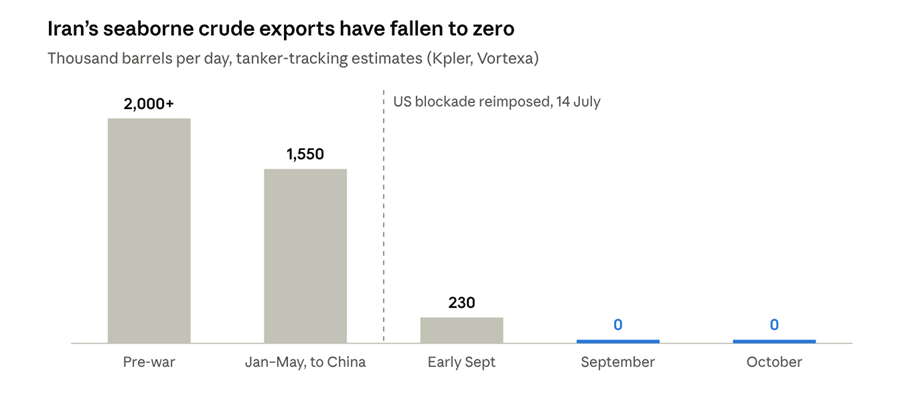
Sources: AGBI (pre-war level); Kpler via Iran International (Jan–May deliveries to China, September loadings); Vortexa via Iran International (early September, October)
Tanker-tracking data backs the broad picture. Kpler recorded no Iranian crude or condensate loaded onto tankers in September, the first full month without loadings since the 1979 revolution, and Vortexa found exports still at zero in mid-October. US Central Command says the blockade has kept at least $25 billion of Iranian crude off the market.
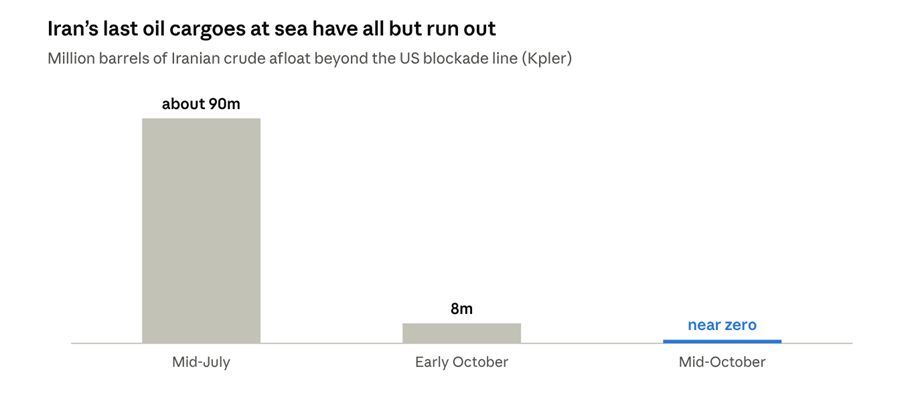
Source: Kpler, reported by Iran International (10 and 22 Oct 2026)
Kpler warns Iran’s crude export revenue could reach zero by mid-December, a first in the country’s history, if the blockade holds. Iran still moves an estimated 250,000 barrels a day overland, but land routes have tight capacity limits. The IMF expects Iran’s economy to shrink 7.6% this year.
Rubio also urged other countries to help protect shipping through Hormuz, though he said G7 counterparts had not yet answered.
The oil market has moved on without Iran
Washington can afford to wait partly because Gulf supply has recovered without Iranian barrels. Kpler data show Middle East oil exports averaged more than 24 million barrels a day in the week to 18 October, above the pre-war level of 23.3 million, which included about 2 million from Iran.
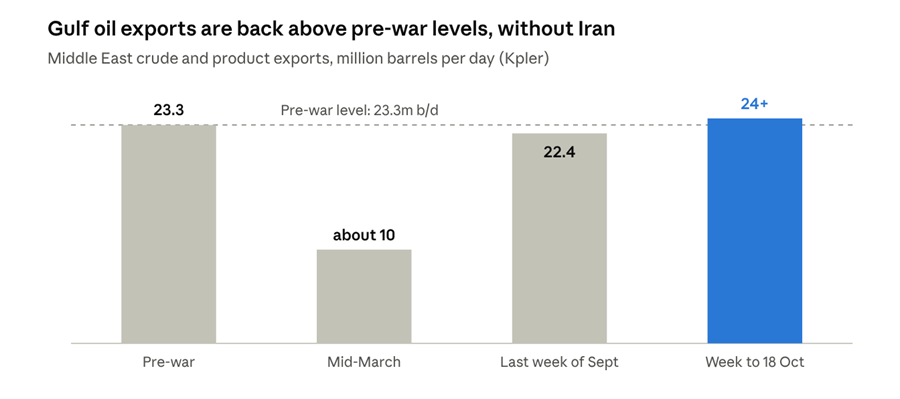
Sources: Kpler via Iran International (pre-war, September) and Wikipedia’s 2026 Strait of Hormuz crisis entry (18 Oct week); mid-March figure is an approximate separate estimate cited there
Much of that oil now leaves by pipeline and through alternative terminals, such as Saudi Arabia’s Red Sea port of Yanbu and the UAE’s Fujairah. Flows through Hormuz itself remain at roughly 82% of pre-war levels, and attacks on shipping continue. Brent crude, which peaked near $126 a barrel in March, fell sharply this week to its lowest since early September as Trump signalled restraint.
How we got here: 2026 timeline
More than eight months of war, truce and blockade, newest first.
| Date (2026) | Event |
| 10 Nov | Women’s Janfada training centre opens at Azadi Square; Rezaei says no talks are under way; Rubio says Iran’s oil revenue is about to dry up |
| 9 Nov | Trump meets Qatar’s prime minister; calls Iran militarily “effectively over” |
| 1 Oct | First Janfada military course for women, at Imam Hossein Square |
| September | Kpler records zero Iranian crude loadings, the first full month since 1979 |
| 19–20 Sep | Rezaei sets out Iran’s conditions, conveyed to Washington via Qatar |
| 18 Sep | Largest Janfada parade in Tehran; hundreds of thousands march |
| 14 Jul | US reinstates naval blockade of Iranian ports |
| 8 Jul | Interim truce breaks down after Iranian strikes on ships in Hormuz |
| 17–18 Jun | Islamabad MoU signed; 60-day window for a final deal |
| 17 Apr | “Daughters Devoted to Iran” rally at Enghelab Square |
| 13 Apr | US naval blockade of Iranian ports begins after Islamabad talks fail |
| 8 Apr | Temporary US–Iran ceasefire agreed |
| 29 Mar | Janfada mobilisation campaign launched |
| 8 Mar | Mojtaba Khamenei named Supreme Leader |
| 4 Mar | Iran declares the Strait of Hormuz closed |
| 28 Feb | US and Israel launch air war on Iran; Ali Khamenei killed |