



“We live here now; we live on this very soil,” says Shaliha Bibi (70), sitting in front of her makeshift hut, amidst the ruins of her home. Her hut is in a small area, with four average-sized bamboo poles standing in four corners and a single thin plastic sheet laid on them, making a roof. The sheet could not cover the entire bambooed area, so the remaining was covered with a fine, overused cloth, fragile enough to be torn by the hands.
With teary eyes, Shaliha Bibi tells FoEJ Media, “Where are we supposed to go now? We are poor people, and our homes have been demolished. They demolished our houses because we are Muslims.”
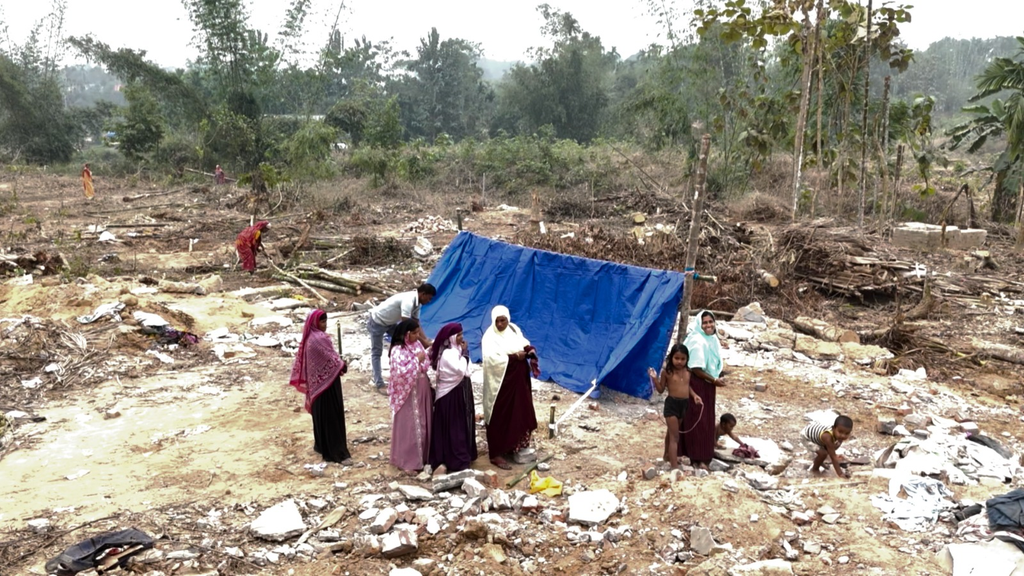
Shaliha Bibi is one of those whose house was demolished in the eviction drive in Assam’s Alamganj, which occurred on the 1st of November, removing as many as 520 families from 650 bighas of land.
The eviction drive started at 6 am under heavy police deployment. The operation was conducted with 60 excavators, with a massive police force monitoring the operation.
It’s done, bro!
In a post dated November 2, Assam Chief Minister Himanta Biswa Sarma shared a video on X of several pieces of footage of demolition drives. He wrote, “Encroachers in Dhubri—it’s done, bro! ” I’ve told you so many times that Assam’s land is for its people, not for encroachers. But some people probably don’t want to understand my words. For them, we present JCBs.”
In another video, Sarma defended the evictions and taking to the social media platform X; he wrote, “More to come. We will not stop till every inch of our land is reclaimed.”
Moreover, on the 8th of November, he shared a video of a single Muslim man standing in the field, watching the eviction. Sarma described the demolition as pre-Diwali “Ghar ki Safai” and played a celebratory song in the background of the video.
“They demolished our homes because we are Muslims.”
While his celebratory video was travelling through the internet, people like Shaliha Bibi were wallowing in pain.
“We sleep right here. We sleep on the bare ground,” she says, pointing towards the floor of her makeshift hut. The floor is cold due to wet soil, and when asked about how Shaliha Bibi covers herself, “We just spread a sheet on the ground like this,” she says, showing the same bedsheet to the FoEJ Meida, that has covered the bamboo sheet, making it apparent that a single overused sheet is being utilized for all.
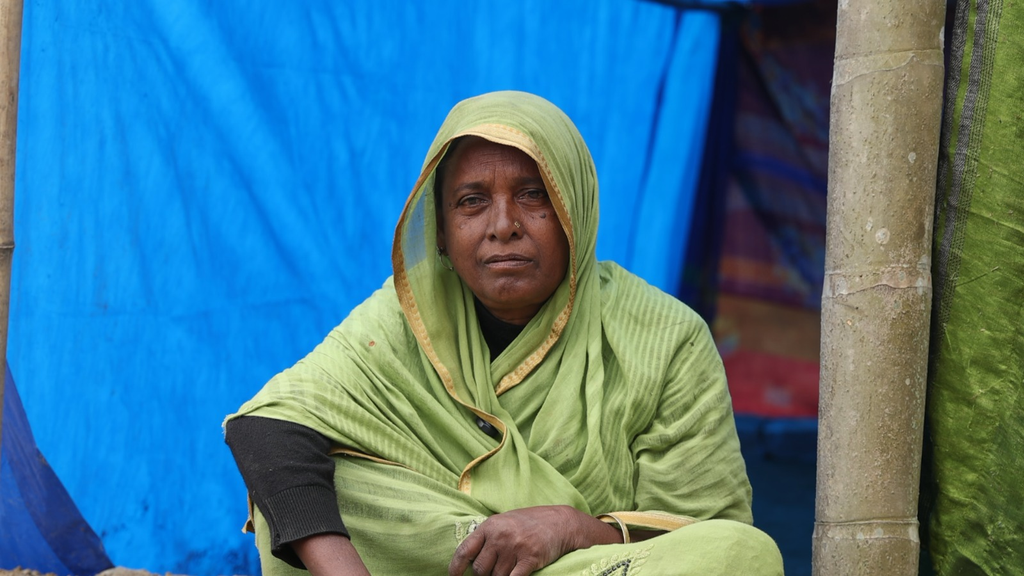
“We live on the bare ground; we sleep on it too. This very soil is now our home,” Shaliha Bibi repeats, and by now, the tear-filled eyes have started to shed tears.
“We are poor people. What are we supposed to do? Where are we supposed to go?” she adds.
“They demolished our homes because we are Muslims,” Shaliha Bibi says.
Meantime, on November 9, Chief Minister Himanta Biswa Sarma denied that the evictions were driven by religious considerations, despite media reports and videos circulating online indicating that Muslims formed the majority of those affected by the demolition drive.
“I don’t even have plastic.”
According to data from Assam’s Revenue and Disaster Management Department and district authorities, compiled by Scroll, nearly 19,000 families, most of them Muslim, have been evicted from government land in the state over the past decade of BJP rule.
A few steps away from her is Robail Haq; he too has the same type of makeshift hut, with the only difference being in the color of the thin plastic—black.
“My wife and I were both ill when our house was demolished,” Haq says, speaking to FoEJ Media, with a medical prescription in his hand.
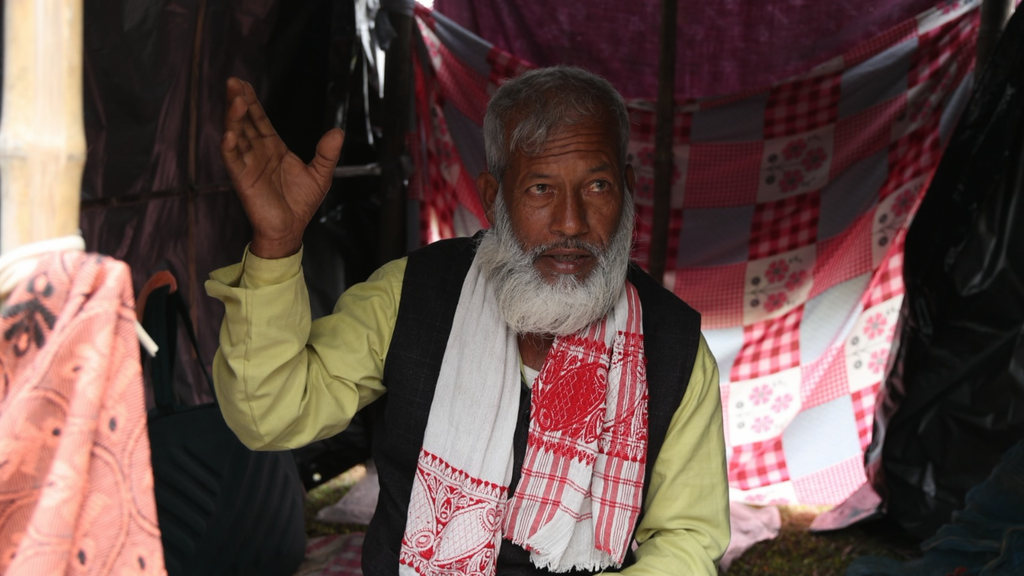
“I was suffering from severe abdominal pain. The doctor told me I had gallstones, but the treatment would cost at least ₹40,000. Where am I supposed to get that kind of money? Now, I don’t even have a home,” he adds.
“We have nothing to eat, nothing at all. We don’t even have a tarpaulin or a plastic sheet. All we have is this small piece of plastic, which we have used to put together this makeshift shelter,” Haq says.
“We don’t even have a single blanket to cover ourselves. In this condition, will a person live or die?” he says, withering in pain.
“Our condition is very bad,” Haq adds with a voice full of grief and sorrow.
In the same vicinity stands Alam Sheikh; however, behind him is not a makeshift hut but wrecked debris and rubble. “I come here and sit here,” he says, on speaking to FoEJ Media, pointing towards the debris.
“We used to work all day long. Why? To build a house and educate our children. But when we finally built a house, it was demolished,” Sheikh says.
“Where do we go now? Where are we supposed to go?” He adds, “Alam Sheikh’s eyes do not have tears, his voice does not talk about sorrow, but his face is drenched in pain.”
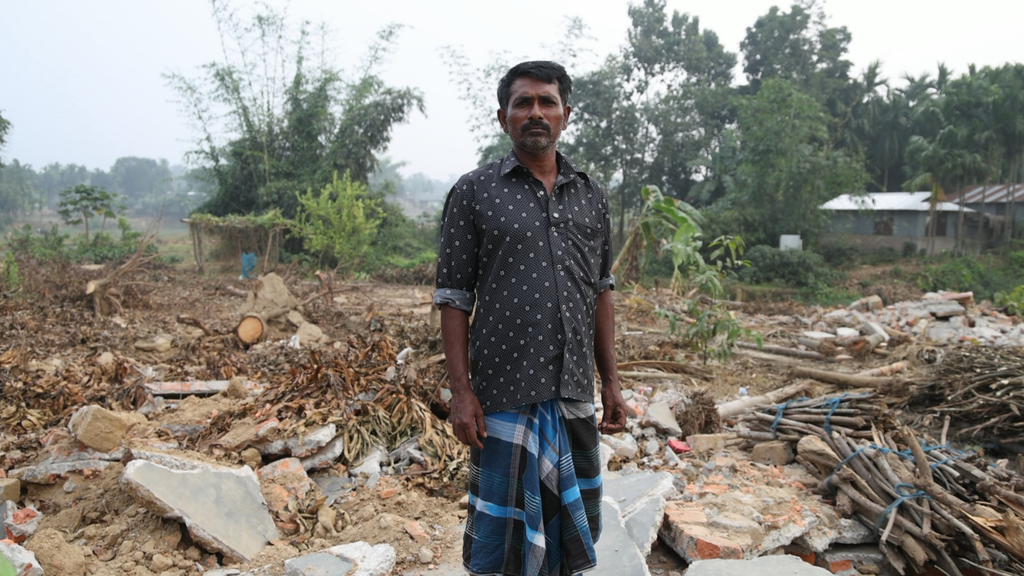
“I was born here, my elder brother was born here, and my father lived here. Where am I supposed to go now?” he says
“We have been living here for 70 years,” Sheikh claims.
“I don’t even have anywhere to go. Even if I leave, where am I supposed to go? ”, he asks.
When asked about the time period he was given to vacate his house, he said, “They gave us notice just two days earlier and then demolished our homes.”