



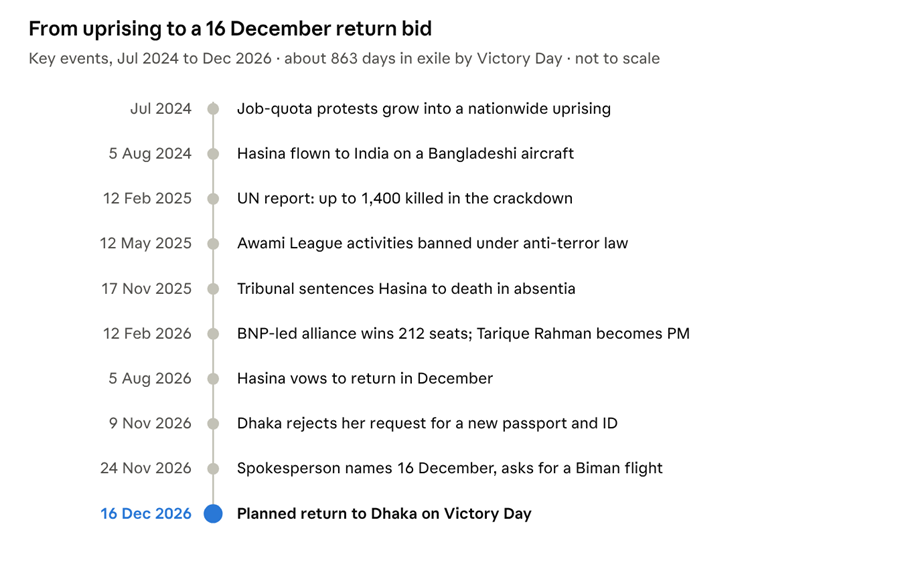
Sheikh Hasina, who governed Bangladesh for 15 years until a student-led uprising drove her into exile, says she will fly home from New Delhi on 16 December, the country’s Victory Day. The plan, made public through her spokesperson on Tuesday, sets her on a collision course with Prime Minister Tarique Rahman’s government, which has said she will be arrested the moment she lands.
It is the first time Hasina has named an exact date. At a press event in New Delhi on 5 August, the second anniversary of her fall, she said only that she would return in December, which she called Bangladesh’s “victory month”, and acknowledged she might be jailed.
What she is asking for
In a statement to Reuters, spokesperson Syed Mozammel Ali said Hasina wants the government to arrange her flight on Biman Bangladesh Airlines, the state carrier. The reasoning is pointed: she left on 5 August 2024 aboard a Bangladeshi aircraft, so, her camp argues, the state should bring her back the same way. Her side calls the exile unconstitutional and says enabling her return on Victory Day is the government’s responsibility.
The request is also about paperwork. Her passport and national ID card were cancelled months after she fled. Earlier this month, her lawyers at London’s Matrix Chambers wrote to Bangladesh’s mission in New Delhi seeking new documents. The government rejected the request within hours, with State Minister for Foreign Affairs Humaiun Kobir calling it absurd and saying Bangladesh does not issue passports to a “fugitive convict”.
Why 16 December matters
On 16 December 1971, Pakistani forces surrendered in Dhaka, ending the nine-month Liberation War and sealing Bangladesh’s independence. The movement was led by Hasina’s father, Sheikh Mujibur Rahman, known as Bangabandhu, the country’s founding leader. Picking that date casts her return as a patriotic homecoming rather than a convict’s surrender. Her aide Abu Obaidha Arin told the Associated Press the choice was deeply symbolic and that he was confident she would spend the day among her supporters.
By 16 December, Hasina will have spent about 863 days, nearly two years and five months, in India.
The verdict waiting for her
On 17 November 2025, Bangladesh’s International Crimes Tribunal, a domestic court despite its name, convicted Hasina in absentia of crimes against humanity over the 2024 crackdown and sentenced her to death. Former home minister Asaduzzaman Khan Kamal received the same sentence. Former police chief Chowdhury Abdullah Al-Mamun, who turned state witness, was jailed for five years. The judges found the attacks on protesters were widespread, systematic and aimed at civilians.
Hasina rejects the verdict as biased and politically motivated. An appeal to the Supreme Court is possible in principle, but her lawyer said at the time that she could not appeal without first surrendering, which is effectively what landing in Dhaka would mean.
The case draws heavily on what happened in July and August 2024. A UN human rights fact-finding report released in February 2025 estimated that as many as 1,400 people were killed between 1 July and 15 August, most of them shot by security forces, and that 12 to 13 per cent of the dead were children. Bangladesh Police reported 44 of its own officers killed, and more than 11,700 people were arrested. The protests began over a job-quota system and grew into a nationwide demand for Hasina’s resignation.
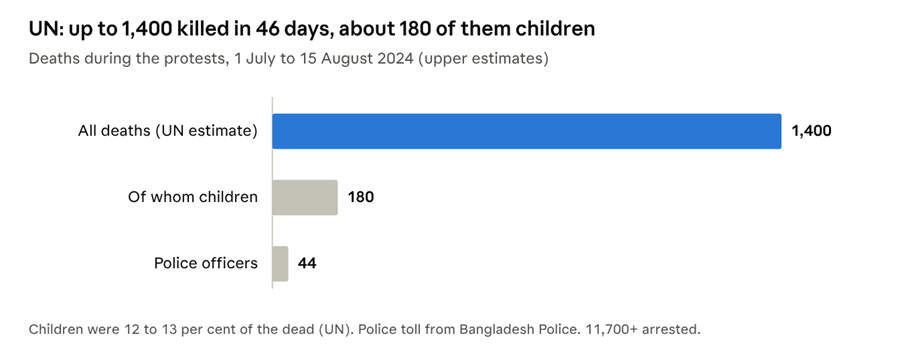
UN OHCHR fact-finding report, 12 Feb 2025; children figure via BenarNews; police figure from Bangladesh Police via the UN
Dhaka’s answer: arrest, not a welcome
The government’s reply came within hours. Kobir said a “terrorist” would never be allowed back except through extradition, and that Hasina would come home under tight custody or surveillance, not as an ordinary passenger. A day earlier, a minister said she would be arrested and jailed on arrival and that there had been no official talks with New Delhi about any journey.
Dhaka’s chosen route is extradition under the two countries’ existing treaty. Bangladesh first asked India in December 2024, sent a formal request days after the November 2025 verdict, and renewed it at talks in New Delhi in April 2026. Law Minister Md Asaduzzaman said on 14 November that every legal step had been completed and the decision now rests with India.
A political map redrawn without the Awami League
Hasina would return to a very different country. In May 2025, the interim government led by Muhammad Yunus banned all activities of the Awami League under an amended Anti-Terrorism Act until the tribunal finished trying the party and its leaders. The Election Commission then suspended the party’s registration. The Awami League called the ban illegal and unconstitutional.
That kept the party which led the independence struggle off the ballot in the 12 February 2026 election. The BNP-led alliance won 212 seats, a two-thirds majority, while the Jamaat-e-Islami-led alliance won 77, with Jamaat itself taking a record 68. Tarique Rahman was sworn in as prime minister, returning the BNP to power after nearly two decades.
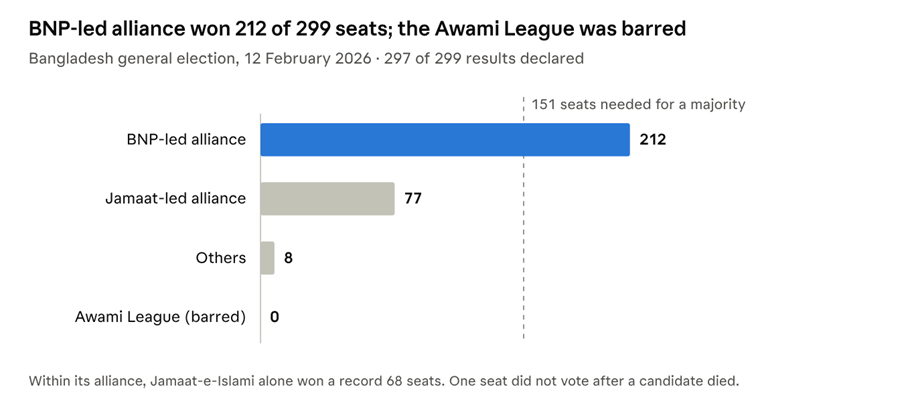
Bangladesh Election Commission figures via Al Jazeera, Gulf Times and NPR · 13th general election, 12 Feb 2026
Streets already on edge
The announcement lands in a volatile week. In Gopalganj, Hasina’s home district, suspected Awami League supporters set fire to a police station and vehicles on 17 November, and the homes of BNP lawmakers there were torched. The banned party called a nationwide lockdown on 19 November. Two local BNP leaders were killed when a BNP march was attacked in Narail, the ancestral home of Muhammad Yunus in Chattogram was set ablaze, and police reported 107 arrests in two days. Home Minister Salahuddin Ahmed accused Awami League leaders abroad of inciting the violence, while Prime Minister Rahman urged supporters to confront the party politically. Days later, nearly 30 houses of Awami League leaders were torched after two BNP men were killed, The New Indian Express reported.
Since Tuesday’s announcement, law enforcers have blamed the Awami League for fresh sabotage and detained dozens of activists.
India’s silence
New Delhi has acknowledged receiving Dhaka’s extradition requests and has said it is examining them, but it has announced no decision. After Hasina’s August press event, India’s foreign ministry said it had no role in it and that she was not permitted to conduct political activity against another country from Indian soil. India has not publicly responded to the 16 December plan. Without a passport, a Biman seat or Indian facilitation, it remains unclear how she would actually travel.