



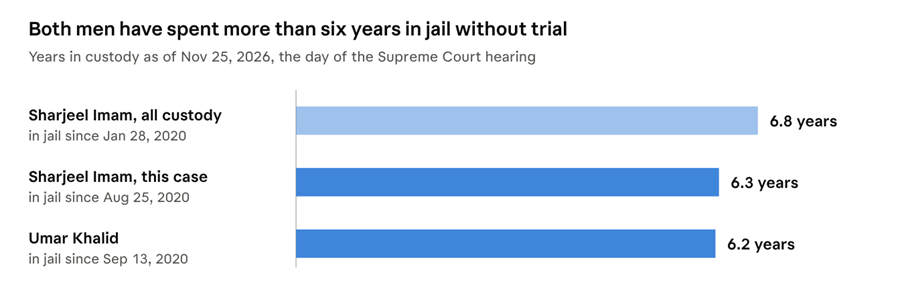
On Wednesday, November 25, the Supreme Court is listed to hear fresh bail pleas from Umar Khalid and Sharjeel Imam. Both have been in jail for more than six years without trial in the UAPA case over the alleged “larger conspiracy” behind the February 2020 northeast Delhi riots. Going by the cause list, Chief Justice Surya Kant and Justices Joymalya Bagchi and V Mohana are likely to take up the matter. Their earlier Supreme Court round, decided in January, went before a two-judge bench.
The two are appealing the Delhi High Court’s September 30 order refusing them bail. Their case rests on two points:
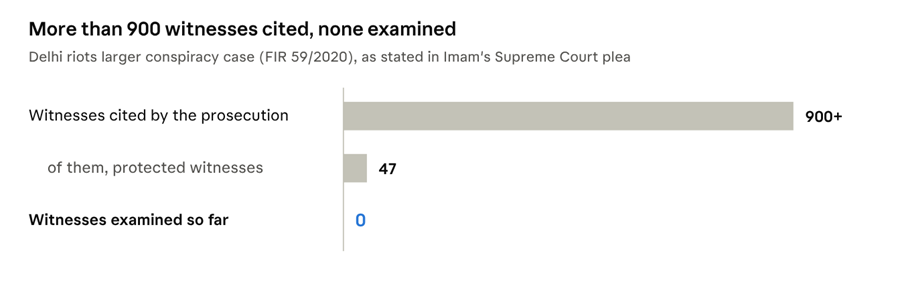
- No witness examined. The prosecution has cited more than 900 witnesses, 47 of them protected, and the trial has not begun. Imam says that after six years and nine months as an undertrial, not a single witness has been examined.
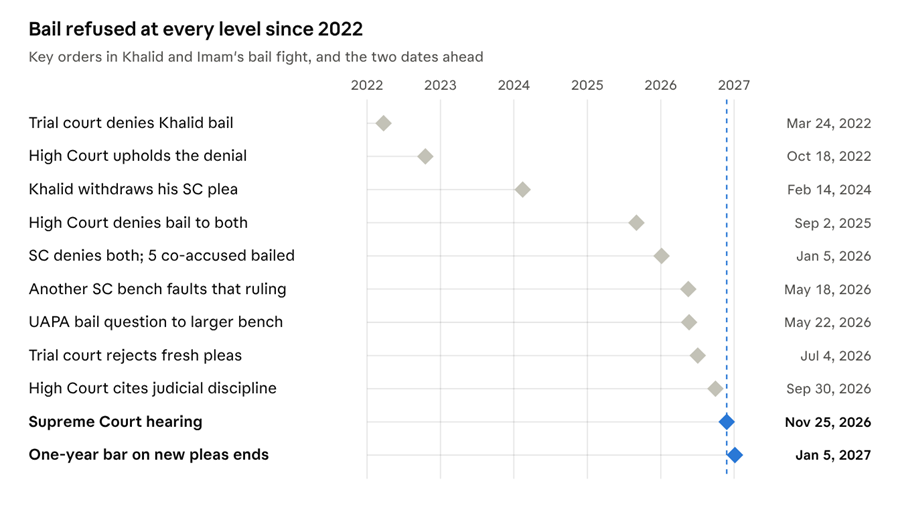
- The one-year bar is nearly over. On January 5, the Supreme Court told them they could apply for bail again only after the protected witnesses were examined or after one year, whichever came first. That year ends on January 5, 2027, 41 days after Wednesday’s hearing. Khalid argues that holding him once the bar lapses would breach his right to life and liberty under Article 21.
The composition of the bench has drawn attention. Chief Justice Kant sat on the three-judge bench that decided Union of India v. K.A. Najeeb (2021). That ruling held that long incarceration can justify bail even under the UAPA. Over 100 activists, writers and academics have since written to him, citing Najeeb.
Six years behind bars
Arrest dates: Delhi High Court order of Sept 30, 2026, PTI and Amnesty International · years counted to Nov 25, 2026
Imam was in custody before this case began. He was detained on January 28, 2020 over speeches made during the anti-CAA protests, and was arrested in the conspiracy case on August 25, 2020. Khalid was arrested on September 13, 2020. In September 2026 a Delhi court allowed Imam seven days of interim bail to attend a cousin’s wedding.
The case: a trial that has not started
The riots of February 24 to 26, 2020 left 53 people dead and more than 700 injured. They broke out during protests against the Citizenship (Amendment) Act, 2019 and the proposed National Register of Citizens. The Delhi Police Special Cell says Khalid and Imam were among the masterminds of a planned conspiracy behind the violence. It has booked them under the UAPA in FIR 59/2020, alongside activist Khalid Saifi, former AAP councillor Tahir Hussain and others: 18 accused in all.
Imam’s Supreme Court petition, as reported by PTI/Siasat, Nov 2026
The first chargesheet was filed in September 2020, and the police have since filed five voluminous chargesheets. Six years on, the case has not reached trial. In 2025, ThePrint counted more than 500 hearing dates and over 160 adjournments in the case. The trial court is still hearing arguments on whether charges should be framed. The Delhi High Court lifted a 2024 stay on that order only in June 2026.
Who caused the delay is disputed. Trial courts have accepted the prosecution’s view that accused persons’ own applications slowed the framing of charges. The defence says the case rests on delayed statements from protected witnesses, with no physical evidence. Khalid’s lawyer has called it a “joke of an FIR”.
Refused at every level
Court orders as reported by SC Observer, LiveLaw, ThePrint and the Delhi High Court · 2022 to Jan 2027
The January 5 ruling is the order every court since has leaned on. A bench of Justices Aravind Kumar and N V Anjaria found a prima facie case against both men under the UAPA. That triggered the statutory bar on bail in Section 43D(5). The bench said the two stood on a “qualitatively different footing” from the other accused. It described them as the “ideological drivers” of the alleged conspiracy and rejected their plea that delay alone entitled them to bail.
Since then, the lower courts have declined to look at the evidence afresh. On July 4, a Karkardooma trial court said it had “no option but to follow” the Supreme Court and dismissed their third round of bail pleas. On September 30, a High Court bench of Justices Prathiba M Singh and Dinesh Bhatt held that it was “bound by judicial discipline” and could not modify the conditions set in January.
Co-accused walked out, these two did not
At least 11 others accused in the same FIR have been released, most of them in 2026. The courts drew the line at role, not at time spent in jail. The Supreme Court said the grant of bail to the five in January was “not a dilution of the allegations” and spoke of a “hierarchy of participation”.
| Accused | Relief | Court | When |
| Umar Khalid, Sharjeel Imam | None, still in jail | Supreme Court denied | Jan 5, 2026 |
| Abdul Khalid Saifi, Tasleem Ahmed | Six-month interim bail on 11 conditions | Supreme Court | May 22, 2026 |
| Gulfisha Fatima, Meeran Haider, Shifa-ur-Rehman, Mohd Saleem Khan, Shadab Ahmed | Regular bail, strict conditions | Supreme Court | Jan 5, 2026 |
| Natasha Narwal, Devangana Kalita, Asif Iqbal Tanha | Regular bail | Delhi High Court | June 2021 |
| Safoora Zargar | Bail on humanitarian grounds (pregnant at arrest) | Delhi High Court | June 2020 |
The interim bail granted to Saifi and Ahmed ran for six months from May 22, which would end around November 22. Whether it has been extended could not be confirmed at the time of writing.
A split inside the Supreme Court
The deeper fight is about how far long jail time can override the UAPA’s bar on bail, and the Supreme Court itself is divided on it.
- Najeeb (2021). A three-judge bench held that the UAPA’s bail conditions “melt down” when an undertrial has spent a long time in jail with no trial in sight.
- Gulfisha Fatima (January 2026). The two-judge bench that ruled on Khalid and Imam held that delay alone was not enough to override the statutory bar.
- Andrabi (May 18, 2026). Justices B V Nagarathna and Ujjal Bhuyan voiced serious reservations about the January judgment. They said it had not properly followed Najeeb, a ruling by a larger bench. They also objected to the order barring fresh bail pleas for a year, and restated that “bail is the rule” even under the UAPA.
- The reference (May 22, 2026). Four days later, Justices Aravind Kumar and P B Varale sent the question to a larger bench. They also defended the January ruling. The Delhi Police had sought the reference.