



A Delhi court on Monday issued a non-bailable warrant (NBW) against YouTuber Dhruv Rathee in an eight-year-old criminal defamation case, the sharpest step yet in a case that has moved from summons to arrest warrant in just six weeks.
Judicial Magistrate First Class Anam Rais Khan of the Saket Courts, sitting as duty magistrate, passed the order on November 23 and listed the matter for December 3, 2026. The complaint was filed in 2018 by Vikas Sankrityayan, also known as Vikas Pandey, who runs the Facebook page ‘I Support Narendra Modi’. He says Rathee’s YouTube video BJP IT Cell Part II made false claims that damaged his reputation.
The warrant came after two rounds of bailable warrants could not be executed. According to reports of the hearing, neither Rathee nor a lawyer for him appeared, and the complainant’s counsel told the court that Rathee had left India and was living abroad. Rathee is based in Germany. No public response from him to Monday’s order had been reported at the time of writing.
Six weeks of escalation
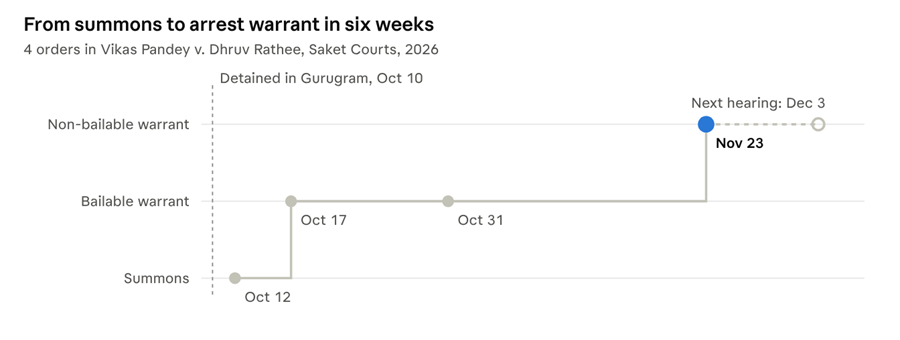
Court orders as reported by LiveLaw, LawChakra, LawBeat and Law Trend, Oct 12 – Nov 23, 2026
Two days after Rathee’s detention, on October 12, the court ordered fresh summons to his Gurugram address, noting he was then in India. When a process server found the house locked, Judicial Magistrate Rahul Jain issued bailable warrants on October 17 and again on October 31. Monday’s order raised that to a non-bailable warrant.
The 2018 video at the heart of the case
The complaint, registered as Ct. Cases 5786/2018, concerns a video Rathee uploaded in May 2018. In it, he called Sankrityayan the alleged second-in-command of the BJP IT Cell and claimed he offered Rs 50 lakh to one Mahavir Prasad to withdraw allegations against the party. Sankrityayan, a self-described BJP volunteer, says the claims are false.
The same video pulled in Arvind Kejriwal, then Delhi Chief Minister, who retweeted it. Sankrityayan sued him as well. In February 2024 the Delhi High Court refused to quash the summons, holding that reposting libellous content can attract defamation law. Weeks later, on February 26, 2024, Kejriwal told the Supreme Court through senior advocate Abhishek Manu Singhvi that he “made a mistake by retweeting” the video.
Rathee has made no such concession. For years, the complainant said, service of summons stalled because Rathee lives abroad.
October: protests, then a dawn detention
Rathee flew in from Germany in early October to join the Cockroach Janta Party’s campaign against Chief Election Commissioner Gyanesh Kumar over alleged irregularities in the Special Intensive Revision (SIR) of electoral rolls. The CJP began as a satirical youth movement in mid-2026, after a Supreme Court judge’s remark likening India’s youth to “cockroaches”. Rathee joined its protest at Bengaluru’s Freedom Park on October 8.
On October 10, the morning of the planned ‘Jantar Mantar 2.0’ rally, Delhi Police detained him at his home in Gurugram’s Sector 56. Police had refused permission for the protest, and reports put the deployment in the capital at more than 20,000 police and central forces. The CJP said at least 150 protesters were also detained on their way.
Gurugram Police sources said Rathee was released at about 3 am on October 11, after being advised not to join the protest. Police warned he could be detained again, or face legal action, if he headed to Jantar Mantar despite prohibitory orders.
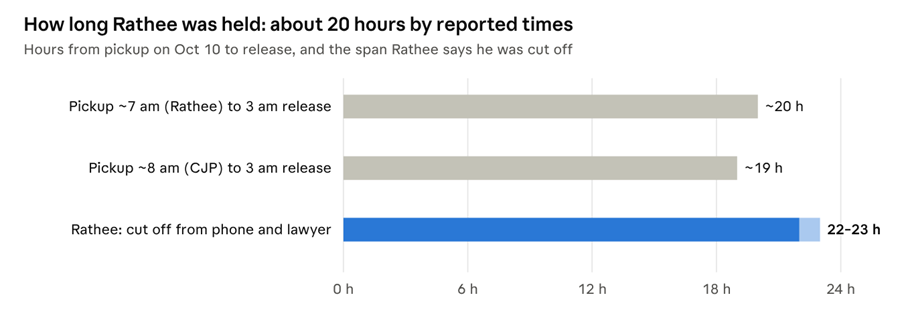
Pickup times from Rathee’s video and the CJP’s post on X; release time from Gurugram Police sources via IANS, Oct 10–11, 2026
The two pickup times reported, about 7 am and about 8 am, put his time in custody at 19 to 20 hours. Rathee says he was cut off from his phone and lawyer for 22 to 23 hours; he has not said how that period was counted.
“I was kidnapped”: Rathee’s account
Hours after his release, Rathee posted a video on X disputing the police version. “I was not arrested or detained, I was KIDNAPPED,” he wrote. He said about 20 people in plain clothes entered his home around 7 am while he slept, took him away before he could ask who they were, and injured him as they pulled him from his bedroom. He said he was moved between police stations and kept from his lawyer and phone for 22 to 23 hours.
These are Rathee’s allegations; police have not publicly answered them in detail. The CJP’s own account at the time put the visit at about 8 am, with roughly 50 personnel in civilian clothes.
Rathee also held up his Indian passport to answer claims, circulated by right-wing accounts, that he is a German citizen with no right to protest in India. “Here is my passport. I am, was and will remain an Indian citizen,” he said, calling the foreign-passport claims “outright lies”. He thanked supporters and called the action an attempt to silence him.
What a non-bailable warrant means
A warrant is a tool to secure a person’s presence in court, not a finding on the complaint. A bailable warrant lets the person be released on furnishing the bail it specifies. A non-bailable warrant directs police to arrest and produce the person, and release then depends on the court.
Whether Rathee or his lawyers appear on December 3, and whether they seek to have the warrant cancelled, will set the case’s next course. Kejriwal’s part of the case remains on hold before the Supreme Court, which had told the trial court not to proceed against him until further orders.