



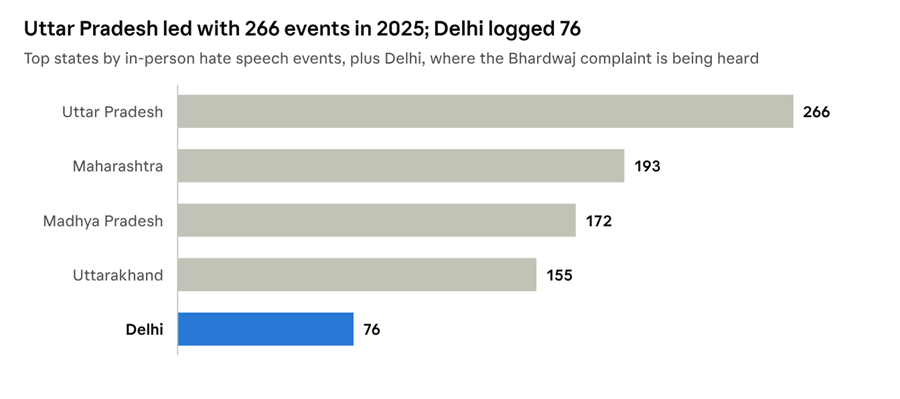
A Patiala House Court magistrate has asked Delhi Police to explain what it has done about an RTI activist’s complaint accusing the 21-year-old influencer of repeatedly posting anti-Muslim content online. The case returns to court on January 8, 2027.
The order
A Delhi court on Monday, November 23, directed Delhi Police to file an action-taken report (ATR) on a criminal complaint against Hindutva social media influencer Swatantra Bhardwaj. The complaint, filed by an RTI activist at the Patiala House Court, alleges that Bhardwaj has repeatedly published and circulated posts, videos and comments across social media platforms that carry disparaging references to Muslims and their religious practices.
Arguing for the complainant, counsel told the court that the content insults religious sentiments, risks promoting communal hatred and threatens public peace and communal harmony. Counsel also said the complainant had already exhausted every avenue of bringing the matter to the police’s attention, without result.
After hearing the counsel, Judicial Magistrate Kautuk Bhardwaj sought the ATR from Delhi Police and listed the matter for further proceedings on January 8. (The magistrate is not related to the accused.)
The plea also asks the court to order the preservation of relevant digital evidence, a significant request, since social media posts can be edited, deleted or made private while a case is pending.
What the complaint alleges
The complainant has asked the court to take cognisance of offences under the Information Technology (IT) Act and the following sections of the Bharatiya Nyaya Sanhita (BNS), the criminal code that replaced the Indian Penal Code in July 2024:
| BNS section | Offence | Old IPC equivalent | Maximum jail term |
| 196 | Promoting enmity between groups on grounds of religion, race, language, etc. | 153A | 3 years (5 if in a place of worship) |
| 299 | Deliberate, malicious acts intended to outrage religious feelings | 295A | 3 years |
| 353 | Statements conducing to public mischief | 505 | 3 years |
| 351 | Criminal intimidation | 506 | 2 years (up to 7 for serious threats) |
| 352 | Intentional insult to provoke breach of peace | 504 | 2 years |
These are allegations in a complaint. No court has yet found that an offence was committed, and no FIR has been ordered in this matter.
What an ATR means, and what comes next
When police do not register an FIR on a complaint that alleges a cognisable offence, a complainant can approach a magistrate under Section 175(3) of the Bharatiya Nagarik Suraksha Sanhita (BNSS), which replaced Section 156(3) of the old CrPC. The BNSS added safeguards: the complainant must first have approached the Superintendent of Police (or equivalent senior officer), must file a sworn affidavit, and the magistrate must consider the police’s side before directing an investigation.
An ATR is that police response. Once it is filed, the magistrate can:
- Direct the police to register an FIR and investigate, if the complaint discloses a cognisable offence;
- Treat the plea as a private complaint, record the complainant’s evidence and decide whether to summon the accused; or
- Decline to act, if no offence is made out.
The Supreme Court has held that once a complaint’s facts disclose a cognisable offence, a magistrate can direct the police to register an FIR, but courts have also said this is a matter of judicial discretion, not an automatic outcome.
Who is Swatantra Bhardwaj
Bhardwaj, 21, is a student from Patna who calls himself a “Sanatani Yodha”. He has built a following of roughly 1.87 lakh on Instagram and over 3.2 lakh on Facebook, posting videos on religion, gender, reservation and Hindutva politics, and photos with BJP leaders.
He rose to national attention in September 2026 over a separate case: the alleged assault of Sanjay Azad, a Dalit man and father of teenage Cockroach Janta Party (CJP) activist Nishu Azad, during a CJP protest at Jantar Mantar on June 23. A podcast clip in which Bhardwaj appeared to boast about the attack went viral; he later denied making the remarks, called the clip fake and said he had acted in self-defence.
Timeline of legal action against Bhardwaj
| Date (2026) | Development |
| June 23 | Sanjay Azad allegedly assaulted at a CJP protest at Jantar Mantar |
| Early Sept | Viral podcast clip; CJP protests outside Parliament Street police station; opposition leaders question lack of action |
| Sept 4–5 | Detained in Bulandshahr, UP; arrested by Delhi Police Crime Branch and sent to one-day police custody |
| Sept 6 | Indian Youth Congress files a separate complaint over alleged anti-Muslim remarks and remarks on Mahatma Gandhi in a podcast |
| Sept 7 | Delhi High Court rejects habeas corpus plea; trial court sends him to judicial custody. SC/ST Act and POCSO provisions are added in the assault case |
| Sept 15 | Granted three weeks’ interim bail; court bars him from discussing the case on social media or contacting the complainant, and flags gaps in the police probe |
| Later | Interim bail made regular; court declines plea to confine him to Delhi-NCR |
| Nov 23 | Magistrate seeks ATR on RTI activist’s hate-speech complaint; next hearing January 8 |
While granting interim bail in September, the court remarked that social media had become a new medium of intimidation, and that bail was a sign of the court’s trust rather than a trophy to be shown off.
The bigger picture: hate speech in numbers
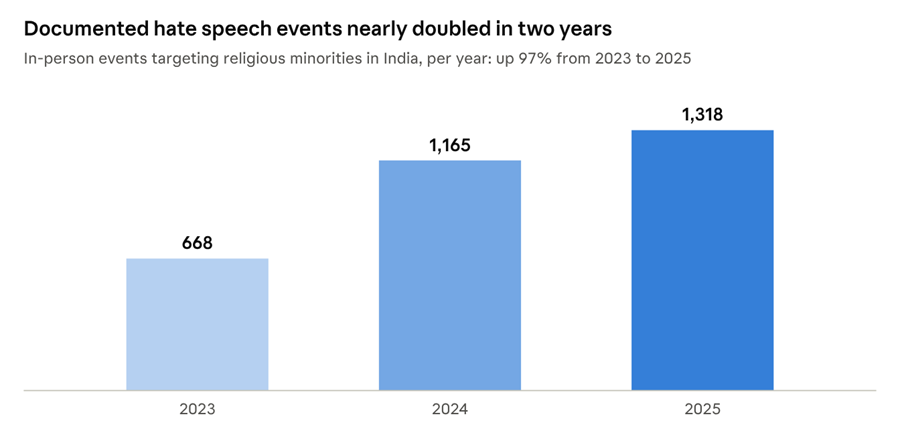
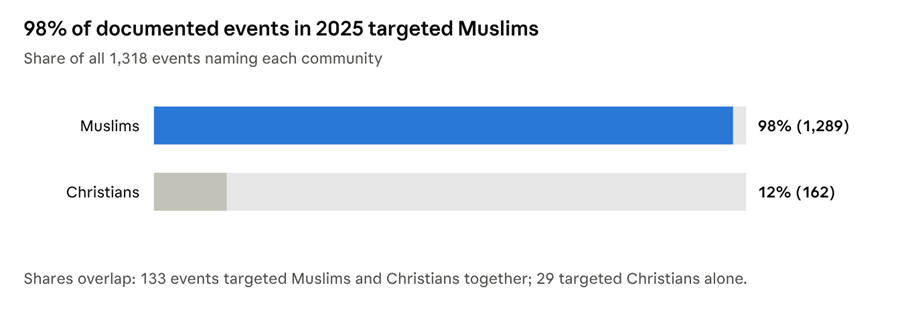
The complaint lands amid a sustained rise in documented hate speech in India. The India Hate Lab (IHL), a project of the Washington DC-based Center for the Study of Organized Hate, recorded 1,318 in-person hate speech events targeting religious minorities in 2025 — an average of nearly four a day, up 13% from 2024 and 97% from 2023.
Source: India Hate Lab / CSOH, Hate Speech Events in India 2025 (Jan 2026)
Source: India Hate Lab / CSOH, Hate Speech Events in India 2025 (Jan 2026)
Source: India Hate Lab / CSOH, Hate Speech Events in India 2025 (Jan 2026)
Social media is central to how this content travels. Of the 1,318 events in 2025, 1,278, about 97%, were first shared or live-streamed online, with Facebook alone hosting 942 first uploads. The report also found that calls for violence rose 19% over 2024, and that April 2025, the month of the Pahalgam terror attack and Ram Navami processions, saw the highest monthly spike, with 158 events.
The IHL counts only in-person events. Purely online content of the kind alleged in the Bhardwaj complaint falls outside its tally, which suggests the full volume of online hate speech is larger.
Official crime data tells a related story. Cases under IPC Section 153A, now BNS Section 196, one of the sections invoked against Bhardwaj, rose from 323 in 2014 to 1,804 in 2020, according to National Crime Records Bureau figures, and stood above 1,500 in 2022.
A parallel case in the same court
The same Patiala House Court complex is also hearing a mirror-image complaint. Supreme Court advocate Amita Sachdeva has sought an FIR against Nishu Azad and her father over four posts on X, published between September 2023 and August 2026, that allegedly insult Hindu deities. Chief Judicial Magistrate Mridul Gupta has likewise sought an ATR from Delhi Police in that case, which is listed for January 2027. That complaint is separate from the assault case