



On Friday, 13 November 2026, the Union Home Ministry renewed its ban on the Islamic Research Foundation (IRF) for five more years. The IRF was founded by preacher Zakir Naik, who has lived abroad since 2016. This is the third five-year ban in a row, and it keeps the group outlawed into late 2031.
The ministry acted under Sections 3(1) and 3(3) of the Unlawful Activities (Prevention) Act (UAPA), 1967. The previous ban was due to lapse on 14 November 2026, one day after the new notification. Section 3(3) let the government make the order effective immediately, so there is no gap between the old and new bans.
| Item | Detail |
| Organisation | Islamic Research Foundation (IRF), Mumbai |
| Founder and president | Zakir Abdul Karim Naik |
| Order issued by | Ministry of Home Affairs, gazette notification |
| Date | 13 November 2026 |
| Legal basis | UAPA 1967, Sections 3(1) and 3(3) |
| Duration | 5 years from gazette publication |
| Took effect | Immediately |
| Previous ban lapsed | 14 November 2026 |
| Next step | Review by a UAPA Tribunal (Section 4) |
What the government alleges
The notification rests on six claims, almost all centred on Naik’s speeches rather than on specific acts by the IRF as an institution. These are the government’s allegations; none has been proven in a criminal trial.
| # | Allegation | Type |
| 1 | IRF members, especially Naik, encouraged followers to promote enmity between religious communities | Communal |
| 2 | Naik made “objectionable and subversive” statements and speeches | Speech |
| 3 | His speeches inspired young people of one religion, in India and abroad, to commit terrorist acts | Terror |
| 4 | He reached millions worldwide through satellite TV, the internet, print and social media | Reach |
| 5 | If not curbed, the IRF could regroup absconding members and spread anti-national feeling | Future risk |
| 6 | It could fuel secessionism by backing militancy and threaten India’s sovereignty | Future risk |
Two of the six (rows 5 and 6) describe what the IRF might do, not what it has done. That forward-looking test is built into Section 3 of UAPA, which lets the Centre ban a group it believes is engaged in, or likely to engage in, unlawful activity.
A decade under ban
The IRF has been an unlawful association without interruption since 17 November 2016. Each ban was confirmed by a UAPA tribunal within about six months, and the new one will go through the same review. The chart counts to the date each tribunal order was published in the gazette; the orders themselves were passed on 11 May 2017 and 9 March 2022.
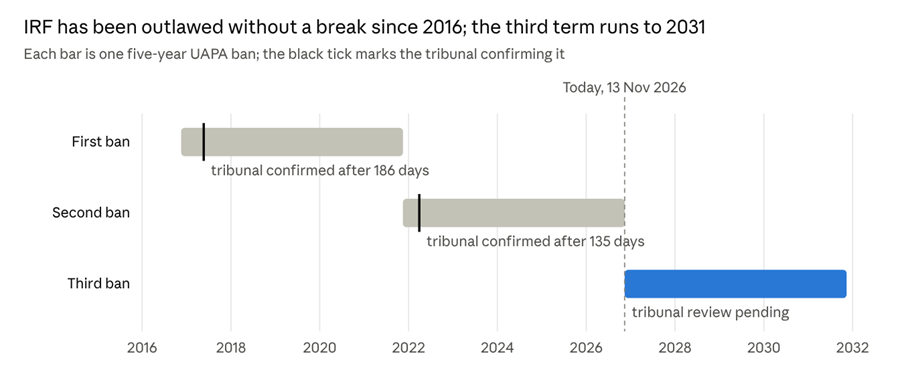
Notification and tribunal dates from the MHA gazette notification as reported by ANI, 13 Nov 2026; third-term end date approximate (five years from gazette publication)
| Date | Event |
| 13 Nov 2026 | Centre issues third five-year ban, effective immediately |
| 3 Nov 2026 | Malaysia tells its Parliament it has decided not to extradite Naik |
| 12 Sep 2026 | Malaysian PM Anwar Ibrahim confirms Naik was discussed with PM Modi at the BRICS summit in New Delhi |
| 30 Mar 2022 | Tribunal confirms the second ban |
| 15 Nov 2021 | Second five-year ban notified |
| 29 May 2020 | India sends Malaysia a diplomatic note asking it to reconsider |
| 19 Jan 2018 | India files its formal extradition request with Malaysia |
| 22 May 2017 | Tribunal confirms the first ban |
| 17 Nov 2016 | First ban notified under UAPA |
| Jul 2016 | Dhaka café attack (29 dead); Naik leaves India as cases against him are opened |
How a UAPA ban works
A ban under UAPA starts with the government, not a court, and a judge reviews it only afterwards. Because the Centre invoked Section 3(3), the IRF is outlawed from today, before any tribunal has looked at the evidence.
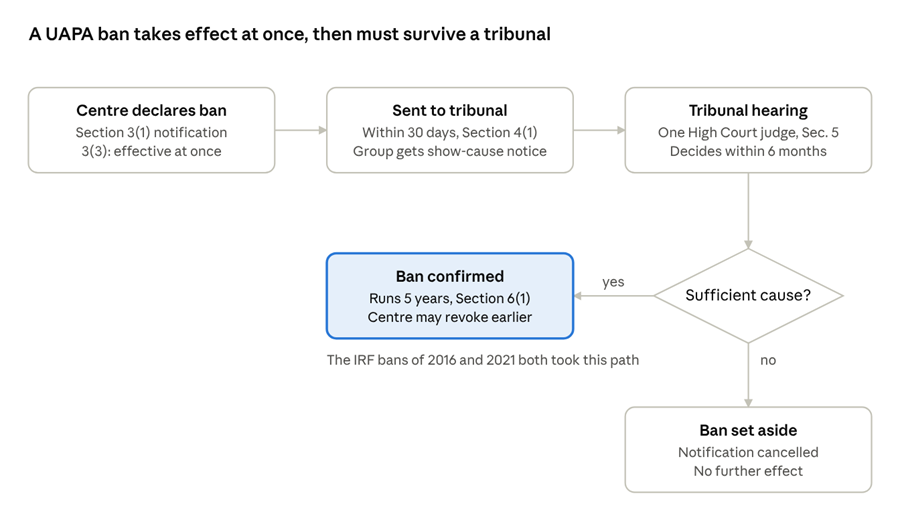
UAPA 1967, Sections 3 to 6 · how a ban is declared and reviewed
A 2013 amendment to UAPA raised the life of a ban from two years to five, which is why each IRF term runs five years. Once a ban stands, the law gives the state wide powers over the group:
| Provision | What it allows |
| Section 7 | Centre can bar the group from using its funds and order them held |
| Section 8 | Places used by the group can be notified, sealed and their contents seized |
| Section 10 | Being or staying a member is a crime, punishable by up to 2 years in jail and a fine |
| Section 13 | Taking part in or advocating the group’s unlawful activity is punishable by up to 7 years |
The IRF’s earlier challenge went beyond the tribunal: the Delhi High Court dismissed its plea against the first ban, holding the Centre’s order was not arbitrary.
Zakir Naik: where his cases stand
Naik has lived in Malaysia as a permanent resident since 2016, and Malaysia said on 3 November 2026 that it has decided not to send him back. That leaves India’s cases against him, and the IRF ban, without any prospect of a trial in India for now.
Indian agencies opened cases against him after the July 2016 Dhaka café attack, in which 29 people died. He is wanted on allegations of money laundering and hate speech, and has denied them.
| Track | Status (Nov 2026) |
| Residence | Malaysia, permanent resident since 2016 |
| Indian charges | Money laundering, hate speech, inciting terrorism (alleged) |
| Formal extradition request | Filed by India 19 Jan 2018; reconsideration note 29 May 2020 |
| Malaysia’s answer | Will not extradite, citing Article 6 of the 2010 India–Malaysia treaty and its Extradition Act 1992 |
| New request from India | None received, per Malaysia’s Home Ministry |
| Peace TV | Banned in India; Naik also denied entry to the UK and Canada. |
Malaysia’s treaty clause lets it refuse where a person risks an unfair trial or persecution. Domestic politics matter too: Naik is popular with many Malay Muslims, and the opposition party PAS has warned against handing him over.
Two sides of the case
Courts have so far sided with the government every time the IRF ban has been tested. The IRF’s main argument, made since 2016, is that an entire organisation is being punished for one man’s speeches.
| Question | Government and tribunals | IRF and Naik’s lawyers |
| Why ban the whole group? | Naik founded IRF and could assign its work, so his acts bind it, even though IRF itself is not an accused (2017 tribunal. | It is wrong to outlaw an organisation for the words of one person. |
| Why immediate effect? | Youths arrested in unrelated terror cases said his speeches inspired them, which the Centre called urgent. | No reasons and no show-cause notice were given before the 2016 ban. |
| Is the evidence current? | In 2022, the Solicitor General said Naik kept reaching Indian followers through videos. | The main case against Naik dates to 2012–13, and IRF is not an accused in it. |
| Did IRF defend itself? | The 2017 tribunal said Naik did not take part and was “absconding and untraceable” | Naik’s lawyer called the UAPA case illegal and said IRF would fight it before the tribunal |
Wider criticism of UAPA bans, from civil-liberties lawyers and opposition voices, centres on the same points: the executive acts first, the review comes later, and the evidence placed before tribunals is often sealed. Supporters answer that speed is the point when a group’s reach is global and its leader is outside the country.
A familiar pattern
The IRF is one of several groups the Centre has kept outlawed by renewing bans back to back, and in every case below the ban has stayed in force. Home Minister Shah’s office used the same “zero tolerance” framing when SIMI and Jamaat-e-Islami (J&K) were renewed in 2024.
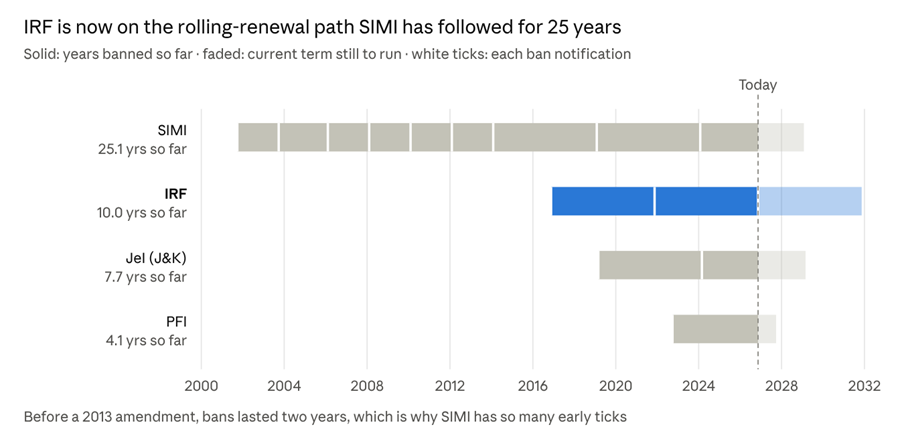
Notification dates from Kerala Kaumudi and The Week (SIMI), WION (JeI J&K), The Tribune (PFI) and ANI (IRF); end dates are five years from the latest notification
SIMI is the longest case: first banned on 27 September 2001 and renewed eight times since. The Supreme Court dismissed a challenge to its 2019 renewal. Jamaat-e-Islami (J&K) was renewed in February 2024. and PFI’s first ban, from September 2022, is due for review in 2027 .


