Sheikh Hasina will be sent to the gallows if she sets foot in Bangladesh, the prosecutor who won her death sentence said on Tuesday, weeks before the ousted prime minister’s promised December homecoming.
“Sheikh Hasina has no option but to face the execution of the verdict,” Md Aminul Islam, chief prosecutor of the International Crimes Tribunal (ICT), told reporters in Dhaka (Al Jazeera). He said the legal road was closed: the statutory window to appeal has lapsed. Since July he has argued that she forfeited that right by not surrendering within 30 days of the November 2025 verdict (Daily Observer).
Hasina, 79, has lived in India since fleeing Dhaka by helicopter on 5 August 2024. She has said repeatedly that she will come back in December. In emailed answers to the Associated Press on 5 November, she said she knew she could be arrested, jailed or killed, and would rather die in her own country than watch from abroad (AP via KSAT).
Islam’s advice to her was blunt: if she truly wants to come home, she should ask Indian authorities to hand her over under the two countries’ extradition treaty.
The verdict: death on one charge, life on the other
On 17 November 2025, International Crimes Tribunal-1 in Dhaka convicted Hasina in absentia of crimes against humanity and sentenced her to death. Her former home minister, Asaduzzaman Khan Kamal, believed to be in India too, received the same sentence. Former police chief Chowdhury Abdullah Al-Mamun, who testified as a state witness, got five years (Dhaka Tribune).
The 453-page judgment, released on 26 November, rests on two charges of three counts each (Dhaka Tribune):
| Charge | What the tribunal found | Sentence |
| 1 — Incitement and failure to restrain | Calling protesters “Razakars” at a 14 July 2024 press conference; telling the Dhaka University vice-chancellor that night that protesters should be hanged; the police killing of student Abu Sayed in Rangpur | Imprisonment for life |
| 2 — Ordering killings | Ordering, in 18 July calls, the use of drones, helicopters and lethal weapons against protesters; six protesters shot dead at Chankharpul, Dhaka, on 5 August; six killed and their bodies burned in Ashulia the same day | Death |
The court also ordered Hasina’s and Kamal’s assets confiscated for distribution to victims. Defence lawyers said at the time that any appeal had to be lodged within 30 days. Hasina, represented by a state-appointed lawyer, rejected the trial outright and called it a “jurisprudential joke”.
The case opened on 1 June 2025 after Hasina ignored summonses to appear. Witnesses included a protester whose face had been badly disfigured by gunfire.
The crackdown in numbers
The death sentence rests on six weeks of state violence. A UN human rights office fact-finding report, published in February 2025 at the interim government’s request, estimated that up to 1,400 people were killed between 1 July and 15 August 2024 — most of them shot by security forces (UN Bangladesh).
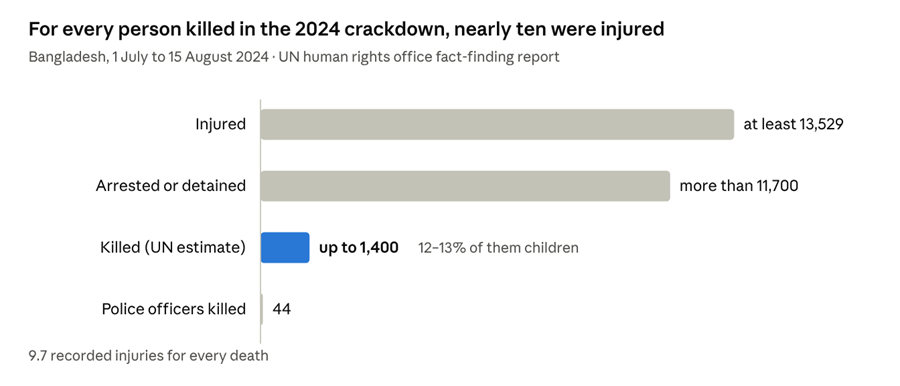
Source: OHCHR fact-finding report, Feb 2025, via UN Bangladesh and The Financial Express; police figure reported by Bangladesh Police
Firearms caused 78% of the deaths, many from military rifles and metal-pellet shotguns; one Dhaka hospital alone treated 736 people for eye injuries (The Financial Express). UN rights chief Volker Türk said there were reasonable grounds to believe the killings, arrests and torture were directed by the political leadership and senior security officials.
The same report also documented revenge attacks after Hasina fell — on Awami League officials and supporters, police, journalists, and Hindu, Ahmadiyya and Indigenous communities.
Fifteen years of growth — and of repression
Hasina’s supporters point to the economy. Under her rule Bangladesh became one of the world’s largest garment exporters, and official World Bank figures show income per person rising from $679 in 2009 to $2,593 in 2024 (World Bank via GeoRank).
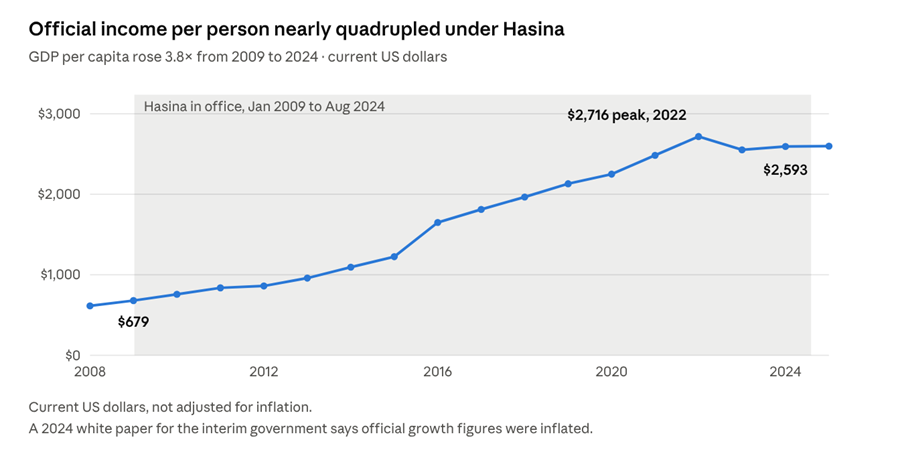
Source: World Bank GDP per capita (current US$), 2008–2025, via GeoRank
Those numbers are now disputed. A white paper commissioned by the interim government and led by economist Debapriya Bhattacharya concluded in December 2024 that growth data had been inflated, and estimated that $234 billion was siphoned out of the country between 2009 and 2023 (The Daily Star; BSS).
The rights record weighs more heavily still. A commission on enforced disappearances classified 1,569 of 1,913 complaints as disappearances, 287 of them in its “missing and dead” category, and found evidence of Hasina’s direct involvement in high-profile cases (Prothom Alo). In her final year in power, Bangladesh ranked 165th of 180 countries on the RSF press freedom index (TBS). Hasina denies wrongdoing.
The India knot
Any return runs through New Delhi, which has sheltered Hasina for more than two years. Dhaka has asked repeatedly for her extradition under the two countries’ 2013 treaty. India says the request is under examination, and officials told The Indian Express in August that the final decision would rest with Indian courts rather than diplomats (bdnews24).
The treaty lets either side refuse a request for an offence “of a political character”. But it expressly excludes murder, use of firearms and incitement to murder from that exception — the core of the charges Hasina was convicted on. Awami League members say they would challenge the verdict in any Indian extradition hearing.
Hasina’s lawyers have now applied at the Bangladesh High Commission in New Delhi for a new passport and national ID card, saying her old documents were revoked. Dhaka has refused. State Minister for Foreign Affairs Humaiun Kobir said the government would instead pursue her handover under the treaty (Al Jazeera). Prosecutor Islam added that the passport authority can deny documents to anyone convicted of serious crimes.
Analysts doubt India will either surrender her or help her go home. A former US deputy chief of mission in Dhaka, Jon Danilowicz, told Al Jazeera there was no chance she would return in December and called the plan a bluff to rally supporters. Zillur Rahman of the Centre for Governance Studies said India was unlikely to abandon an old ally, but equally unlikely to help her rebuild power in Bangladesh.
A test for Tarique Rahman
Hasina’s planned return lands on a government built by her oldest rivals. In the 12 February 2026 election, held with the Awami League barred, Tarique Rahman’s Bangladesh Nationalist Party (BNP) won 209 of 297 seats and Jamaat-e-Islami took 68 (Outlook India). Rahman, son of Hasina’s late rival Khaleda Zia, was sworn in on 17 February.
The Awami League remains banned, its senior leaders jailed or in exile. Hasina alleged to the AP that at least 20,000 party members had been killed since August 2024; Human Rights Watch and other groups have criticised the government over civil and political rights, while officials say every arrest involves specific charges (AP via KSAT).
Violence is already rising ahead of December:
- At least 15 crude bombs exploded in Dhaka between 1 and 7 November, and buses were torched in the capital and other districts. Police arrested 21 people over the blasts and 898 people linked to the Awami League in the same week (The Daily Star).
- On Monday, Dhaka police said they had arrested 12 people over this month’s petrol-bomb attacks on property, an empty bus and police vehicles. Spokesman Md Akhtar Hossain said those held were Awami League members. No casualties were reported in those attacks (News Central).
The BNP rules out any deal. Acting secretary general Ruhul Kabir Rizvi said on Monday that Hasina was deluding herself if she thought she could return to power. Many Bangladeshis want to see the sentence carried out; others fear her arrival could rally supporters and set off new street clashes.
Timeline: from uprising to death sentence
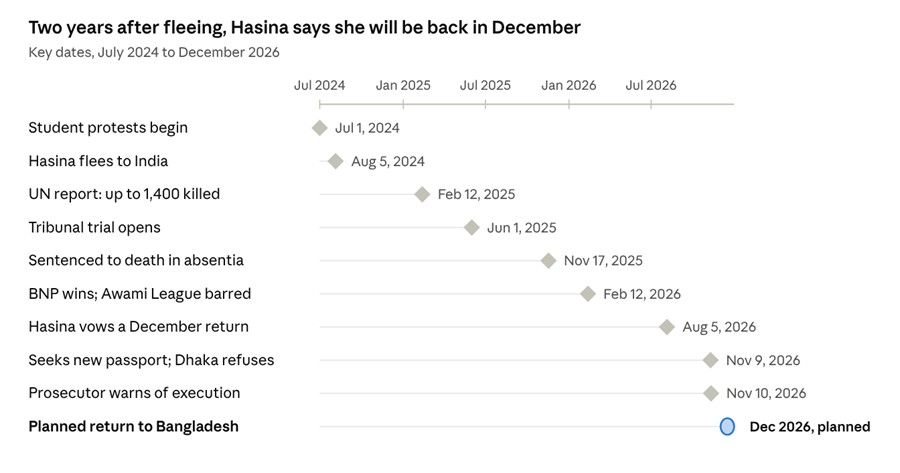
Key dates, Jul 2024 – Dec 2026 · sources: UN OHCHR, Dhaka Tribune, Outlook India, Al Jazeera, AP
In the 28 months since she fled, Hasina has been tried, condemned and replaced by her rivals at the ballot box; December is the first date she has set for coming back.