Rashtriya Swayamsevak Sangh chief Mohan Bhagwat’s claim that firecrackers of earlier times were free of chemicals and cleansed the atmosphere has run into a wall of contrary evidence, from medieval pyrotechnic manuals to this week’s air-quality readings in the capital.
Speaking at a Diwali gathering hosted by the Maheshwari Panchayat in Nagpur on 10 November, two days after the festival, Bhagwat said traditional crackers were not made with chemicals and that their smoke killed insects that harmed crops. He added that lamps lit with ghee or oil produced a particular kind of air, and urged people to understand the science behind such customs. He summed up his message as “vatavaran shuddh, jeevan shuddh” — a clean environment makes for a pure life.
The remarks came as Delhi lay under a blanket of smog. On the morning after Diwali, the city’s AQI stood at 368, with all 54 reporting stations above 200 and 15 in the “severe” band, according to Central Pollution Control Board (CPCB) data reported by Business Standard. Restrictions under Stage III of the Graded Response Action Plan were already in force.
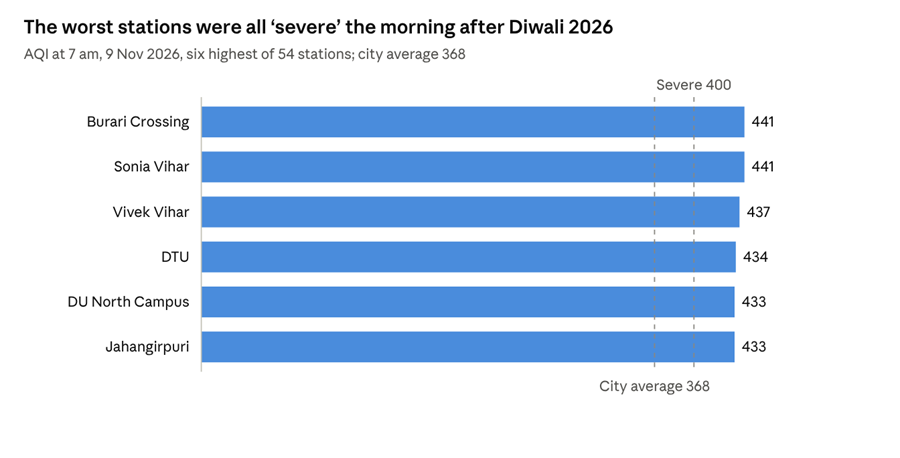
CPCB real-time data, 7 am 9 Nov 2026, via Business Standard
Gunpowder was always chemical
Historians say the first part of the claim does not hold. Gunpowder, the heart of any firecracker, is a mixture of saltpetre, sulphur and charcoal — the saltpetre supplying oxygen, the other two acting as fuel. Historian P.K. Gode’s study of Indian fireworks between 1400 and 1900 cites the Kautukacintamani, a text by the Odia king Gajapati Prataparudradeva (1497–1535), which gives recipes using sulphur, saltpetre, charcoal and powdered iron and steel.
Even writers who argue that fireworks are an ancient Indian tradition point to the same ingredients. Where today’s crackers do differ is in their additives: researchers list perchlorate oxidisers, aluminium and magnesium powders, and metal salts such as barium and strontium used for colour.
Weak evidence on insects
On insects, the record is thin. A 1994 field trial in Papua New Guinea found that smoke from burning leaves and coconut husks cut bites from some mosquito species, but not others. A 2021 Taiwanese study found incense smoke only weakly repelled mosquitoes and joss-paper smoke had no effect. A 2022 review of 42 studies found some insects are drawn to smoke while others avoid it. None of the research reviewed examined firecrackers as a tool against crop pests.
Air gets worse, not cleaner
The claim that firecracker smoke purified the air is contradicted by a decade of monitoring. Delhi’s 24-hour AQI on Diwali day has been above 300, the “very poor” threshold, in nine of the last eleven years. This year’s 376 was the highest since 2021.
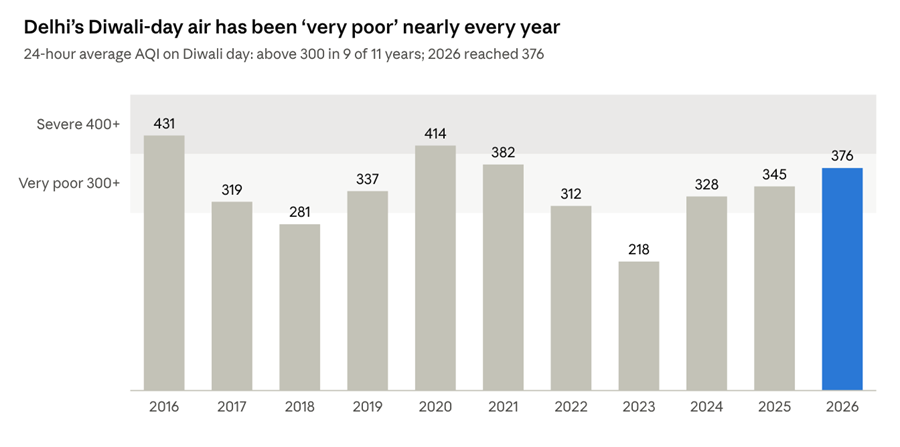
CPCB 24-hour average AQI on Diwali day · 2016–2021 via Tribune, 2021–2026 via PTI/DTNext
An analysis by Down To Earth found that average AQI across six NCR cities rose the day after Diwali in eight of the nine years from 2017 to 2025. Hourly CPCB data analysed by Climate Trends show fine particulate matter (PM2.5) rising after Diwali night in every year from 2021 to 2025, more than tripling in 2023.
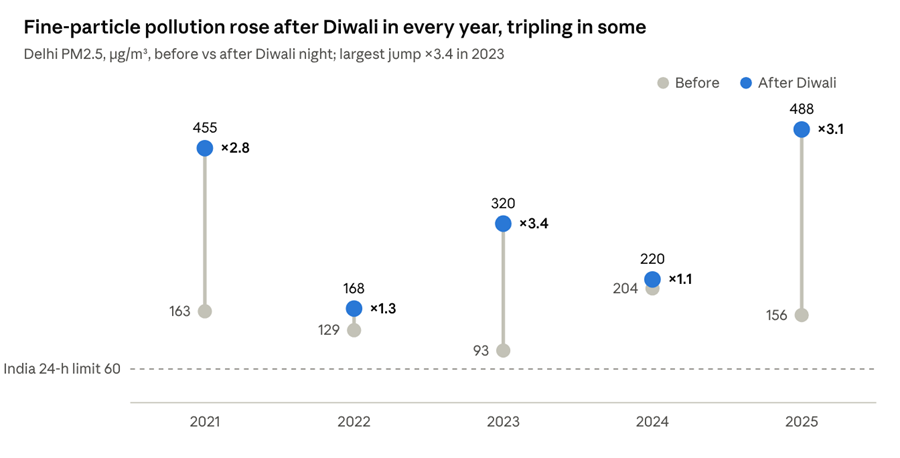
CPCB hourly data analysed by Climate Trends · 2025 ‘before’ derived from the reported 212% rise
The smoke also carries toxic metals. A study of Amritsar’s Diwali in 2022, published in Urban Climate, found metals made up nearly a quarter of PM2.5, with arsenic, cadmium and lead above permissible limits.
Studies on ghee lamps offer little support for purification either. A 2022 test published in a journal of Dev Sanskriti Vishwavidyalaya found ghee lamps produced about 16% less carbon monoxide than peanut-oil lamps, with no significant difference in particles or other gases.
Not the only culprit
Experts stress that firecrackers are one source among many. Crop-residue burning in Punjab and Haryana accounted for between a quarter and over 40% of Delhi’s PM2.5 around Diwali in past years, and vehicles, construction dust and still winter air add to the load. In Mumbai, strong sea breezes gave the city its cleanest Diwali afternoon in four years.
Supporters of Bhagwat’s view argue that festivals carry deep cultural meaning, that blanket bans are widely flouted, and that firecrackers are singled out while larger polluters escape scrutiny. Bhagwat himself framed his speech as a call for an eco-friendly Diwali.
The Supreme Court has taken a middle path. In its 29 October order, it declined a total ban, citing a lack of adequate data, and allowed only CSIR-NEERI-certified green crackers in Delhi-NCR during set hours on 7 and 8 November, while banning barium-based crackers. The full ban resumed on 9 November, and the court will review compliance on 16 December.