



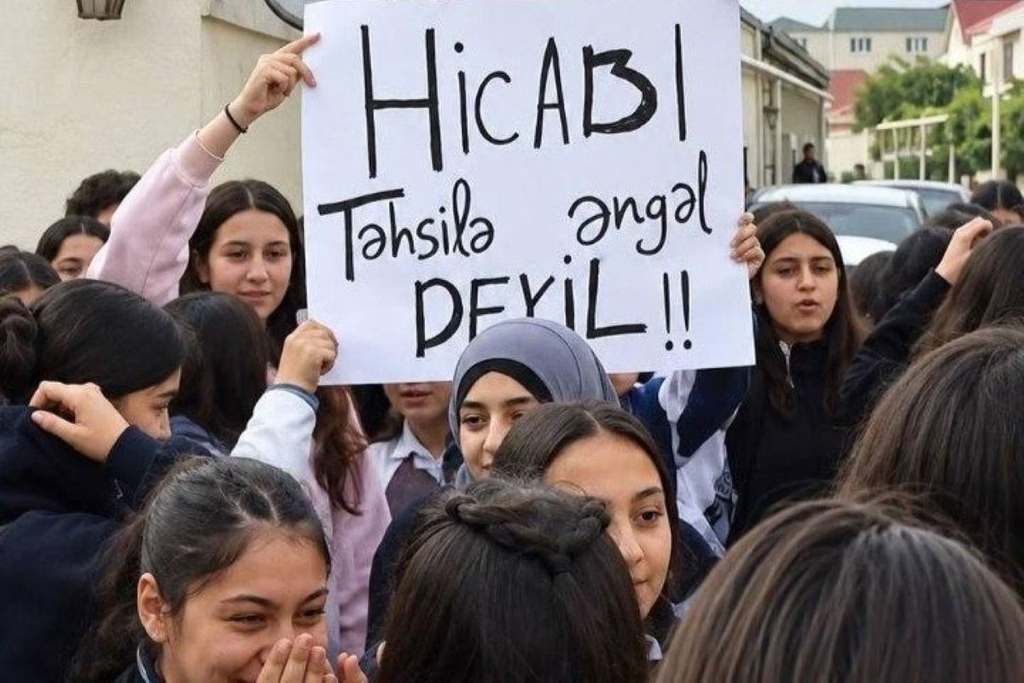
In the name of the “principle of secularism,” hijab-wearing Muslim pupils and teachers were denied entry to schools in Azerbaijan, a country of about 96% of the Muslim population and a close ally of Israel, which committed genocide against civilians in Gaza and Palestine, as the UN Commission of Inquiry concluded. They protested but were detained. They spoke out against the new dress code on social media, but their TikTok and Instagram handles were taken down. An activist, Ilkin Huseynov, who launched a free online platform to connect volunteer teachers with students excluded from school because of their hijab, went missing on 14 October 2026.
Secularism should ensure the impartiality of public institutions and should not demand the erasure of every visible expression of faith because it undermines the very freedom on which it is based. A school may have a reasonable dress code, but a blanket restriction solely on wearing ordinary headscarves is a grave violation of Article 48 (Freedom of Conscience) of the Constitution of the Republic of Azerbaijan.
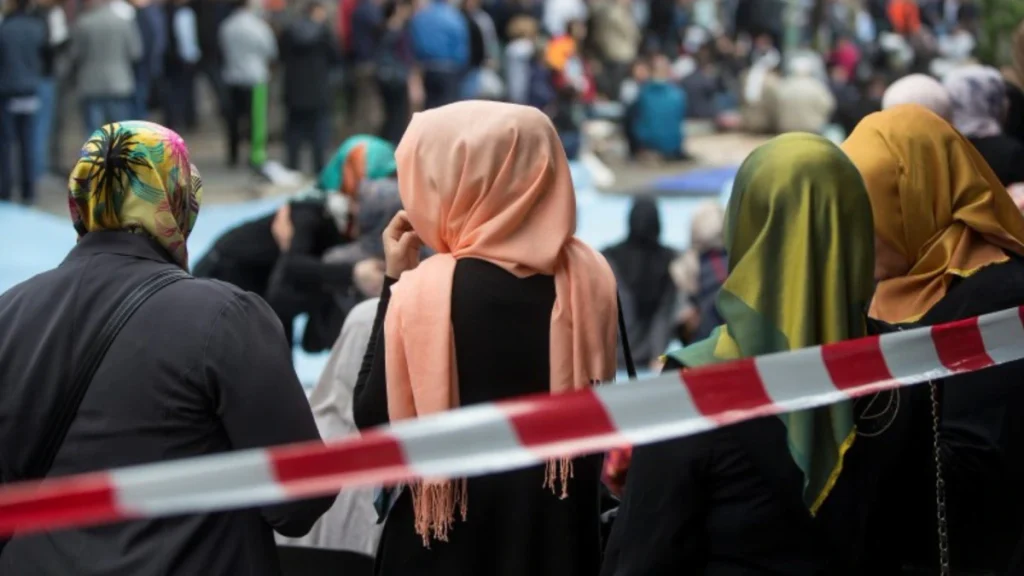
Muslim women around the globe wear hijab, burqa, or niqab, but there is a slight difference among the three. The hijab, the most worn, refers to a headscarf that covers a woman’s hair and neck while leaving her face visible. A niqab, only a number of women wear, covers the face while generally leaving the eyes exposed, whereas a burqa, as implemented in Afghanistan, conceals the body and face behind an enclosing garment and mesh screen.
The hijab has long been debated by both right- and left-wing movements. Some Western countries, including France, Australia, and Italy, restrict face coverings or hijabs in particular settings, defending them in the name of secularism, security, or equality. Many argue that these policies undermine Muslim women’s freedom to choose what to wear.
For many Muslim women, hijab is an expression of faith, identity, and modesty. They wear it voluntarily, not under coercion. Some liberal and secular critics, however, argue that the headscarf represents social conformity or patriarchal coercion, framing its removal as a form of women’s emancipation, which overlooks women’s agency and the diversity of Muslim women’s experiences.
There is no place for gender injustice, but a gender-specific role has. Europe, nevertheless, has a long history of restricting women’s access to education, employment, reproductive autonomy, suffrage, and political participation. Modern Europe has made significant advances towards equality, but it does not give them an unlimited authority to dictate what and how women should dress. Women must retain the freedom to wear—or not wear—a headscarf as an expression of personal choice and bodily autonomy.
Debate about hijab centers on the Qur’anic terms “khimār” and “jalābīb.” There are varied opinions among Islamic scholars, as they do not agree on a single, universally applied set of rules for hijab.
The Islamic Emirate of Afghanistan, under its interpretations of Sharia, applies extensive covering (burqa), including restrictions on women’s appearance in public spheres. Since the Taliban regained power in 2021, girls, beyond Grade 6, and women, since December 2022, have been barred from educational institutions. Its consequences extend to women’s employment and participation in public life.
Other Muslim-majority countries differ widely in their interpretations of Sharia and social expectations: some require or expect women to cover their hair and neck, such as Iran, while others leave the choice to the individual, such as the United Arab Emirates and other Arab countries. In practice, many Muslim women do not wear the hijab altogether.
The problem lies at the extremes of state-enforced secularism and religious conservatism. The former compels women to remove the hijab, defending the restriction in the language of secularism and women’s emancipation and arguing that it represents social conformity or state-enforced patriarchy.
To name the hijab-wearing women a victim of social coercion or religious conformity is to ignore their autonomy as they put it on voluntarily to express their personal convictions, similar to the women who choose not to wear it. The hijab-wearing woman, pursuing an education, leading an organization, or participating in policy-making discourse is worth as much as respect as a woman who refuses to wear it.
The latter, under the interpretation of Sharia, pressures women to cover their full faces, justifying it as a religious obligation. Both approaches raise an essential question: Who has the right to decide what a woman wears—herself, her family, religious authorities, or the state?
The hijab does not diminish a woman’s achievements. A hijab-wearing woman can be an accomplished scientist, an elected representative, a public figure, or a political dissident. The true test of a secular and liberal society is not whether a woman is veiled or unveiled, but whether she can choose either without fear or coercion. Freedom begins with self-determination.
The views expressed in this article are those of the author and do not necessarily reflect the views of FoEJ Media


