Rajasthan’s voters can be dead on one list and alive on another. During the Election Commission of India’s (ECI) Special Intensive Revision (SIR), about 8.75 lakh people were struck off as “deceased”. The Reporters’ Collective found that 1,82,440 of them — roughly one in five — still appear as eligible voters on the State Election Commission’s (SEC) rolls for the panchayat elections now under way.
If they are alive, they can vote for their sarpanch this month but not for their MLA or MP. If they are dead, 1.82 lakh dead people are on a live voter list. Either way, one of two official rolls, revised in the same months from the same base data, is wrong.
The gap is not limited to the “dead” category. A separate study by the People’s Union for Civil Liberties (PUCL) puts the overall overlap at 26.63 lakh people deleted by the SIR who remain on the SEC’s 2026 rolls.
The SIR in Rajasthan, by the numbers
The SIR cut 41.85 lakh names from Rajasthan’s draft roll on 16 December 2025, about 7.7% of the 5.47 crore electors on the pre-SIR roll. Most were marked shifted or absent; the “dead” category is the second largest, and about a fifth of it reappears on the panchayat rolls.
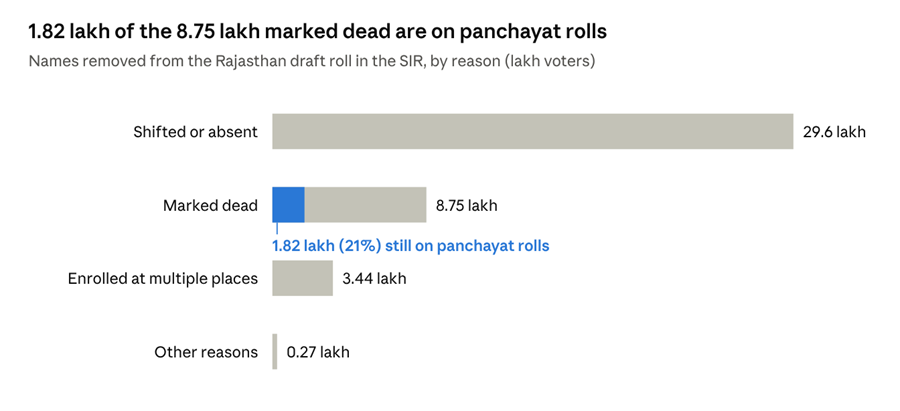
ECI draft-roll figures, 16 Dec 2025, as released by Rajasthan CEO Naveen Mahajan; overlap from The Reporters’ Collective’s EPIC-number match
After claims and objections, the final roll of 21 February 2026 added back 12.91 lakh names and removed another 2.43 lakh, ending at 5,15,19,929 electors. Official figures put the net cut at 31.36 lakh; The Reporters’ Collective uses 32.31 lakh, a gap that may reflect Anta, the one seat whose final roll came later (12 March).
Two commissions, one calendar
The two revisions overlapped almost completely, so neither commission can blame the gap on time passing. The ECI published its final SIR roll on 21 February 2026; the SEC finalised its panchayat roll on 25 February.
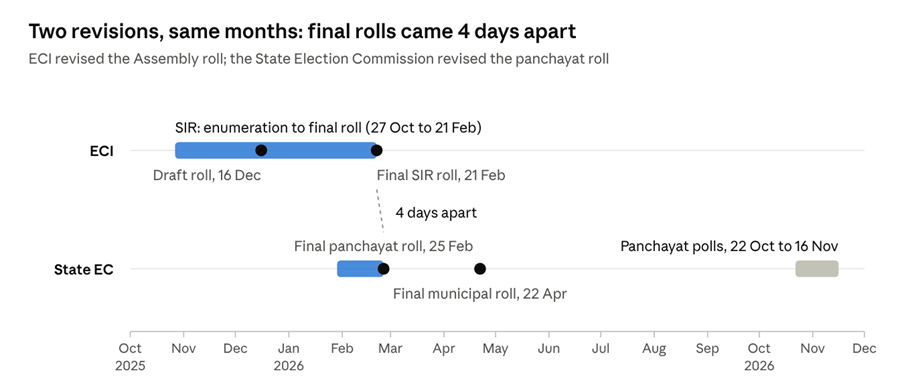
Dates: Rajasthan CEO releases (ANI, PTI); SEC roll dates per PUCL via National Herald; poll dates per SEC revised schedule, 6 Oct 2026
The bodies are separate by design. The ECI keeps the rolls for Lok Sabha and Assembly polls; the SEC keeps them for panchayats and municipalities, usually built from the ECI’s Assembly roll. In Rajasthan, the SEC did not start from the SIR roll. According to PUCL, it used the ECI roll with a qualifying date of 1 January 2025 — the pre-SIR base — and ran its own claims-and-objections process, during which it removed 25.85 lakh names of its own.
By the time The Reporters’ Collective downloaded both databases in October, panchayat polling had begun and the SEC rolls were frozen. An SEC official told National Herald that corrections were no longer possible with the election under way.
The gap across the whole roll
The “dead” voters are one slice of a much larger mismatch. PUCL matched all 5.15 crore final SIR records against 5.48 crore SEC records by EPIC number and found the local-body rolls about 30 lakh names larger — close to where the ECI roll stood before the SIR.
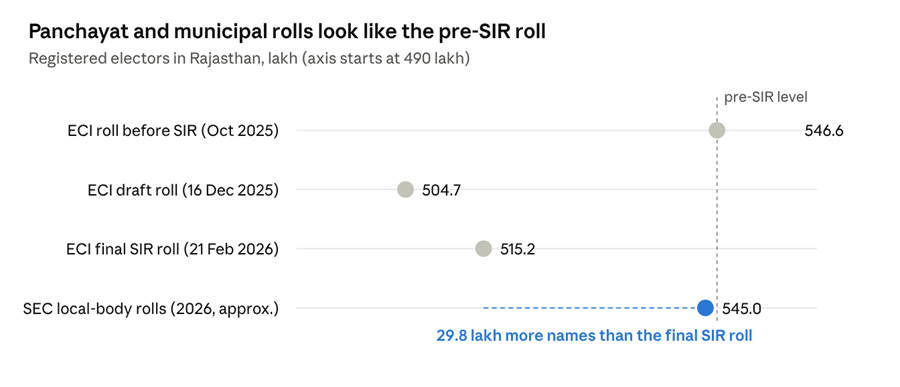
ECI figures from Rajasthan CEO releases; SEC total is PUCL’s approximate count across 199 constituencies, via National Herald (8 Oct 2026)
- 26.63 lakh people deleted in the SIR are still on SEC rolls. The ECI said 17.57 lakh of them had permanently migrated, yet the SEC lists them at Rajasthan addresses.
- Women make up 58% of the mismatch and 62% of those dropped as “shifted”.
- The gap runs the other way too: 15.52 lakh people on the final SIR roll are missing from SEC rolls, more than half aged 18–25.
- It is sharper in cities: 8.5% of municipal electors versus 3.6% of panchayat electors are on SEC rolls but not the SIR roll. Bhilwara is highest at 20.5%; Pali, Ajmer, Sikar, Alwar and Kota exceed 10%.
For the “dead” category, The Reporters’ Collective found the most cases in Garhi (4,889 voters) and Sirohi (4,624). One named case is Shalu Doliya, 26, of Kishangarh in Ajmer: dead in the ECI’s records, an eligible voter in the SEC’s.
How the match was done, and its limits
The Reporters’ Collective took the ECI’s list of voters marked Absent, Shifted, Dead or Duplicate (ASDD) and searched for each EPIC number in the SEC’s panchayat rolls. It then spot-checked a sample on the SEC’s public lookup portal, which shows a voter’s details for any EPIC number.
Three limits matter:
- No ground check. The analysis does not establish which commission is right about any individual.
- Later ECI updates not examined. The ECI has revised its roll monthly since February, in small numbers. It has not said whether a reinstated voter keeps the same EPIC record, so those changes could not be traced.
- Timing. Both databases were downloaded in October 2026, after panchayat polling had begun and the SEC rolls were frozen.
The national backdrop
Rajasthan was part of the SIR’s second phase across 12 states and union territories, after the first run in Bihar. Bihar’s exercise dropped about 65 lakh names from its draft roll and ended with 7.42 crore eligible voters.
On 27 May 2026, a Supreme Court bench of Chief Justice Surya Kant and Justice Joymalya Bagchi upheld the ECI’s power to conduct the SIR, while requiring searchable records of deletions. The ruling settled the legality of the exercise, not the accuracy of individual deletions — which is what the Rajasthan rolls now call into question.
In Rajasthan the SIR was contested from the start. The Congress alleged politically targeted deletions and sought a forensic probe; activists, led by Nikhil Dey of the Mazdoor Kisan Shakti Sangathan, have demanded a booth-level public audit of every change.
About 4.03 crore people are eligible to vote in this year’s panchayat polls, at 45,384 booths, with counting on 20 November. Anyone among the 1.82 lakh who is alive can vote in them, but will find no name on the roll at the next Assembly or Lok Sabha election unless they re-enrol.