Uttar Pradesh’s Chief Electoral Officer has ordered every district to match the Assembly electoral roll against panchayat and urban local body voter lists, after Election Commission sources flagged a gap of nearly 2.4 crore names between the two sets of records. The aim is to find eligible citizens — especially women — who sit on local-body lists but are missing from the roll that will decide the 2027 Assembly election.
The gap follows the Special Intensive Revision (SIR), which cut UP’s electorate from 15.44 crore to 13.40 crore. The matching drive now folds into the Special Summary Revision (SSR)-2027, with 1 January 2027 as the qualifying date. The 2.4 crore figure comes from unnamed EC sources; the exact comparison base (rural-only vs. rural + urban lists) has not been published.
How the roll shrank
ECI/CEO UP press briefings via AIR News (6 Jan, 10 Apr 2026); projected adults: National Commission on Population via NewsDrum
The SIR ran from 27 October 2025 to 10 April 2026. The draft stage struck 2.89 crore names; claims and objections then restored a net 84.3 lakh, including 42 lakh women. The final roll still sits about 2.77 crore below the projected adult population — the pool the roll-matching drive is now fishing in.
Why names fell off
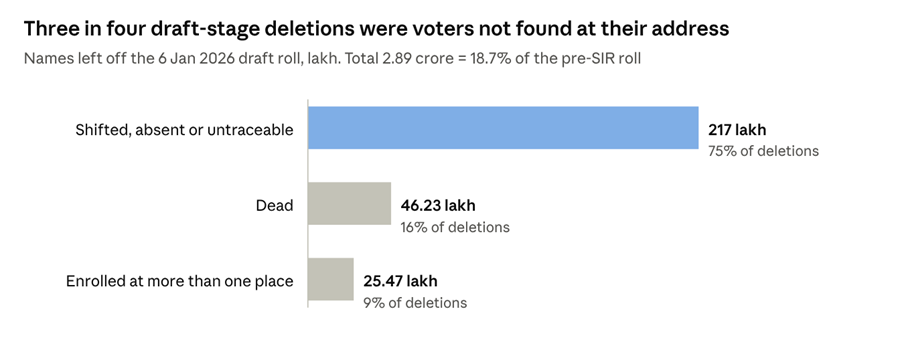
CEO UP, draft-roll briefing 6 Jan 2026, via AIR News; shifted/absent figure reported as 2.17 crore (rounded)
Only 81.3% of electors returned enumeration forms. The “not found” category is where genuine voters are most likely to be lost: a migrant worker, or a woman who moved after marriage, can be both missing at the old address and not yet enrolled at the new one. Deletions were heaviest in cities — Lucknow (about 12 lakh), Prayagraj (11 lakh) and Kanpur (9 lakh), per Deccan Herald.
Two rolls, two authorities, three gap figures
The Assembly roll is kept by the Election Commission of India through the state CEO; panchayat and municipal rolls are kept by the State Election Commission (SEC). Both are largely compiled by the same booth-level staff, yet they now tell different stories about who lives in UP.
| Claim | Size | Who said it | What it compares |
| Local-body vs Assembly gap | ~2.4 crore | EC sources (Nov 2026) | Panchayat + ULB lists vs Assembly roll |
| Panchayat voters missing from Assembly roll | 66 lakh | CM Yogi Adityanath (Outlook) | Panchayat roll vs Assembly roll |
| Adults not on any Assembly roll | ~2.7 crore | Derived (NewsDrum) | 16.17 cr projected adults vs 13.40 cr electors |
The rural count alone shows the strain. In January, Samajwadi Party chief Akhilesh Yadav pointed out that the provisional panchayat roll held 12.69 crore rural voters while the entire statewide Assembly draft held 12.56 crore (Deccan Herald). The SEC’s final panchayat list, published on 10 June 2026, recorded about 1.81 crore additions and 1.41 crore deletions — a net rise of about 41 lakh (UNI).
Both main parties now run their own enrolment drives: the SP’s “PDA Praharis” started months ago, and the CM has since told BJP workers to coordinate with BLOs. Adityanath’s further claim that 1.27 crore of the missing are Hindu cannot be checked — the EC does not record voters’ religion.
The missing women
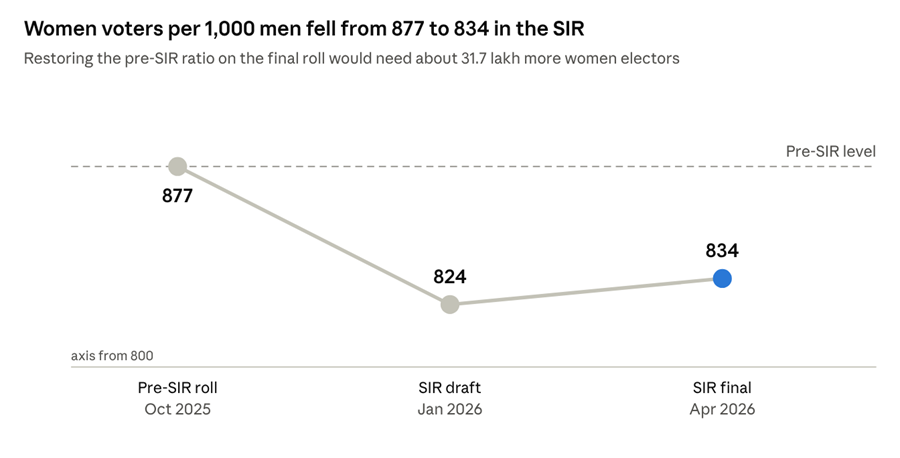
ECI data via Daily Pioneer and AIR News; shortfall derived from final-roll counts (7.31 cr men, 6.09 cr women)
CEO Navdeep Rinwa calls the number of women on the post-SIR roll “abnormally low.” Women make up 45.5% of the final roll, and more women than men were cut at the draft stage. Women who married into another village are a likely blind spot: they may sit on the local panchayat list but never transferred their Assembly enrolment.
The outreach leans on the state’s door-to-door workforce:
- Health and nutrition workers — ASHAs, ANMs and anganwadi workers identify unregistered women and help them fill Form 6
- Self-help groups — Samuh Sakhis of the UP State Rural Livelihood Mission in villages
- Departments — Women Welfare, Child Development & Nutrition, and Health
- Other channels — fair-price (ration) shops, schools and colleges for 18–19-year-olds, and RWAs in cities
Anyone eligible and not enrolled in any constituency in India will be asked to file Form 6.
Fewer booths, same cap
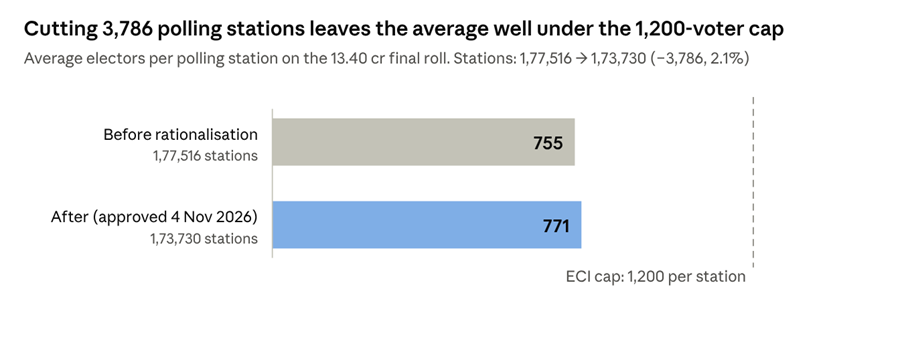
CEO UP via PTI/ThePrint, 4 Nov 2026; averages computed on the 10 Apr 2026 final roll of 13,39,84,792
The Election Commission approved the rationalisation on 4 November across all 403 constituencies in 75 districts. The average hides spread: some booths will sit near the 1,200 cap, others far below. BLOs must tell voters in writing if their booth changes and keep families in the same part of the roll; mismatches are fixed through Form 8. Recognised parties get the approved station list. If roll-matching adds lakhs of names, some booths may need to be split again before polling day.
What happens next
The SSR-2027 runs on a tight clock ahead of the 2027 Assembly polls (Zoom News):
- By 2 Nov 2026 — polling-station rationalisation (done; approved 4 Nov)
- 12 Nov 2026 — integrated draft roll published at the 1,73,730 stations
- Draft to final — claims and objections; roll-matching and Form 6 enrolment drives
- 4 Jan 2027 — final roll published