



A baby girl born on September 9 at the Dinhata Sub-Divisional Hospital in West Bengal’s Cooch Behar district still has no birth certificate. The reason has nothing to do with her: her father’s name was struck off the electoral roll during the special intensive revision (SIR).
Her parents, Amina Khatun and Abdul Habib of Khatamari village, applied for the certificate at the hospital and the panchayat office soon after she was born, The Hindu reported on Tuesday. They were told to bring residential verification from the panchayat head or the local MLA. When Habib went to the office of Dinhata MLA Ajoy Roy, he was turned away because his name had been deleted from the rolls. An official there, Habib told the newspaper, called him a Bangladeshi and said he would first have to register under the National Register of Citizens (NRC), the exercise meant to list Indian citizens and identify undocumented immigrants. The block development officer of Sahebganj turned him down on the same grounds.
“I have been living in India since my birth,” Habib told The Hindu. He said the family house in Khatamari was built by his grandfather and that he had shown officials all his documents. His appeal against the deletion is pending before an SIR appellate tribunal.
His case is one entry in the largest voter-roll revision West Bengal has seen. It shows how a deletion meant to decide who may vote is now also deciding who can get a birth certificate, a ration card, a police clearance or a passport.
The scale: one in eight names gone
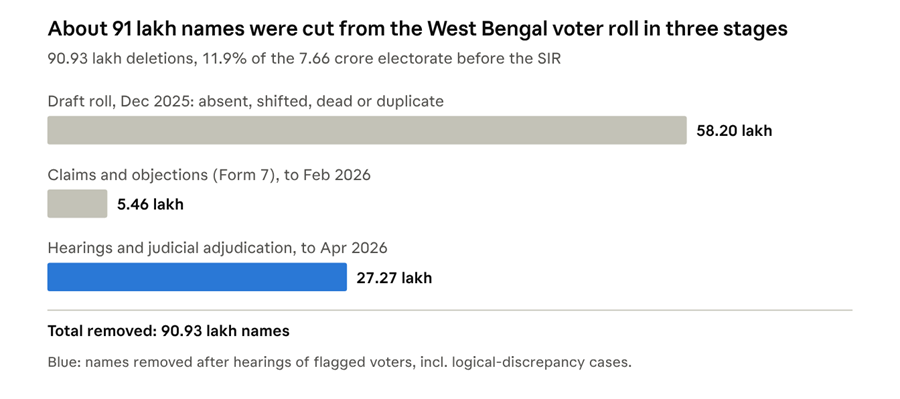
Election Commission data as reported by ANI, The Statesman/Scroll and All India Radio, Dec 2025 to Apr 2026. Draft-stage and adjudication figures are rounded; the commission put total deletions at 90,93,345.
The draft roll published on December 16, 2025 dropped more than 58 lakh names as absent, shifted, dead or duplicate, and sent over 31 lakh voters who could not be matched to the 2002 roll for hearings. The final roll of February 28 stood at 7.04 crore, and judicial adjudication of flagged voters removed about 27 lakh more just before the April polls, taking the electorate to roughly 6.77 crore.
The Election Commission says the exercise cleans the rolls of duplicate, dead, shifted and otherwise ineligible voters. The BJP has argued it exposes “illegal Bangladeshi” and dead voters and ends bogus voting. Critics point out that the deletions clustered in border districts, minority-heavy areas and Matua refugee belts: Murshidabad lost about 4.55 lakh names at the adjudication stage alone, North 24 Parganas about 12.4 lakh across both phases.
A ‘logical discrepancy’ splits a family
The Election Commission summoned Habib and three of his sisters for hearings, citing a “logical discrepancy”. The commission uses the term for records it treats as inconsistent: a parent’s name spelt differently across documents, an implausibly small age gap between parents and children, or parents with more than six children. All four siblings were deleted. Habib’s parents, his wife and another sister remain on the rolls.
Spelling flags have caught many people in Bengal, where the same name is routinely transliterated in different ways. In North 24 Parganas, a farmer was removed because his father’s surname appeared as “Sheikh” in one record and “Sekh” in an older one, The News Minute reported.
Cooch Behar, a border district with a large Rajbanshi Scheduled Caste population and former Bangladeshi enclaves whose residents became Indian citizens only in 2015, was among the hard-hit districts. About 1.13 lakh names were dropped there at the draft stage, the most in Dinhata (16,442). Of the 2.38 lakh voters in the district sent for adjudication, more than 1.2 lakh, over half, were deleted from the final roll.
The appeal queue Habib is standing in
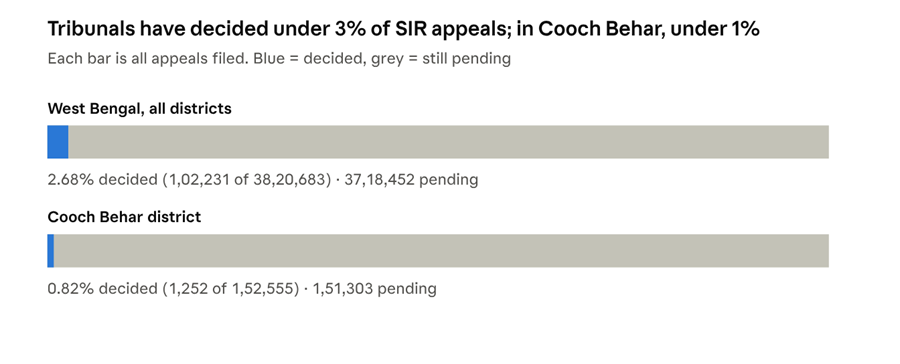
Election Commission affidavit to the Supreme Court, September 2026, as reported by LiveLaw and National Herald. Covers appeals against both exclusions and inclusions.
Of the 38.2 lakh appeals filed before the tribunals, 37.2 lakh were still pending when the commission reported to the Supreme Court in September. In Cooch Behar, 1,252 of 1.53 lakh appeals had been decided.
Not every appeal is from someone like Habib. The commission told the court that about 22 lakh appeals were filed by people whose names were deleted, while some 16 lakh challenge names that were included. Where tribunals have ruled, excluded voters have mostly won: an RTI reply showed that as of August 7, 91% of decided appeals ended with the name restored. Those voters still could not vote in the April 2026 Assembly election.
What the Supreme Court has said
- March 10: The court ordered appellate tribunals of former High Court chief justices and judges to hear appeals against exclusions. Anyone whose claim for inclusion is rejected by a judicial officer can approach them. Hearings began in April.
- April 24: The court asked tribunals to give out-of-turn hearings to people who make a case for urgency.
- May 27: A bench of Chief Justice Surya Kant and Justice Joymalya Bagchi upheld the legality of the SIR, saying it advances free and fair elections. It held that the commission may make a limited inquiry into citizenship for the electoral roll, but cannot finally determine anyone’s citizenship.
- September: The commission proposed adding tribunals, one per parliamentary constituency, to clear the backlog. The court has said all appeals should be decided before the 2029 Lok Sabha election.
That May ruling is what makes Habib’s experience stand out. A voter-roll deletion that is still under appeal was treated at an MLA’s office as proof that he is a foreigner.
Beyond the ballot
Habib’s daughter is not the only person whose paperwork now depends on the voter list.
- Rations: A June 4 order of West Bengal’s Food and Supplies Department marks the ration cards of people deleted in the SIR as inactive and ties the Annapurna Yojana cash scheme to the same lists. People with appeals pending or applications under the Citizenship (Amendment) Act keep benefits until their cases end. Petitioners told the Supreme Court that 35 to 60 lakh cards could be deactivated; the court sent them to the Calcutta High Court. The state government says the aim is to cut fraud and pilferage in the public distribution system.
- Bihar: Chief Minister Samrat Choudhary has said people excluded in the SIR will lose government benefits, including rations, though no notification has been issued.
- Police clearance: Akash Sarkar, an Agniveer recruit from Cooch Behar, was refused a police clearance certificate after his and his father’s names were deleted; the Calcutta High Court stepped in.
- Passports: In November the High Court sought the state’s response to a student denied a passport because his mother’s name was deleted. A former editor of The Telegraph got a passport only after a months-long ordeal over an SIR deletion.
Did the deletions shape the election?
The BJP won 207 of West Bengal’s 294 seats on May 4, ending 15 years of Trinamool Congress rule. Several outlets have since compared SIR deletions with winning margins seat by seat.
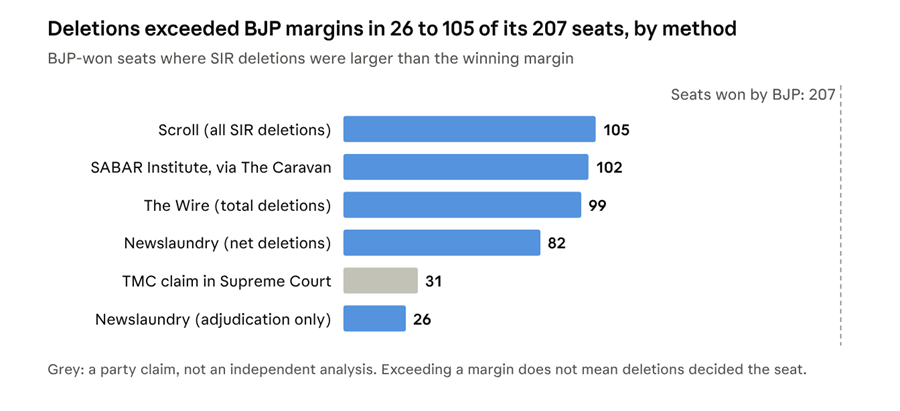
Scroll, The Wire (via National Herald), Newslaundry, SABAR Institute (via The Caravan), Outlook (TMC submission); analyses published May to June 2026. Each counts deletions differently.
The answers depend on what is counted. Scroll also found that each percentage point of roll shrinkage in a seat was associated with a 0.377-point shift in the BJP-Trinamool margin towards the BJP. A stricter Newslaundry test, comparing adjudication deletions with the change in margin since 2021, found only 14 such seats, and the BJP won just one of them.
Other analysts caution against reading too much into the overlap. Outlook’s analysis concluded that the BJP’s victory cannot be explained by the SIR alone, though deletions mattered in a smaller set of close seats. Statewide, the BJP polled about 32 lakh more votes than the Trinamool. Political scientist Gilles Verniers has argued that the SIR makes it impossible to draw definite conclusions about the verdict.
Protests, and a revision that keeps growing
On October 2, protesters gathered at Jantar Mantar in Delhi, Shivaji Park in Mumbai, and in Lucknow and Ahmedabad, demanding the resignation of Chief Election Commissioner Gyanesh Kumar. Groups including the Cockroach Janta Party and student organisations also called for halting the SIR, restoring the January 2025 rolls and repealing the 2023 law on appointing election commissioners. Police detained hundreds. Opposition parties followed with a march to the commission and “Save Democracy” rallies.
The protests grew after The Indian Express reported on September 23 on internal disagreement within the commission. The commission said the report reflected “differing views and deliberations” rather than formal objections, and has rejected allegations of political bias.
The exercise is not winding down. On May 14 the commission announced the SIR for 16 more states and three Union Territories. For Habib, the only road left runs through a tribunal with more than 1.5 lakh appeals pending in his district alone. Until it hears him, his daughter has no birth certificate.