Democrats have reclaimed control of the US Senate following a series of historic victories in traditionally Republican states, dealing a major blow to President Donald Trump and threatening to constrain his legislative agenda during the final two years of his presidency.
The party’s gains in the November 3 midterm elections have also put it in a strong position to take control of the House of Representatives. If the projected results hold, Democrats will command both chambers of Congress from January 2027, ending the Republicans’ unified control of Washington. Celebrating the victory in Washington DC, Senate Minority Leader Chuck Schumer said the results had defied expectations.
“Wow! Wow! Now, against all odds, we Democrats have won the Senate,” Schumer said. “We have five words for the American people: relief is on the way.”
Historic flips in Republican strongholds
Democratic candidates secured victories across several states that had long been considered Republican strongholds. Their gains included Texas, Kansas, Iowa, Ohio, North Carolina and South Carolina, marking a significant shift in the political landscape. The party’s success in these states was particularly striking given their voting patterns in recent presidential and congressional elections.
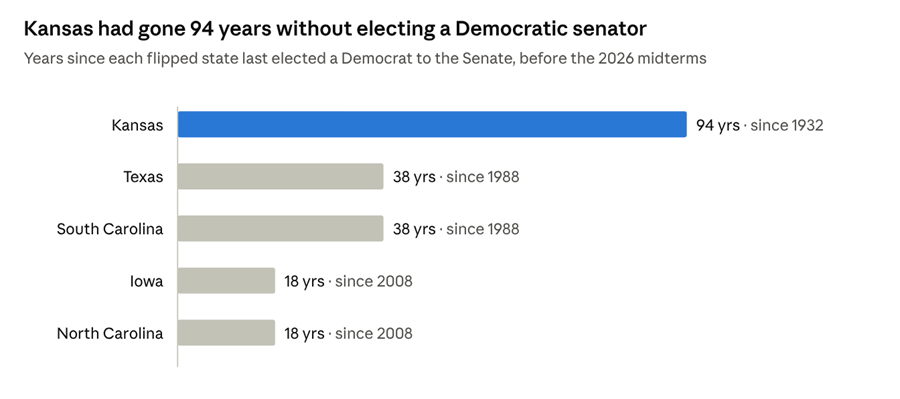
Figures as reported in the article · Ohio also flipped; the article gives no year for its last Democratic win
The scale of the victories was particularly significant in states where Democrats had struggled to win Senate elections for decades. Kansas had not elected a Democratic senator since 1932, while Texas had not done so since 1988. South Carolina had gone 38 years without electing a Democrat to the Senate. In Iowa and North Carolina, the last Democratic victories dated back 18 years.
The change in control will give Democrats considerable influence over the functioning of the Senate. They will be able to block or delay Trump’s legislative proposals and exercise greater authority over the confirmation of his Cabinet nominees, federal judges and other presidential appointments. This could also affect any future vacancy on the US Supreme Court, where conservatives currently hold a 6-3 majority.
How the landscape shifted since 2024
The results represent a sharp reversal of the political landscape established in the 2024 elections. Trump returned to the White House that year, while Republicans secured a 53-seat Senate majority, ending four years of Democratic control of the chamber.
At the time, a Democratic comeback in the Senate appeared unlikely. Most of the seats contested in 2026 were in states with established partisan loyalties, leaving the party with a difficult path to reclaiming the majority. The declining tendency among American voters to split their tickets between candidates from different parties also made the prospect of widespread Republican losses seem remote.
Initially, Democrats focused their campaign on Republican-held seats in North Carolina, Ohio, Alaska and Maine. Republicans, meanwhile, sought to expand their majority by targeting Democratic-held seats in Georgia, Michigan, New Hampshire and Minnesota.
However, Trump’s declining approval ratings and a series of controversial policy decisions changed the electoral landscape. His handling of the economy and immigration, two issues that had previously strengthened his political appeal, increasingly became liabilities for Republicans.
The administration’s decision to launch military strikes against Iran and deploy federal immigration agents for large-scale raids further intensified public criticism. The operations in Minneapolis, which resulted in the deaths of two US citizens, added to the backlash against the administration’s immigration policies.
The conflict in the Middle East also contributed to rising fuel prices, increasing pressure on American households. These developments helped Democrats expand their electoral ambitions beyond their initial target states, with Texas, Kansas and Iowa emerging as increasingly competitive races.
Addressing the reasons behind the party’s success, Schumer said Democrats had focused on listening to voters and their concerns about the administration.
“Republicans had a choice of following Trump over the cliff, even though Trump policies made American families’ pain much worse,” he said.
He added that Democrats had spoken directly with voters about their everyday concerns and had made those issues central to their campaign.
Primary fights that backfired
The results also exposed weaknesses in the Republican Party’s campaign strategy, including Trump’s involvement in several contentious primary contests.
In North Carolina, Trump had criticised Republican Senator Thom Tillis for opposing his flagship domestic policy legislation. Tillis subsequently announced that he would not seek re-election, leaving an open seat that Democratic candidate and former governor Roy Cooper went on to win.
In Texas, Trump’s endorsement of state Attorney General Ken Paxton over longtime Republican Senator John Cornyn contributed to a divisive primary contest. Cornyn lost the nomination, giving Democrats an opportunity to challenge the Republican hold on the state. Democratic state representative James Talarico ultimately won the Senate race by a double-digit margin, according to the Associated Press.
In South Carolina, the death of longtime Republican Senator Lindsey Graham created another contested race. Trump backed Graham’s sister, Darline Graham, to succeed him, despite her lack of experience in elected office and the presence of other Republican candidates. She subsequently lost to Democratic candidate Annie Andrews by around four percentage points.
Narrow Republican holds
Even in states where Republicans retained their seats, the results pointed to growing vulnerabilities. Florida Republican Ashley Moody secured re-election by approximately three percentage points, a considerably narrower margin than Republicans had achieved in the state in previous elections. In Louisiana, Republican Julia Letlow won the open Senate seat by a margin of around two percentage points, despite Trump’s approximately 22-point victory in the state in 2024.
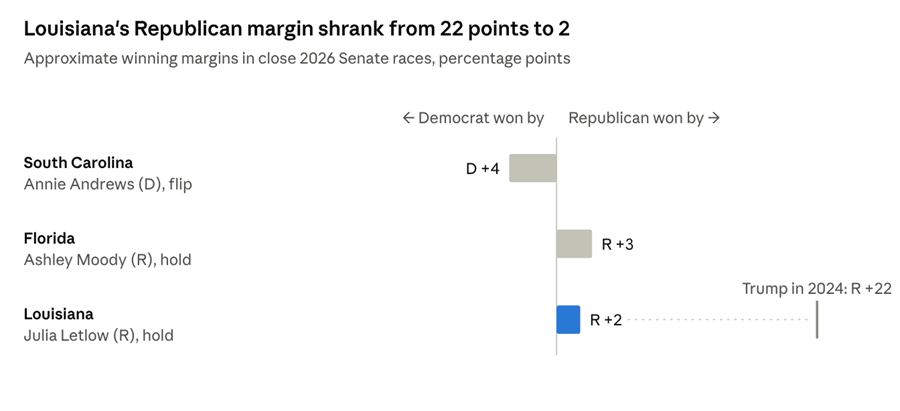
Approximate margins as reported in the article · Texas (Talarico, D) left out: the article gives only a “double-digit” margin
What comes next
With control of the Senate set to change hands in January, Republicans have only a limited period left to exercise their majority. The outcome has also raised questions about whether the party will attempt to push through additional conservative judicial appointments before the new Congress takes office.
One possibility attracting attention is a renewed effort to confirm a conservative Supreme Court nominee if a sitting justice retires before the end of the year. Asked about the possibility, Schumer urged Republicans to take the election results as a warning and pay attention to voters’ priorities.
“I hope Republicans learn the lesson that they failed to see up to tonight. Listen to the American people,” he said, adding that voters wanted Congress to focus on “costs, chaos, corruption.”