Jantar Mantar protests: Miss or Hit?
Amidst the ongoing agitations (which started on 2nd October coinciding with Gandhi Jayanti) and the unrest at the Jantar Mantar in the country’s capital—Delhi, the demand for CEC Gyanesh Kumar’s resignation stands at the center of this mass movement. The demand arrives as a reaction to heavy irregularities in the Special Intensive Revision (SIR) of Electoral Rolls. The movement brings together various pressure groups and leaders from the opposition, collectively alleging that the SIR has managed to remove many minority votes including the Muslims in a participatory democracy like India.
The success of the last agitations carried out by the CJP (Cockroach Janata Party) and backed by the students in the month of July in 2026 still echoes louder than any mass movement ever carried out in the country, including the CAA. The resignation of Dharmendra Pradhan came as a victorious blow on the face of the ruling party BJP.
Following Pradhan’s departure as the Education Minister of India, the office was undertaken by Prahlad Joshi. 63-year-old Joshi is already the minister of new and renewable energy and consumer affairs, food and public distribution but is now also handling the education portfolio. A look in Joshi’s life reveals that he has been a close associate of P.M. Narendra Modi and allegedly been a member of the RSS.
Although the mass movement turned fruitful for the CJP alongside the left and opposition leaders, even succeeding in sending ripples of unease and a momentary unrest in the ruling BJP—it remains uncertain whether these demands can actually drive structural transformations in the socio-spatial landscape to address fundamental questions related to citizenship, education, voting rights and, totality of the overarching democracy across the country.
The demand for Pradhan’s resignation echoed louder, compared to Joshi’s silent arrival. The knights may move or they may rest until the pawns are gone, yet a crucial question persists; whether Joshi truly offers a solution to the broader dilemmas and the demands of the CJP; in favour of the country’s educational landscape.
Moving Beyond the Reactionary Politics
As the protests surrounding the demand for the resignation of CEC Gyanesh Kumar attracts traction, the question lingers: ‘what happens after Kumar’s resignation?’. The accusations of ‘vote chori’ by the protestor are no doubt valid, but the marginalization of the minority communities; specifically—Muslims of the country cannot be counted merely as a contemporary issue.
Political representation remains the heart of a participatory democracy. Muslim representation in the parliament peaked in the 1980 at 9.04%, dropping to a mere 4.4% in 2024, a figure significantly lower than the total Muslim population share. The average representation in the Upper House of the Parliament since 1952 remained at around 11%, although currently, out of the total 233 seats for the elected members, only 14 Muslim members remain, while no nominated (12 seats) political representative from the Muslim community remains in the Rajya Sabha bringing the representation down to a mere 7% percent in the Upper House.
While democracies frequently try to address the issue of underrepresentation by compensatory constitutional mechanisms, reserved for dispersed minorities. However, unlike other dispersed minorities in India like the Scheduled Castes for instance, this compensatory mechanism restricts the Muslims from their right of reserved seats in the parliament. As a result the political representation of the Muslim community becomes conditional upon the support of other groups.
The aspirations of a mass mobilization shrinks as questions of structural necessities and important statistics are ignored. The structural fissure and irregular representation of minority and Muslims leaders in the parliament prompts an imbalance in the power dynamics between different communities.
What lies beneath?
The Muslim community for many decades now has been seen as an adversary of the nationalistic aspirations of the country, in the light of partition. The reluctance to articulate and fulfill Muslim needs by major political parties on a majoritarian hyper-nationalistic platform makes the Political parties cautious in handing out tickets to Muslim candidates.
At first glance the irregular representation of the Muslim community may be attributed to the dynamics of ticket distribution or the arithmetics of First Past the Post system (FPTP) where a territory is divided into spatial constituencies; and each constituency sends one representative, but these explanations only scratch the surface.
As illustrated above, the issue of political representation of the Muslim community is not merely institutional but also spatial. A look beneath the arithmetics reveals a deeper structural reality of how the Electoral boundaries themselves are drawn.
Article 82 of the constitution mandates that, after each census, the allocation of seats in the House of the People (Lok Sabha) to the states and the division of each state into territorial constituencies shall be readjusted by an authority determined by Parliament through law. Article 81 of the Constitution talks about the composition of the House of People (Lok Sabha). Article 81(2) states that, the seats allotted to each state shall be commensurate to the ratio between the number of seats and population of the state and will be the same for all states, as far as practicable.
This practice of maintaining the ratio between the seats and the population of a state is handled by the ‘Delimitation Commission of India’, a quasi-judicial body constituted by the Union Government to redraw the boundaries of the Lok-Sabha and State Legislative Assembly based on the latest census data.
Ideally, this practice strengthens democracy by making each vote carry equal weight. However, when examined closely, delimitation can become a powerful political instrument—capable of reshaping not just constituencies, but outcomes.
Driving Outcomes
Gerrymandering—the process of manipulating election maps by re-drawing the boundaries to favour particular political outcomes. Using this process as an instrumental tool, the government may change the outcomes related to representation, where it is not outrightly denied but distributed in small packets to dilute the vote concentration of a particular community.
There are two types of gerrymandering: Cracking and Packing.
Cracking splits groups of disfavored voters among multiple districts. With their electoral strength divided, cracked groups struggle to elect their preferred candidates in any of the districts because they are too small a share of the electorate to be effective.
Packing is the opposite of cracking. With packing, map drawers cram members of disfavored groups or parties into as few districts as possible. The packed groups are able to elect their preferred candidates by overwhelming margins, but their voting strength is weakened everywhere else.
These techniques are not mutually exclusive, both may be deployed by map drawers to engineer a decided partisan advantage.
This practice of power redistribution does not merely distribute as the phrasing suggests but also concentrates. Apparently the reserved seats for other communities also plays a major role in this process, where seats of most constituencies with more than 30% Muslim voters are reserved for SC or ST candidates, effectively preventing the Muslims from electing a representative from their own community.
Gerrymandering in Assam
Recent delimitation exercises in states like Assam and Jammu & Kashmir have intensified concerns. In several cases, constituency boundaries were redrawn in ways that significantly altered their demographic composition—transforming areas with strong Muslim electoral presence into minority-dominated constituencies.
Muslims constitute more than 34 percent of Assam’s population – only Jammu and Kashmir, and the island of Lakshadweep have higher proportions of Muslims, and neither is a full-fledged state, unlike Assam. Prominent poll analyst Yogendra Yadav, writing in The Indian Express newspaper, referred to the Assam model of delimitation as “communal gerrymandering” likening it to the model in the US.
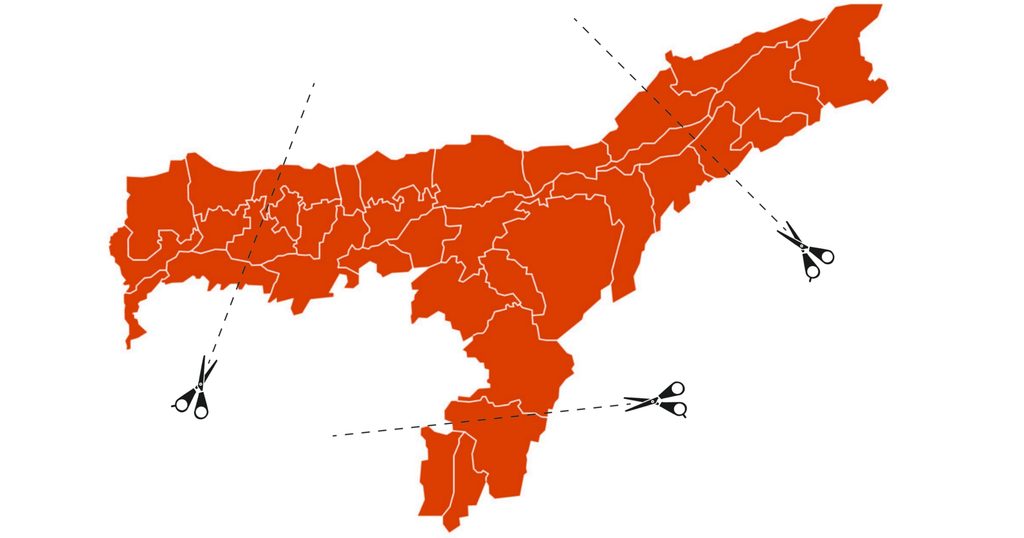
Muslims formed the majority in about 35 of the state’s 126 constituencies before delimitation. That number is now down to about 20, say opposition leaders and experts.
FPTP against Proportional Representation
Gerrymandering has been perpetually used to disempower Black and Latin voters in the US. Ever since the partition the Delimitation practice has been used to discredit and disempower the Muslim voters in the country in the same manner as the US. This arbitrary power of limitation alone is enough to discredit the FPTP.
The constituent assembly debates clearly show the disagreement around this issue as Congress abolished separate electorates. Some Muslims did speak up demanding proportional representation. It needs to be noted, however, that separate electorates have one significant demerit- that Hindus can’t vote for Muslims and vice versa. While Hasrat Mohani did raise this point, he also maintained that joint electorates with FPTP would lead to the elimination of Muslim representation. He was one of the most vocal opponents of this system (FPTP).
The debate revolving around FPTP lasted years. On Tuesday, the 4th January 1949, Kazi Syed Karimuddin also reportedly opposed the present electoral system in the Constituent Assembly. “The present electoral system, of single member constituency according to me, is very defective. The one pervading evil of democracy is the tyranny of the majority that succeeds in carrying elections. To break off that point is to arrest danger. The common system of representation perpetuates the danger and the only remedy is proportional representation”..Karimuddin stated.
Currently, over 130 countries worldwide use some form of Proportional Representation (PR) or mixed system to elect their lower chamber, with Party-List PR being the most prevalent method.
Party-List PR is used in approximately 59 to 85 countries, including major democracies such as Germany, Spain, Brazil, South Africa, Netherlands, and Sweden. This system allocates seats to political parties in proportion to their share of the vote, often using open or closed lists depending on the nation, so that the distribution of representation could be equal along different community lines.
FPTP while discrediting the Muslim question in India also hold substantial bearing on the question for the Dalits, as the reserved constituencies for the SC and ST act as proxies for the Upper castes of the area, eventually leading to a majority consensus.
Contemporary tangents
The 2014 parliamentary election constituted a landmark election. The massive consolidation of Hindu voters behind the BJP and its Hindu nationalist agenda played a crucial role in its performance. This support for BJP’s agenda may not always have been anti-religious but it was decidedly majoritarian and expressively religious. The political success of the Hindu nationalists therefore lay in its ability to weave a pan-India Hindu identity and a gradual transformation of India to an “ethno-democracy”. The salience of religious cleavage brought together the upper caste, the backward castes, and the Dalits as a bloc.
The performance of Muslim candidates in the 2014 parliamentary elections was abysmal. There were only 22 Muslim candidates elected to the Lok Sabha, the lowest representation of the community since 1952. The thin distribution of Muslims under the FPTP electoral system makes it politically expedient for the Muslims to support mainstream parties. Since the late 1980s, Muslim voting behavior has largely been shaped in a political context defined by the rise of Hindu nationalist BJP.
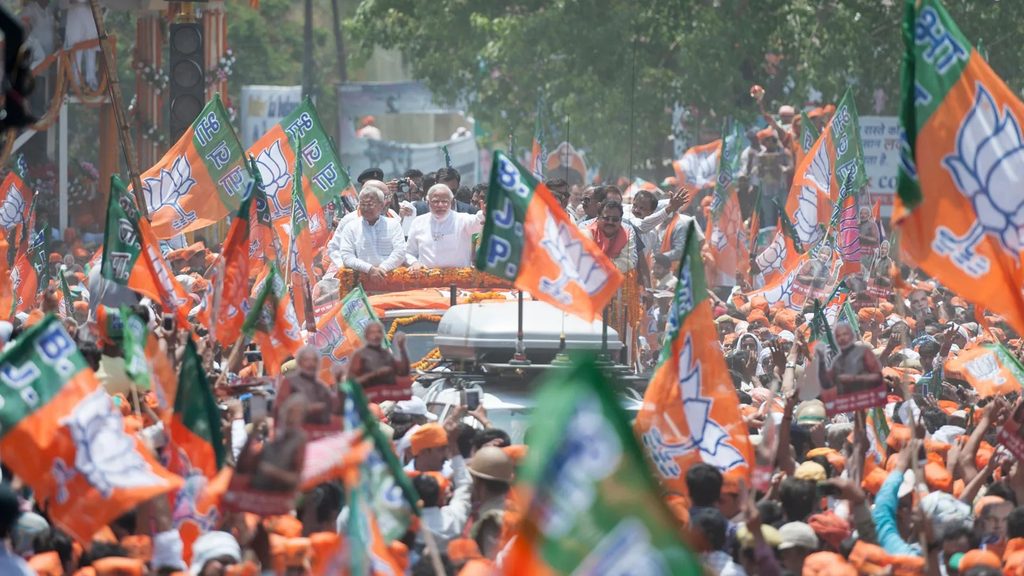
There exists a large variation in terms of whom the Muslim community votes for. Even historically, Muslims voting preferences have mostly depended on the nature of electoral competition, spatial distribution of the community, and available political choices.
Though Muslim-led parties such as the AIMIM, IUML, and AIUDF have been successful mainly in Muslim dominated constituencies, these parties too do not claim to exclusively represent Muslim interests due to the same reluctance and fear against the majoritarian consensus.
Important Questions
While the demand for Kumar’s resignation apparently levitates on the verge of culmination, the questions related to fundamental and structural functioning of the bodies remain in the shadows.
In the landmark judgement of Anoop Baranwal vs Union of India (2023) case, the Supreme Court observed that the Election Commission is an independent body and, therefore, the selection process of its commissioners should not be solely determined by the Executive. Thus, an interim mechanism was established to fill this legislative vacuum where, the Constitution Bench held that until Parliament enacts a law under Article 324(2), appointments must be made by the President based on the advice of a three-member committee comprising of the Prime Minister, Leader of the opposition and Chief Justice of India.
The judgment emphasized that the independence of the Election Commission is integral to the basic structure of the Constitution and essential for free and fair elections.
But the interim mechanism of the appointment of the CEC lasted merely 10 months. Subsequently, Parliament passed the Chief Election Commissioner and Other Election Commissioners (Appointment, Conditions of Service and Term of Office) Act, 2023, which replaced the Chief Justice of India with a Union Cabinet Minister nominated by the Prime Minister, rescuing the process from the checks and balances of the Supreme court and diluting most of the power again, in the hands of the Executive’s control.
This statutory change has been challenged in the Supreme Court, with critics arguing it dilutes the neutrality mandated by the Anoop Baranwal ruling, but When the Bill was passed in the Lok Sabha on December 21, 2023, AIMIM chief Asaduddin Owaisi was the only Opposition MP to speak against it during the debate.
As we have also illustrated above, the question related to the representation of Muslims in Politics in India is not merely reflected by numbers and arithmetics of nominations or education but also raises a question towards the structural integrity of the constitution and the reluctance of the state to address representation of Muslims in the country, while actively participating in the marginalization of the community from the overall political sphere.
Amid these deliberate structural changes aimed at covertly producing a majoritarian consensus, apparently the governing bodies also uphold a biased positioning. The voice of the Muslim and other minority communities are hardly ever heard, their issues barely addressed.
The political representation and the distribution of power between the communities remains in a state of imbalance, but the difficult task is identifying the structural deficiencies which have rendered minorities helpless; and have been aiding, rather than checking the majoritarian assault.
Conclusively, the questions of Muslim representation and the issues related to the deletion of votes in light of systematic shortcomings of the legislative, executive and judiciary reveal a broader pattern of the exclusivist approach towards the minority communities of the country, explicitly the Muslims.