Bulldozers moved into Bhendi Bazaar on Thursday as the Brihanmumbai Municipal Corporation (BMC) began tearing down what is left of the Haji Ismail Haji Habib Musafirkhana, the crumbling Pakmodia Street building that was once the family home and early operational base of fugitive gangster Dawood Ibrahim. A JCB pulled down sections of the structure under heavy police deployment; no resistance from residents had been reported by mid-day.
The demolition, scheduled for November 18 and 19, has opened a fresh row. Residents, along with leaders of the Congress and AIMIM, say the ground floor of the building houses a 140-year-old mosque that falls under the Waqf Board, and that it cannot be razed while the dispute is pending. The BMC classifies the same space as a “prayer hall”. Opponents said they were preparing to approach the courts to stop the demolition.
On November 16, the civic body issued a fresh notice asking those using the ground-floor space to move to an alternative site, saying the structure is hazardous and must be cleared for road widening. Part of the building lies on a proposed internal road alignment in the Bhendi Bazaar redevelopment area. Because of the building’s history and the religious dispute, the BMC held meetings beforehand on possible law-and-order trouble.
“Issuing this notice despite stay orders from the Supreme Court and the Waqf Tribunal is illegal,” AIMIM leader Waris Pathan said, calling the site a 140-year-old mosque and asking for 15 days to present the community’s legal case. Congress MLA Amin Patel, who represents Mumbadevi where the building stands, alleged that the BMC and a trust had conspired to raze the site without the mandatory seven- or 15-day notice, despite stay orders he said were valid for 2024–25. Residents, he told NDTV, do not oppose the trust’s development plans, but the matter is pending before the Waqf Tribunal and both sides should be heard first.
The trust in question is the Saifee Burhani Upliftment Trust (SBUT), which bought the Musafirkhana from its original trust for the Bhendi Bazaar cluster redevelopment. SBUT says the demolition falls under Section 354 of the Mumbai Municipal Corporation Act and has offered the prayer hall’s users temporary space in its An-Nasr tower or rental assistance.
Mosque or prayer hall? The two sides
| BMC and SBUT | Residents, Musafirkhana trust members, Congress and AIMIM | |
| What the ground floor is | A “prayer hall” in a vacated, C-1 (extremely dangerous) building | A 140-year-old mosque, a waqf where namaz has been offered for generations |
| Legal basis | Bombay High Court order of Aug 31, 2020 directing BMC and MHADA to act on demolition and eviction; Sec. 354 of the MMC Act; MHADA no-objection certificate | Stay orders they say were issued by the Waqf Tribunal and the Supreme Court; “once a waqf, always a waqf” |
| Waqf status | A Maharashtra Waqf Tribunal order of Apr 8, 2025 (per Outlook) declared the Musafirkhana non-waqf | That decision was not transparent and is still being contested |
| Notice | Fresh notice issued Nov 16, 2026 | Mandatory 7- or 15-day notice period was bypassed |
| Ask | Clear the hazard and the road alignment | 15 days to present their case; hear both sides first |
The Building
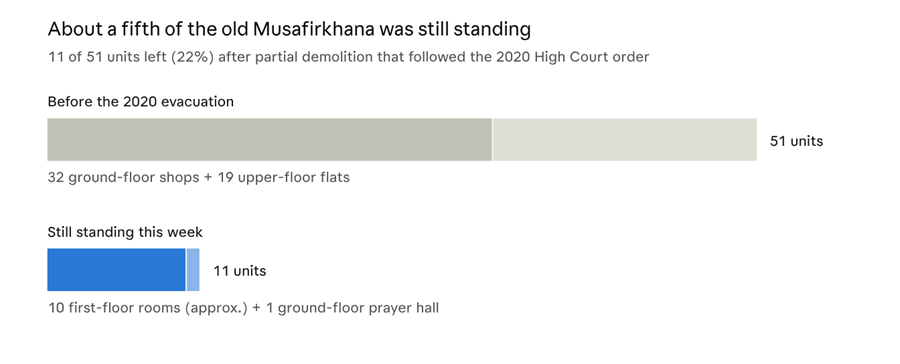
The Musafirkhana is a ground-plus-two-storey structure. After the BMC classified it C-1 and the Bombay High Court ruled on a petition in August 2020, occupants were evacuated and the upper floors were torn down in stages, including the second-floor rooms the Kaskar family once lived in. By this week only the disputed ground-floor prayer space and roughly 10 first-floor rooms remained.
From Pilgrims’ inn to D-Company Base
The building began as a musafirkhana, a charitable rest house where Haj pilgrims could stay while passing through Bombay on their way to Mecca. Local accounts date it to 1864, which would make it 162 years old; residents call the mosque 140 years old, and one report says the building dates to around 1939. In 1944 the Bombay High Court framed a scheme for the trust that ran it. As pilgrim traffic dwindled, the trust rented out the shops below and the rooms above, using the income for educational and medical aid.
The Kaskar family moved here from nearby Temkar Mohalla. Until the 1980s, the building is alleged to have served as an early base for Dawood Ibrahim’s gang, where smuggled goods were stored, and rival Pathan gang members once opened fire at its entrance trying to kill him. The family lived on the second floor, which held Dawood’s personal room and an office; the conspiracy for the 1993 serial blasts is alleged to have been hatched there. A first-floor tenant has told the Waqf Board in an affidavit that Dawood occupied the second floor as a trespasser.
After Dawood left India in 1986, his mother Amina Bi stayed on, and his brother Iqbal Kaskar reportedly used the premises in later years. Following the 1993 blasts, the government moved to seize the family’s properties under SAFEMA. Amina Bi and sister Haseena Parkar fought the seizure in the Delhi High Court and the Supreme Court, which dismissed their plea on April 20, 2018.
| Year | Milestone |
| 1864 | Musafirkhana built for Haj pilgrims (local accounts) |
| 1944 | Bombay High Court frames a scheme for the managing trust |
| 1986 | Dawood Ibrahim leaves India |
| 1993 | Mumbai serial blasts; SAFEMA seizure proceedings follow |
| 2009 | SBUT set up to redevelop Bhendi Bazaar |
| 2016 | SBUT acquires the Musafirkhana |
| Nov 2017 | Three Dawood properties in Bhendi Bazaar auctioned to SBUT |
| Apr 20, 2018 | Supreme Court dismisses the Kaskar family’s plea |
| Aug 31, 2020 | Bombay High Court order on the dilapidated building; upper floors razed in stages |
| Apr 8, 2025 | Waqf Tribunal declares the Musafirkhana non-waqf (per Outlook) |
| Sep 15, 2025 | Supreme Court partly stays the Waqf (Amendment) Act |
| Nov 16, 2026 | BMC issues fresh demolition notice |
| Nov 19, 2026 | Demolition begins under police deployment |
Dawood’s Seized Properties
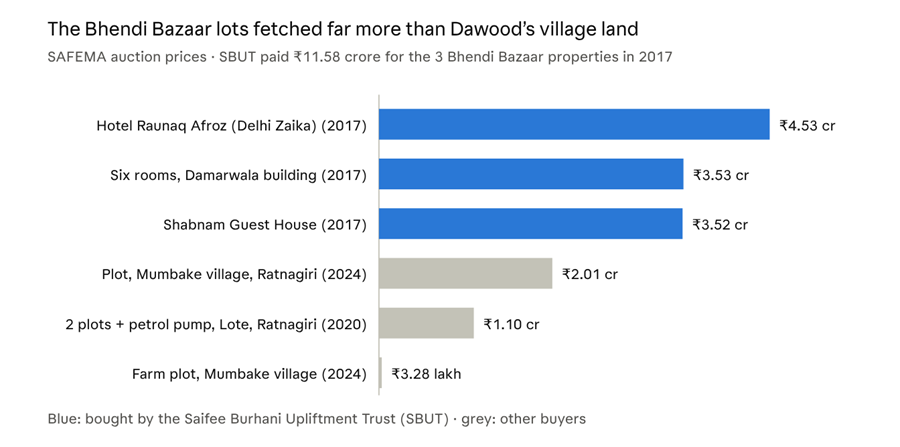
SAFEMA auctions: Tribune / Deccan Chronicle (Nov 2017); Hindustan Times via inkl (Nov 2020); Siasat / National Herald (Jan 2024)
The Musafirkhana itself was never Dawood’s to sell: it belonged to a charitable trust. But several properties his family owned nearby were confiscated and auctioned. For years no one would bid, and police suspected buyers were being threatened. In November 2017 SBUT won all three Bhendi Bazaar lots, saying they lay inside its redevelopment area and were unfit for living. Later auctions of ancestral land in Ratnagiri district, where Dawood spent his early childhood, drew far lower prices.
The Bigger Project Behind the Bulldozers
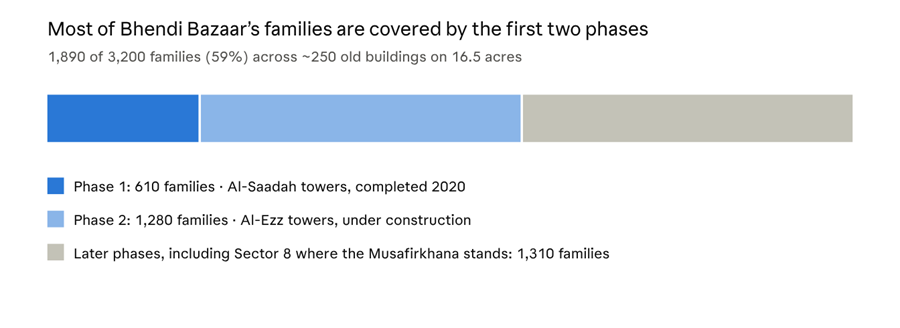
The Musafirkhana sits in Sector 8 of the Bhendi Bazaar Redevelopment Project, run by SBUT, a trust of the Dawoodi Bohra community. Valued at around ₹4,000 crore, it is one of India’s largest cluster redevelopment schemes: about 250 dilapidated buildings, 1,250 shops and 3,200 families are to be rehoused in about 11 towers. SBUT has bought several other waqf-linked properties for the project, and the contest over the Musafirkhana’s waqf status has been a major stumbling block.