The ruling
On 17 November 2026 the Supreme Court put Samajwadi Party leader Azam Khan, his wife Tazeen Fatma and their son Abdullah Azam Khan on equal footing: all three now have their convictions in the forged birth-certificate case suspended while their appeals are heard. A bench of Justice Dipankar Datta and Justice Sheel Nagu dismissed Uttar Pradesh’s appeal against the relief Azam Khan already had, and allowed the appeals of Fatma and Abdullah, who had been refused the same relief (Verdictum).
The matters, led by State of U.P. v. Mohd. Azam Khan & Ors. (SLP (Crl) Nos. 11030–11032 of 2025), arose from the Allahabad High Court’s order of 24 May 2024. Senior Advocate Kapil Sibal appeared for Azam Khan and Fatma. The bench announced its decision in court; a reasoned judgment had not been published when early reports went out (LawChakra).
The ruling is interim. It does not acquit anyone or disturb the trial court’s findings; the appeals on the merits continue.
Court by court
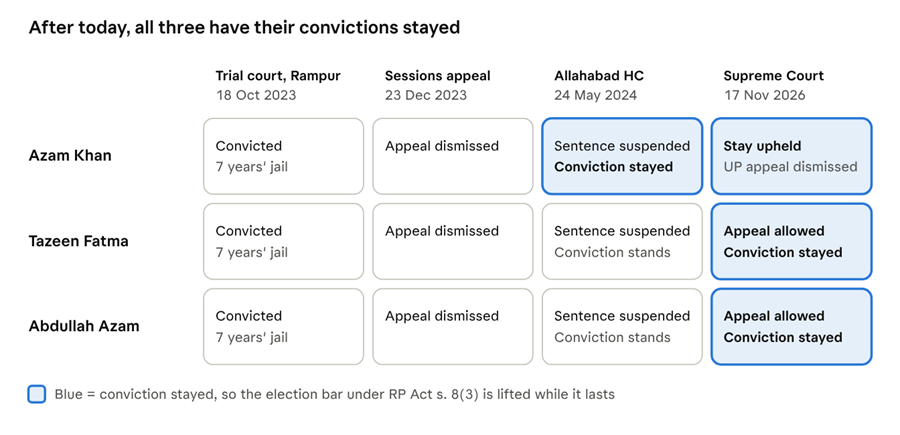
Relief at each court, birth-certificate case · 3 accused, 4 courts
Every court up to the High Court treated the three alike; the High Court split them, and the Supreme Court has now re-joined them.
The two certificates
The case turns on two municipal birth certificates for Abdullah Azam Khan. Akash Saxena, then a BJP functionary and now the BJP MLA from Rampur, filed the FIR at Rampur’s Ganj police station on 3 January 2019, accusing Azam Khan and Fatma of conspiring to obtain both.
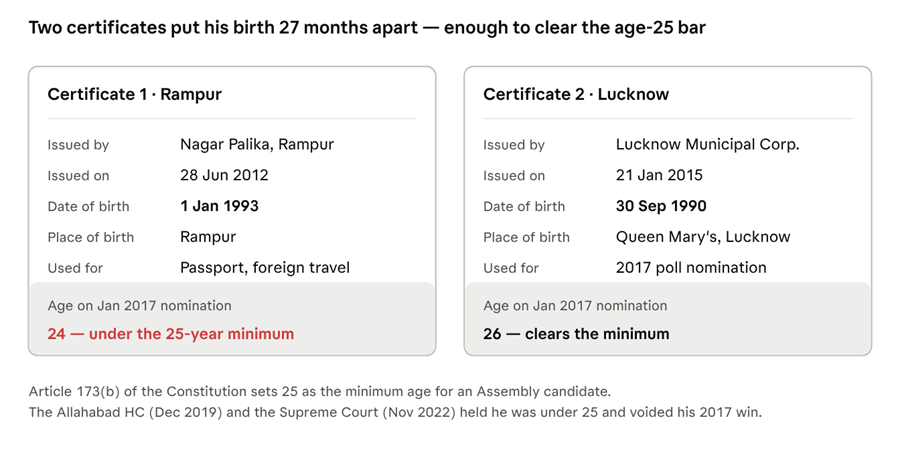
Certificate details as described in the prosecution case · Verdictum, Deccan Herald, Free Press Journal
The prosecution’s case is that the Rampur certificate rests on the parents’ affidavits, and that the Lucknow certificate was obtained so that Abdullah could meet the age bar for the 2017 Suar Assembly seat, which he won. The age question is already settled in the election case (Verdictum, 2022); the criminal case asks who, if anyone, committed forgery and cheating in obtaining the certificates.
Timeline
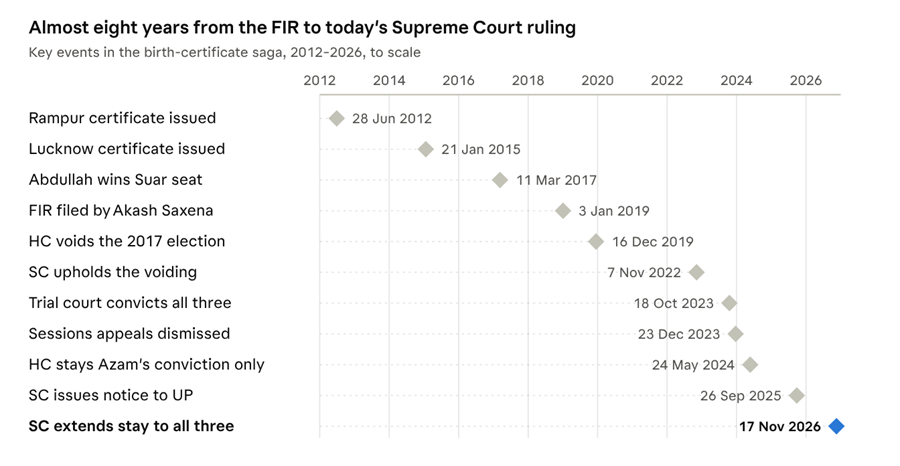
Dates from Verdictum, LawChakra, Deccan Herald, PTI and court records · 11 events
The election case and the criminal case ran in parallel: the age question was settled in 2022, while the criminal trial produced a conviction in 2023 that is now on hold.
Why the High Court split the family
On 24 May 2024 the Allahabad High Court suspended the sentences of all three and released them on bail. It went further only for Azam Khan, staying his conviction because it found no material showing he had supplied the information used to get the second (Lucknow) certificate (LawChakra). Fatma and Abdullah were refused that relief because of their alleged roles in obtaining and using the document.
The High Court also flagged weaknesses in the prosecution case that cut across all three accused (Verdictum):
- The Lucknow certificate of January 2015 was said to rest on a hospital certificate dated April 2015 — a document that came later.
- Neither the State nor the complainant could say who had been cheated; the complainant was not himself deceived.
- The officials who issued both certificates were never examined during investigation or produced at trial.
- The offences were not heinous, and none of the accused had misused bail. Azam Khan was about 74 and Fatma about 72.
Fatma and Abdullah’s petitions leaned on the same point: the High Court itself had found no material proving that any of them forged the 2015 certificate (Sunday Guardian). When the Supreme Court issued notice in September 2025, then-CJI B.R. Gavai noted that staying a conviction is rare, while suspending a sentence is routine. The Datta–Nagu bench has now extended that rare relief to all three.
Conviction vs sentence: why the difference matters
The gap between the two forms of relief is what this litigation was about. Under Section 8(3) of the Representation of the People Act, 1951, anyone convicted and sentenced to two years or more is disqualified from contesting elections from the date of conviction until six years after release. Suspending the sentence keeps a person out of jail but leaves that disqualification running; staying the conviction suspends it too (Deccan Herald).
| Suspension of sentence | Stay (suspension) of conviction | |
| Keeps the convict out of jail | Yes | Yes |
| Lifts RP Act s. 8(3) disqualification | No | Yes, while the stay lasts |
| How often courts grant it | Routinely | Rarely, in exceptional cases |
| Status after 24 May 2024 | All three | Azam Khan only |
| Status after 17 Nov 2026 | All three | All three |
Before today, the refusal kept Fatma barred from contesting elections or holding trust positions, and Abdullah under the same bar (Lawbeat).
What the ruling does not settle
Today’s order clears one conviction, not the family’s legal record. Three matters still stand in the way, two of them for Azam Khan and Abdullah:
- The appeals on the merits. The stay lasts only until the criminal revisions are decided; the trial court’s findings stand meanwhile (LawChakra).
- The dual PAN card case. A separate complaint by Akash Saxena accused Abdullah of holding two PAN cards with the same two birth dates. A Rampur MP/MLA court convicted Azam Khan and Abdullah on 17 November 2025 — a year to the day before today’s ruling — with seven years each and a ₹50,000 fine (Free Press Journal). The Rampur sessions court later dismissed their appeals (ETV Bharat). On 29 October 2026 the Allahabad High Court granted bail but refused to stay those convictions (Bar & Bench).
- The wider caseload. As of November 2025, 104 cases had been registered against Azam Khan; 12 had been decided, with seven convictions and five acquittals.
Because the PAN-card convictions carry seven-year sentences and remain unstayed, the Section 8(3) bar would on its face still apply to Azam Khan and Abdullah, whatever today’s ruling says. Fatma was not an accused in the PAN case, so the practical gain may be largest for her. That reading is an inference from public reports, not something the Supreme Court said.