Delhi’s short break from toxic air is ending. A day after stronger winds and light rain thinned the smog, the national capital is expected to slip back into the ‘very poor’ air quality band on Tuesday, November 17, and the Air Quality Early Warning System (AQEWS) expects it to stay there for the six days that follow.
The citywide number hides how uneven the air is. The Commission for Air Quality Management (CAQM) put Delhi’s overall AQI at 288 (‘poor’) at 1 am, yet at midnight several monitoring stations were already well past 300, with Sirifort at 393, a few points short of ‘severe’. PM2.5, the fine particulate matter that penetrates deepest into the lungs, was the dominant pollutant at most of them.
Reading the AQI scale (CPCB): 0–50 good · 51–100 satisfactory · 101–200 moderate · 201–300 poor · 301–400 very poor · 401–500 severe.
Snapshot: hotspots far above the city average
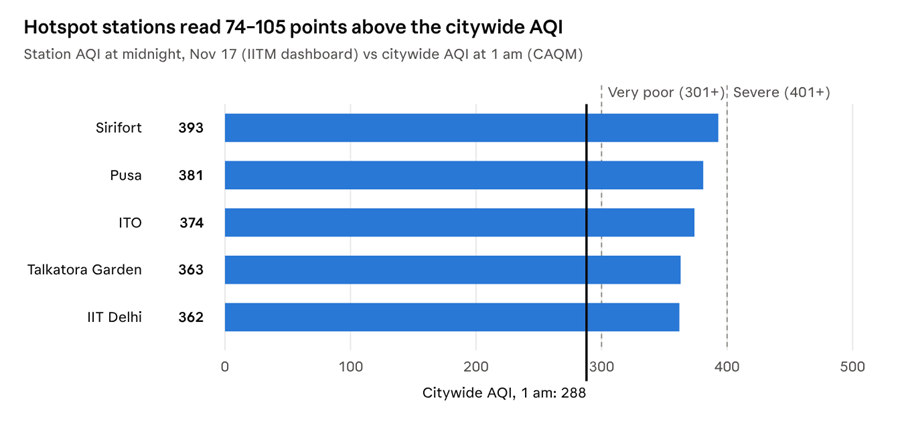
Source: IITM dashboard station readings at midnight, Nov 17; CAQM citywide AQI at 1 am, Nov 17 (as reported by Outlook India)
The citywide AQI is an average across Delhi’s roughly 57–59 monitoring stations, so it smooths over the worst-hit neighbourhoods. At midnight every one of the five highest-reading stations was already deep in the ‘very poor’ band, with Sirifort, Pusa and ITO the worst. Chandni Chowk, Burari Crossing, North Campus and the Commonwealth Sports Complex also crossed 300.
For someone living or commuting near these stations, the ‘poor’ headline understates what they are actually breathing.
How November unfolded
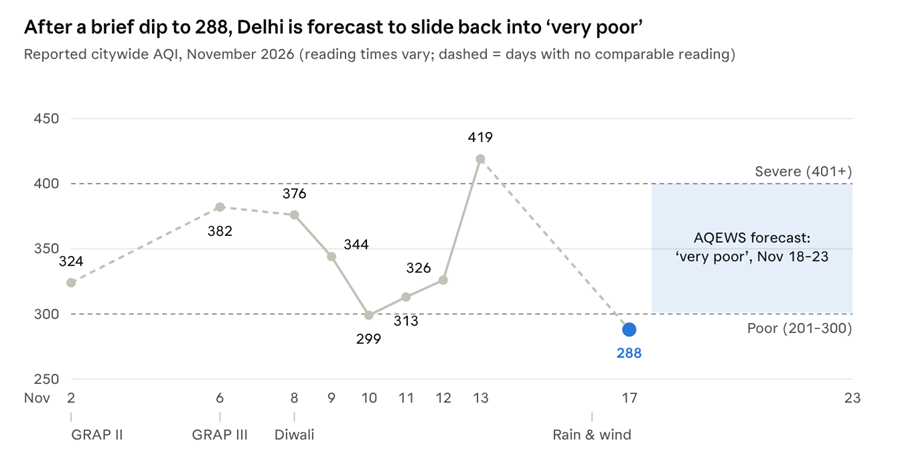
Source: CPCB/CAQM readings as reported by PTI, IANS, Outlook, Swarajya, NewsBytes and Outlook India; forecast from the Air Quality Early Warning System. Readings are taken at different times of day, so treat the line as indicative.
The season’s first ‘very poor’ day came on November 2, when the AQI reached 324 and CAQM imposed Stage II of the Graded Response Action Plan (GRAP) across the NCR. By November 6 the daily average had climbed to 382 and Stage III followed, as a precaution days before the festival.
Diwali (November 8) pushed the average to 376 at 4 pm, the worst festival-day reading since 2021 and well above Diwali 2025’s 345. The morning after, 14 stations were in the ‘severe’ band. A short improvement followed, with the daily figure briefly dipping to 299 on November 10, before weak winds and a falling mixing height brought the city to its worst point of the month: 419 on the morning of November 13, when 33 of 58 stations were ‘severe’ and IIT Delhi touched 488.
Stronger winds and light rain on November 16 gave the city its first real break. The overnight 288 is the result, and the forecast says it won’t last.
What’s driving it
PM2.5 dominates. On November 12, PM2.5 was the leading pollutant at 47 of 57 reporting stations, and it again led at most stations on the night of November 16–17. These particles are small enough to reach deep into the lungs and bloodstream, which is why ‘very poor’ days are linked to breathing trouble even in healthy people.
Weather does the trapping. Delhi’s winter combination of low wind speeds, cooler nights and temperature inversions holds emissions close to the ground. That is why a single day of brisk wind and drizzle, as on November 16, can clear the air so quickly, and why the gains fade as soon as calm returns. Forecasters flagged weak winds and a falling mixing height ahead of the November 13 peak.
Stubble burning is down, but it isn’t the whole story
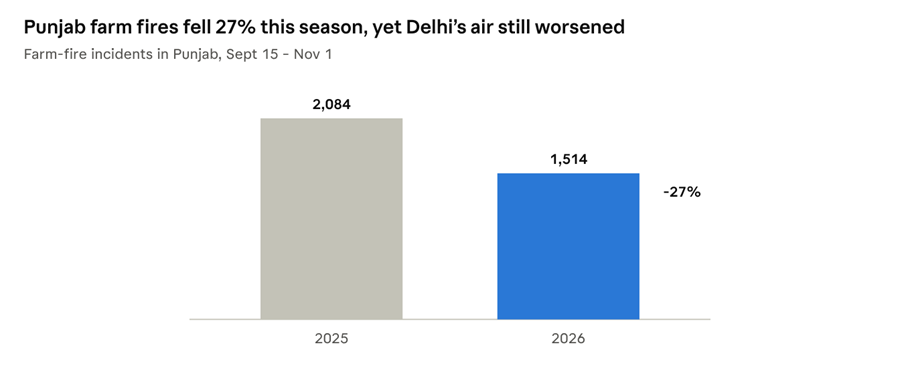
Source: Delhi-NCR air-pollution management fact sheet, as reported by Outlook India
Punjab recorded markedly fewer farm fires this season than last, continuing a multi-year decline. Yet Delhi’s Diwali-day AQI was higher than in 2025, and the city logged its worst air in 287 days on November 3. Researchers have repeatedly found that Delhi’s PM2.5 does not fall in step with farm-fire counts: local sources such as vehicles, construction dust, industry and waste burning, plus festival firecrackers, keep the baseline high. One caution: a recent study found farmers increasingly burning in the late afternoon, after the satellites that count fires have passed overhead, so official counts may understate the real number.
Restrictions in force, and what comes next
Stage III of GRAP has been in force across Delhi-NCR since November 6, on top of the Stage II measures (mechanised sweeping, water sprinkling, dust control at construction sites and stricter checks on open burning and visibly polluting vehicles) introduced on November 2. Despite them, the city has spent most of November in the ‘very poor’ band, with repeated spells of ‘severe’ air.
The outlook offers little relief. The Air Quality Early Warning System expects ‘very poor’ air from Tuesday and for the six days after it, as the weather that cleared the skies on Monday gives way to calmer conditions. Pollution in Delhi typically stays elevated from November into January.
What residents can do on ‘very poor’ days
- Check the reading at the nearest station, not just the citywide figure: as the snapshot above shows, they can differ by 100 points.
- Cut back on outdoor exercise, especially early morning and late evening, when pollution tends to be trapped near the ground.
- Wear a well-fitted N95 or equivalent mask outdoors; cloth and surgical masks do little against PM2.5.
- Take extra care with children, older people and anyone with asthma, heart or lung conditions, and seek medical advice if symptoms worsen.