Late on Sunday, 15 November, the Union Environment Ministry emailed All India Students’ Association (AISA) president Neha Bora. The message was meant to defuse a planned citizens’ delegation to Environment Minister Bhupender Yadav’s office. It didn’t work. On Monday afternoon the delegation marched to the ministry’s Jor Bagh office anyway, under the banner of the “right to breathe”. Supporters gathered on Second Avenue in Lodhi Colony and demanded that the group be allowed to meet senior officials.
The trigger was silence. On 12 November Bora and several co-signatories wrote to Yadav asking for an urgent meeting on Delhi-NCR’s air. They said nobody replied until after Bora posted a video appeal asking citizens to come with her to the ministry.
What the ministry said, and where the minister is
The ministry’s email said the minister was abroad and was still overseeing enforcement. It was signed by V Pazhaniyandi, a director in the ministry. It said Yadav attaches the “highest priority” to air pollution and is “continuously monitoring and reviewing” what state governments and local bodies are doing.
The email made three main points:
- Enforcement on the ground. A review meeting told NCR states to enforce rules strictly, on deadlines and in coordination, and to post secretary-level officers in cities across the region.
- CAQM coordination. The Commission for Air Quality Management (CAQM) is working with Delhi, Punjab, Haryana, Uttar Pradesh, Rajasthan and local bodies.
- Accountability. The Centre wants real-time monitoring, accountable field officers, and action against industries that haven’t installed the required pollution-control equipment.
Yadav is in Antalya, Türkiye. He is leading India’s delegation at the UN climate summit COP31, which runs from 9 to 20 November 2026. Officials told ThePrint the delegation arrived by 9 November and the minister would join in the second week. At a 3 November briefing he said India would push climate finance as a key priority and work with the G-77/China, LMDC and BASIC blocs.
The protesters’ reply. The delegation said it would meet the minister’s team and the officials in charge while he is away, and would also ask for an appointment with Yadav once he returns from his foreign travel.
Context the email left out. Since late 2025 Yadav has chaired a series of NCR review meetings. In January 2026 he set a goal of cutting Delhi-NCR pollution by 15–20% by 2027. Critics have questioned how much these reviews have produced. In January, Newslaundry reported that only three meetings had been held on Delhi’s air crisis.
Two weeks of smog
Delhi spent most of early November in the “very poor” band and close to “severe”. It eased only in the days before the march.
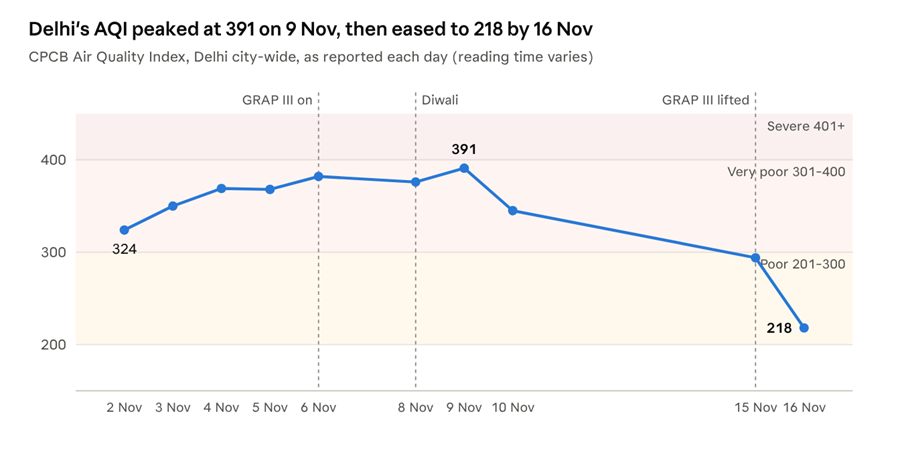
Source: CPCB readings as reported by PTI, NewsBytes, Outlook, ANI · 2–16 Nov 2026 · reading times differ day to day
On 3 November the city recorded its worst air in 287 days. CAQM brought in Stage III of the Graded Response Action Plan (GRAP) on 6 November, before Diwali. Diwali-day pollution was the highest since 2021. City-wide averages also hide spikes: on 4 November, 20 of 59 stations read “severe”, and on 9 November Bawana hit 436. CAQM lifted Stage III on 15 November, when the AQI dropped to 294, but kept Stages I and II in force.
Who marched, and what they want
The delegation brings together student, parent, health-policy and environmental voices:
| Member | Background |
| Neha Bora | President, All India Students’ Association (AISA) |
| Bhavreen Kandhari | Environmental activist, Warrior Moms |
| Urvashi Prasad | Public policy and health expert, founder of PAVANA |
| Ashish Jacob | Former member, Air Pollution Action Group |
Their 12 November letter raised five areas of concern:
- Monitoring gaps. Too few stations, and doubts about how reliable the data is.
- Public health risk. What prolonged exposure does to children, the elderly and outdoor workers.
- Emissions at source. Transport and industrial emissions.
- Dust and waste. Construction dust and waste management.
- Transparency and accountability. Open air-quality data and real consequences for polluters.
In Bora’s video appeal, the campaign is about the “right to breathe” as part of the constitutional right to life. At the march, placards included one reading “Remember a clear Delhi sky?”
The demand for better data has some support in the reporting. During the post-Diwali spike, the opposition alleged that water was being sprayed on monitoring stations to hold readings down. Delhi’s government denied it. Independent analysts have also argued that city-wide averages hide severe local hotspots.