On 13 November 2026, the United States Commission on International Religious Freedom (USCIRF) posted on X that Sharjeel Imam “is a Muslim man detained in India for his religious freedom advocacy,” and linked to his profile in its database of religious prisoners. Within a day the post had passed 640,000 views, its replies had filled with anger, and India’s ambassador in Washington had publicly rebuked the commission. USCIRF posted similar profiles the same day of Dalit activist Jyoti Jagtap and Arun Pannalal, president of the Chhattisgarh Christian Forum.
Imam, a former PhD scholar at Jawaharlal Nehru University (JNU), has been in custody since 28 January 2020. As of 14 November 2026 that is 2,482 days, about six years and nine months. The Delhi Police accuse him of being one of the “masterminds” of the February 2020 riots in north-east Delhi, in which 53 people were killed and more than 700 injured.
This article sets out what USCIRF said, how people reacted, what the cases against Imam actually allege, and how his bail pleas have fared. It also explains why a criminal prosecution and a religious-freedom assessment can reach such different conclusions about the same person.
What USCIRF’s profile actually says
The profile does not hide the charges. Under “nature of charges” it lists seven categories: criminal premeditation and conspiracy; hate speech; illicit financing; murder and attempted murder; public disorder; terrorism; and treason and sedition, mostly under the Unlawful Activities (Prevention) Act (UAPA).
It then reaches its own conclusion. It classifies Imam’s detention as persecution linked to religious-freedom advocacy, and it describes his part in the protests against the Citizenship (Amendment) Act (CAA) in December 2019 and January 2020 as peaceful opposition to a law it calls religiously discriminatory.
The database records two different things side by side: the charges a government has brought, and USCIRF’s view of why the person is really being held. A listing is an advocacy judgment by a US advisory body, not a court finding. USCIRF calls itself an independent, bipartisan agency of the US legislative branch. Congress created it in 1998 under the International Religious Freedom Act, and its recommendations do not bind the State Department.
The backlash on X
The replies were overwhelmingly hostile. Many simply called Imam a terrorist. One user called USCIRF itself “an American terrorist organisation” and complained that it has never had a practising Hindu on its board. Another answered with a sarcastic comparison to Aafia Siddiqui, the Pakistani neuroscientist imprisoned in the US on terrorism-related charges.
Several replies went straight to the speeches behind the first cases against him. One asked whether “religious freedom” meant urging people to cut off the “chicken’s neck” corridor to the North-East, calling for communal violence and threatening India’s integrity. The same user warned Americans that they would face similar demands within 10 to 15 years. Others reposted a 2020 protest clip of Imam and asked whether Washington was now backing radicals. One long post lumped Imam together with Osama bin Laden, Hamas, Hafiz Saeed and Masood Azhar, and argued that he was jailed for trying to cut off the North-East, not for opposing the CAA. None of the charges reported against Imam mention any of those people or groups. Another user chanted “Jai Shri Ram” and wished that Imam would rot in jail forever.
Commentary sites joined in. One called the post a “shameful whitewashing” of a serious criminal case. Few replies addressed the point USCIRF was actually making. Its listing admits the charges and disputes the motive behind them. Most replies treated the post as a claim that Imam is innocent, and answered with the allegations, which the profile already lists.
India’s response
India’s ambassador to the United States, Vinay Mohan Kwatra, answered publicly. He said USCIRF has no locus standi to judge the constitutional rights of Indian citizens, and that India’s commitment to religious freedom could not be diminished by the commission’s “habitual partisan, ill-informed, and jaundiced assessments.” He told the commission to look at its own prejudices and stop lecturing others.
This fits a long pattern. India’s Ministry of External Affairs (MEA) rejected USCIRF’s 2026 annual report as a “motivated and biased characterisation” of the country. In October 2024, MEA spokesperson Randhir Jaiswal urged the commission to give up what he called agenda-driven efforts and look at human rights in the United States instead.
Who is Sharjeel Imam, and what is he accused of?
Imam was born in 1988 in Kako, in Bihar’s Jehanabad district. He studied at IIT Bombay and later became a history PhD scholar at JNU. He became a national figure during the anti-CAA protests through two speeches: one near Jamia Millia Islamia on 13 December 2019, and a roughly 40-minute address at Aligarh Muslim University (AMU) on 16 January 2020.
The AMU speech is at the centre of the anger. Police allege that he urged protesters to “cut off Assam from India” by occupying the “Muslim-dominated chicken’s neck,” meaning the Siliguri Corridor, the narrow strip of land in West Bengal that connects the North-East to the rest of India. In the clip, he talked about the situation of Muslims in Assam and about blocking roads and railway tracks to stop supplies. Imam’s supporters say this was a call for a blockade, a form of protest, not for secession or violence. Shortly before his arrest he told The Indian Express that the clips had been edited and that nothing could be proved against him.
The police responded within days:
• 25 January 2020: Assam Police registered an FIR for sedition, promoting enmity between groups, and Section 13 of the UAPA. Aligarh police in Uttar Pradesh booked him for sedition the same day.
• 26 January 2020: Delhi Police and the Itanagar police in Arunachal Pradesh filed FIRs. Manipur followed.
• 28 January 2020: He was arrested in Jehanabad, Bihar, after appealing for calm on social media. On the same day, Home Minister Amit Shah called his words more dangerous than the slogans for which Kanhaiya Kumar had been charged.
By 2022 he faced eight cases across five states: Delhi, Assam, Arunachal Pradesh, Manipur and Uttar Pradesh.
The case that keeps him in jail came later. Imam was already in custody when the riots broke out on 23 February 2020. Months afterwards, Delhi Police named him as an accused in FIR 59/2020, the “larger conspiracy” case under the UAPA. The prosecution’s theory is that his speeches and organising during the protests were part of a planned conspiracy that ended in the riots.
The bail record: two very different outcomes
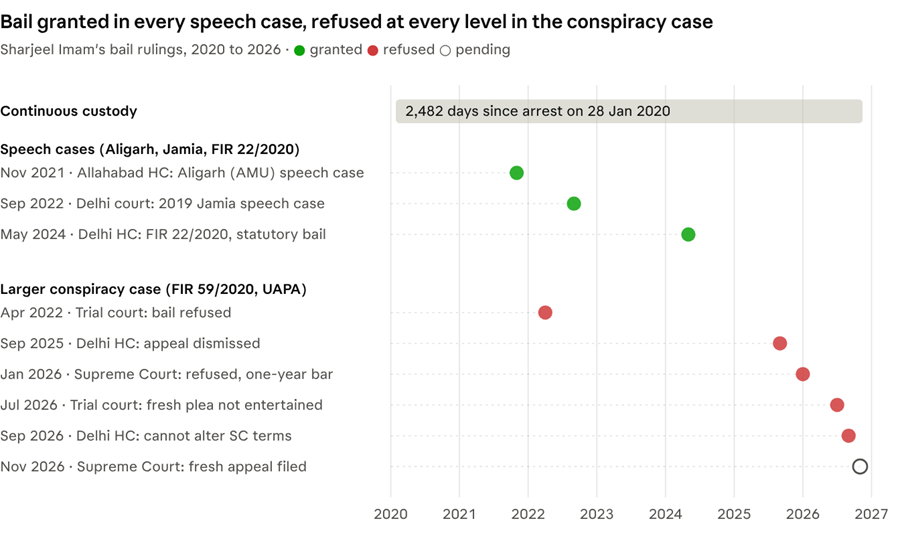
Compiled from court reporting (LiveLaw, The Quint, Scroll, SCC Online, ANI, LawBeat) · rulings dated to the month · Jan 2020 to Nov 2026
The pattern is consistent. In the cases about his speeches, courts have granted bail. In November 2021 the Allahabad High Court, granting bail in the Aligarh case, observed that the AMU speech had not called on anyone to take up arms and had not incited violence. A Delhi court granted bail in 2022 in the case over the 2019 Jamia speech, and he also has bail in the Assam and Arunachal Pradesh cases. On 29 May 2024, the Delhi High Court granted him statutory bail in FIR 22/2020, the Delhi Police case over both speeches. By then he had spent more than four years in custody, over half the seven-year maximum sentence for the offences charged. Trial on the sedition charge has been on hold since May 2022, when the Supreme Court suspended the use of Section 124A.
None of those orders freed him, because he is still held in the conspiracy case, where every court that has heard his bail plea has refused it.
The conspiracy case: bail denied, trial not started
FIR 59/2020 was registered on 6 March 2020. UAPA provisions were added on 19 April, and the first chargesheet was filed on 16 September 2020. It names 18 accused, most of them student activists who led anti-CAA protests, plus one politician, former Aam Aadmi Party councillor Tahir Hussain.
The prosecution’s case, as the Supreme Court accepted it. On 5 January 2026, a bench of Justices Aravind Kumar and N.V. Anjaria refused bail to Imam and Umar Khalid and granted it to five co-accused: Gulfisha Fatima, Meeran Haider, Shifa-ur-Rehman, Mohd Saleem Khan and Shadab Ahmed. The court said Imam and Khalid stood on a “qualitatively different footing” from the others. It accepted, prima facie, the prosecution’s description of them as the central figures who planned to turn the protests into disruptive road blockades. It also held that a “terrorist act” under the UAPA is not limited to violence with conventional weapons. Under Section 43D(5), a court must refuse bail if the accusation appears prima facie true, and the bench described its task as one of “statutory plausibility, not evidentiary sufficiency.” It said both men could apply again once the protected witnesses had been examined, or after one year, whichever came first.
The criticism. Civil-liberties group PUDR, legal commentators and several editorials said the ruling made the seriousness of the allegations, rather than the evidence, the reason to keep people in jail before trial. On 18 May 2026, a different Supreme Court bench, hearing an unrelated narco-terror case, said that “bail is the rule” applies even under the UAPA and openly doubted the reasoning of the January judgment. On 22 May, another bench gave co-accused Khalid Saifi and Tasleem Ahmad six months’ interim bail and sent the wider question of long pretrial detention under the UAPA to a larger bench.
Where the trial stands. Arguments on whether to frame charges ended on 13 July 2026, but no charges have been framed. The trial judge is waiting for the Supreme Court to rule on a co-accused’s request to inspect documents the prosecution does not rely on. Imam’s latest petition says the prosecution has not examined a single witness. By September 2025, a ThePrint count found more than 510 hearing dates and at least 166 adjournments. Trial judges have blamed some of the delay on defence applications, and in September 2025 the Delhi High Court ruled that long custody and slow trials are not, on their own, grounds for bail.
The riots at the heart of the case
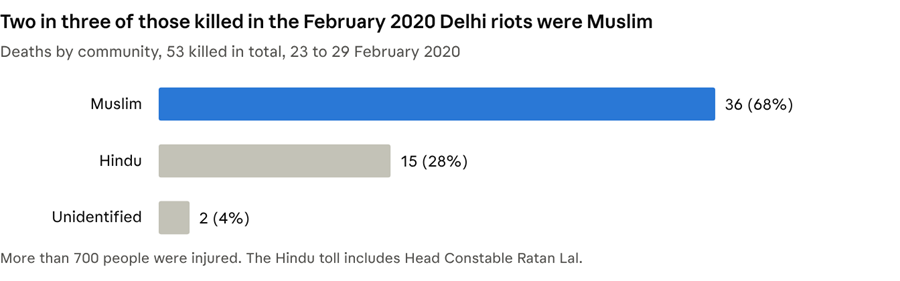
The violence in north-east Delhi between 23 and 29 February 2020 was the city’s worst communal violence since the anti-Sikh massacre of 1984. Official counts put the dead at 53 and the injured at more than 700. The Supreme Court’s January 2026 judgment refers to 54 deaths. The Delhi Police list of the dead, filed in court, shows that most were Muslim.
The UAPA by the numbers
NCRB data in a Lok Sabha reply, via The Quint and Bar & Bench · people arrested and convicted under the UAPA, 2019 to 2023
Imam’s long detention is typical of UAPA cases. Section 43D(5) bars bail whenever the accusation appears prima facie true, which reverses the usual presumption in favour of bail, and UAPA trials move slowly. In 2020, about 95% of UAPA cases before the courts were still awaiting trial, according to NCRB data. As analysts note, arrests and convictions in the same year do not match up one to one, because many cases are still pending. Even so, the gap is large.