That is the central finding of Air pollution and health in India: A review of epidemiological evidence, released on 13 November 2026 by the Centre for Research on Energy and Clean Air (CREA), an independent research organisation that tracks the trends, causes, health impacts and solutions to air pollution. The team, led by CREA analyst Dr Manojkumar N with collaborators from the Vellore Institute of Technology and the Tamil Nadu Dr MGR Medical University, screened 184 epidemiological studies published over half a century, from 1975 to 2025. Together they cover 18 states and Union Territories, plus national and multi-state datasets.
The review arrives in the thick of another toxic winter. CREA’s monthly tracker found that in October 2026, 261 of the 267 Indian cities with enough monitoring data breached the World Health Organization’s daily guideline for PM2.5.
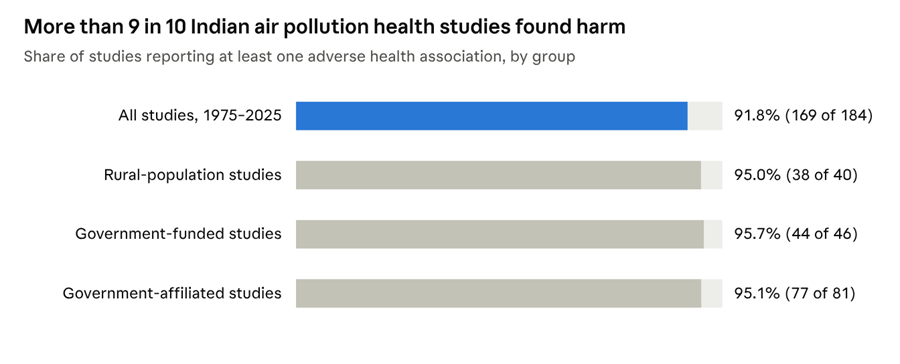
169 of 184 studies found harm
Of the 184 studies reviewed, 169 (91.8%) reported at least one adverse association between air pollution exposure and a health outcome. The pattern holds even in research the state itself backed: 44 of 46 government-funded studies, and 77 of 81 with government-affiliated authors, documented adverse effects.
Source: CREA, Air pollution and health in India: A review of epidemiological evidence (13 Nov 2026)
That consistency matters politically. Indian policymakers have repeatedly questioned whether global research linking dirty air to illness and shorter lives applies to Indian conditions, and researchers say their findings are often met with scepticism because they are “not based on studies from India.” This review assembles exactly that home-grown evidence, and it points overwhelmingly in one direction.
Beyond the lungs
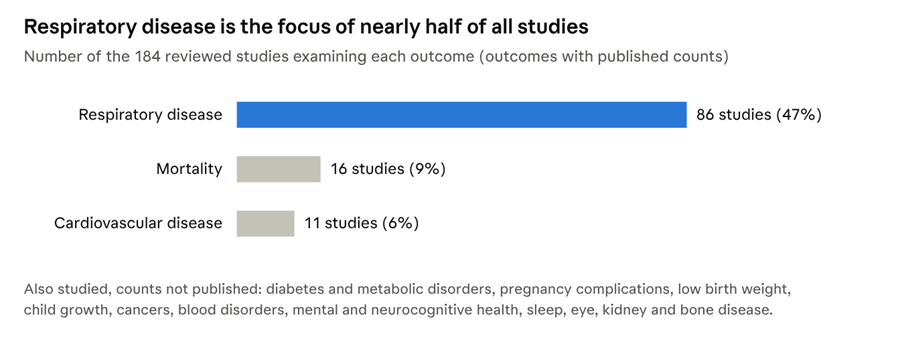
Respiratory illness is still where most Indian research looks: 86 studies, close to half the total, examined it, followed by mortality and cardiovascular disease.
Source: CREA epidemiological review (13 Nov 2026); shares computed against 184 studies
But the review shows the evidence has widened far past breathing problems. Studies have linked air pollution exposure to diabetes and other metabolic disorders, pregnancy complications and low birth weight, impaired child growth, cancers, blood (haematological) disorders, neurocognitive and mental-health conditions, sleep disorders, eye disease, and chronic kidney and bone disease.
Among studies of gaseous pollutants specifically, statistically significant adverse associations were reported for higher mortality, more acute respiratory hospital and emergency visits, asthma-related admissions, and impaired lung function.
The Indian findings line up with global evidence. The Lancet Countdown on Health and Climate Change 2024 warns that pollution from fossil fuels and biomass raises the risk of respiratory and cardiovascular disease, lung cancer, diabetes, neurological disorders and adverse pregnancy outcomes.
Not only an urban problem
Rural India is badly under-researched: only 40 of the 184 studies (about 22%) examined rural populations. Yet 38 of those 40 — 95% — reported at least one adverse health association, a higher hit rate than the evidence base as a whole (see the chart above).
That fits what emissions data show. According to PAVITRA, an air-quality management tool developed by IIT Bombay, CSTEP and two US universities, about 70% of India’s PM2.5 originates in non-urban areas, and roughly 95% is emitted from places outside the 131 cities that the National Clean Air Programme (NCAP) tracks. A separate CREA assessment of 4,041 cities and towns found 1,787 of them (about 44%) exceeded the national annual PM2.5 standard in every year from 2019 to 2024 (excluding the Covid year 2020) — yet only about 4% of these chronically polluted places fall under NCAP.
“The findings highlight the need to move beyond a city-centric approach and explicitly include rural areas through a regional, airshed-based approach in the next phase of National Clean Air Programme (NCAP 2.0),” said CREA analyst Manoj Kumar.
Where the research has been done
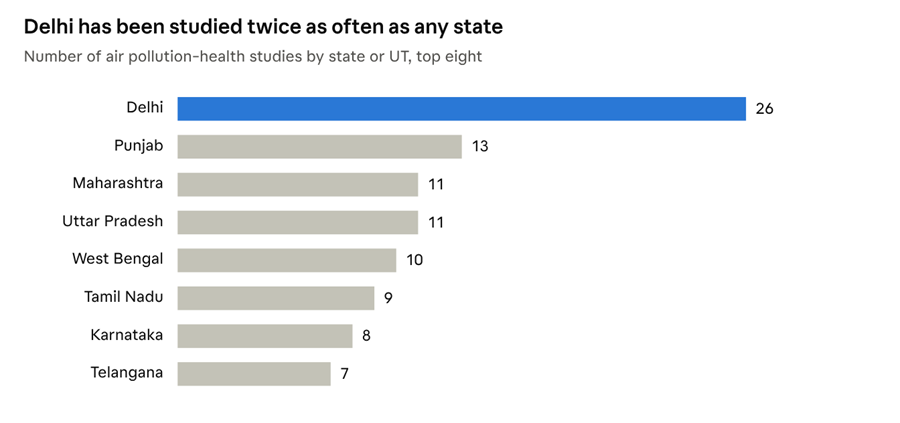
The evidence is geographically lopsided. Delhi alone accounts for 26 studies — double the next-most-studied state, Punjab, where research has often focused on crop-residue burning.
Source: CREA epidemiological review (13 Nov 2026)
The map of research follows the map of attention more than the map of exposure. CREA’s satellite-based assessment identifies the Indo-Gangetic Plain as the country’s most polluted airshed in every season, and flags the Northeast as an emerging year-round concern — Byrnihat, on the Assam–Meghalaya border, topped CREA’s 2025 ranking of India’s most polluted cities. Yet Bihar and the northeastern states do not appear among the most-studied regions, and in a state like Maharashtra, whose annual average sits right at the national standard, 14 districts still exceed it. Large parts of the population living in these hotspots remain largely invisible in the health literature.
Particles and the gases behind them
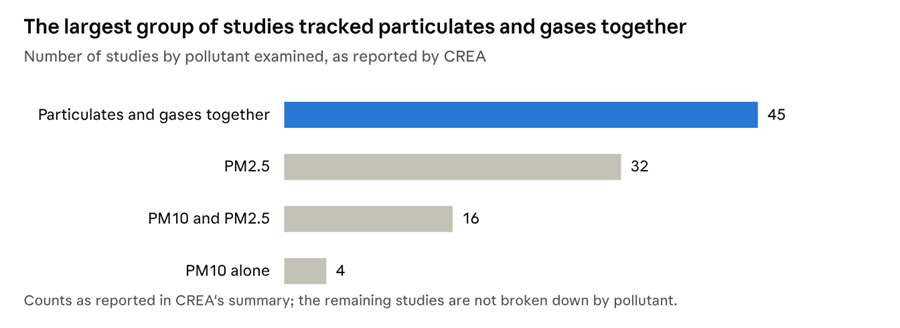
Studies examined a wide range of pollutants. The largest group — 45 studies — looked at particulate matter and gaseous pollutants together.
Source: CREA epidemiological review (13 Nov 2026)
The gases matter twice over. Beyond their own direct effects, sulphur oxides (SOx) and nitrogen oxides (NOx) react in the atmosphere to form sulphate and nitrate particles — so-called secondary PM2.5. Those reactions, along with ozone formation, mean that cutting dust alone cannot clean the air.
Yet India’s flagship programme is still built around coarse dust. NCAP’s targets are set in PM10, and CREA’s January 2026 progress report found that spending has leaned heavily toward road-dust measures, while industry and household fuel use each received less than 1% of funds. Its first recommendation was to prioritise PM2.5 and its precursor gases over PM10.
“Air pollution mitigation must adopt a multipollutant approach, addressing gaseous precursors that contribute to secondary PM2.5 and ground-level ozone formation. This requires emission reductions at major sources, including industries, power plants, residential cooking, and other combustion activities,” Kumar said.
The human toll
The review counts studies, not deaths — but separate burden estimates show what is at stake. They put India’s annual air pollution toll at between 1.6 and 2.1 million deaths.
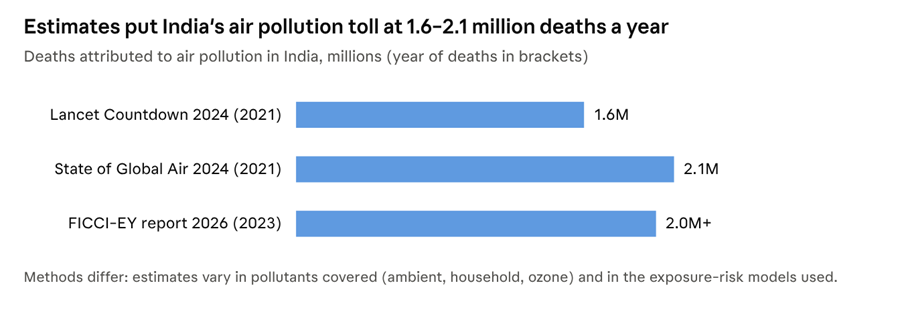
Sources: Lancet Countdown on Health and Climate Change 2024; State of Global Air 2024; FICCI–EY report (Nov 2026)
Other research fills in the detail:
- Short-term spikes kill. A 2024 Lancet Planetary Health study of 10 Indian cities linked 7.2% of daily deaths — about 33,000 a year between 2008 and 2019 — to PM2.5 above the WHO guideline. Delhi bore the most, at roughly 12,000 deaths a year (11.5%). Each 10 µg/m³ rise in PM2.5 raised daily mortality by 1.42%, and the authors found no safe threshold.
- Children are hit hardest. The State of Global Air 2024 report attributed 169,400 deaths of children under five in India in 2021 to air pollution — more than in any other country.
- Ozone is a growing threat. India accounted for 237,000 ozone-related COPD deaths in 2021, nearly half the global total.
- Even India’s own standard is too lax. The CHAIR-India consortium estimated about 300,000 deaths a year from long-term PM2.5 exposure above the national standard of 40 µg/m³ — eight times the WHO guideline of 5 µg/m³.
What it means for NCAP 2.0
The review lands as India weighs the next phase of its clean-air programme, and the first phase has fallen short. NCAP, launched in January 2019 for 130 cities, aimed to cut PM10 by 20–30% from 2017–18 levels, a goal later raised to 40% by 2025–26. By CREA’s count, fewer than a quarter of monitored cities got there.
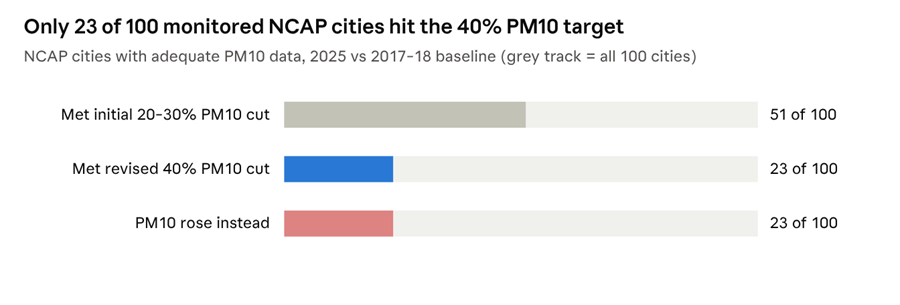
Source: CREA, Tracing the Hazy Air 2026: Progress Report on NCAP (Jan 2026)
In addition, 28 NCAP cities still had no continuous monitoring station as of 2025, and India’s National Ambient Air Quality Standards have not been revised since 2009. Drawing on the health evidence, CREA’s priorities for NCAP 2.0 are:
- Go regional. Manage pollution by airshed rather than city limits, and explicitly bring rural areas into planning.
- Target PM2.5 and its precursors. Shift from PM10 to fine particles, SO₂, NOx and ozone, through a multipollutant approach.
- Cut emissions at the source. Tighten and enforce standards for industry, power plants and other combustion sources.
- Clean up household energy. Speed the move away from biomass, coal and dung for cooking and heating.
- Measure more. Expand ambient (CAAQMS) and industrial stack (OCEMS) monitoring.
- Update the standards. Revise national limits, last set in 2009, in line with current health evidence.
Five decades of Indian research now point the same way. The question for NCAP 2.0 is whether policy will follow the evidence beyond city limits.