One in five Maharashtra voters — 2.07 crore people — was left off the draft electoral roll after the Special Intensive Revision (SIR), and Muslim-named voters were removed at a higher rate than their share of the population. That is the central finding of a preliminary analysis by the Kolkata-based Sabar Institute, which also found that Shaikh was the single most common surname among deleted voters, at 7.54 lakh names.
The study estimates that 30.2 lakh Muslim-named voters were dropped, or 14.6% of all deletions, against an estimated 12.1% share of the state’s population. The gap widens in Mumbai, and it is sharpest in one deletion category: voters marked “already enrolled” elsewhere, a classification the researchers suspect may reflect name-matching errors but could not verify.
The findings land as the Supreme Court weighs a challenge to the Maharashtra exercise and the Election Commission runs a drive to bring wrongly deleted voters back onto the rolls.
The scale: 21.1% of the electorate gone from the draft roll
Maharashtra had 9.785 crore registered electors before the revision; 2,06,88,421 of them did not appear on the draft roll published on 31 August 2026. That is 21.1% of the pre-SIR electorate, the largest absolute cut in any state now awaiting a final roll.
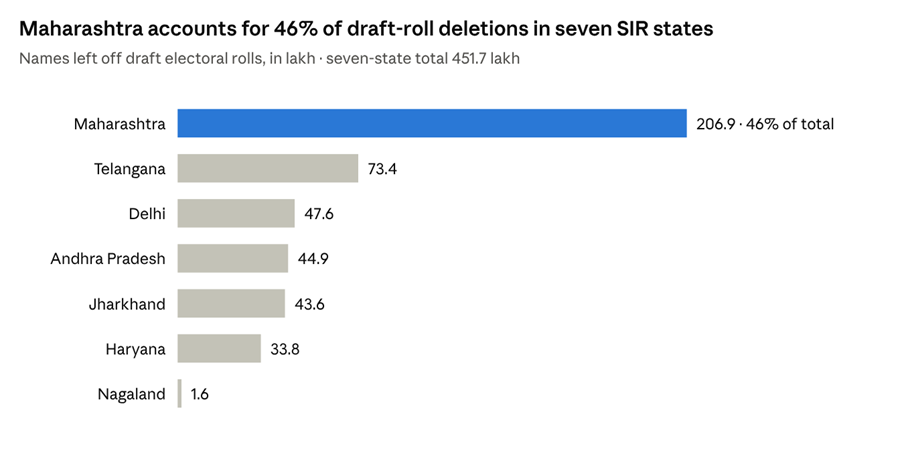
Election Commission figures for the seven states whose final rolls were pending, via The Daily Pioneer (Nov 2026)
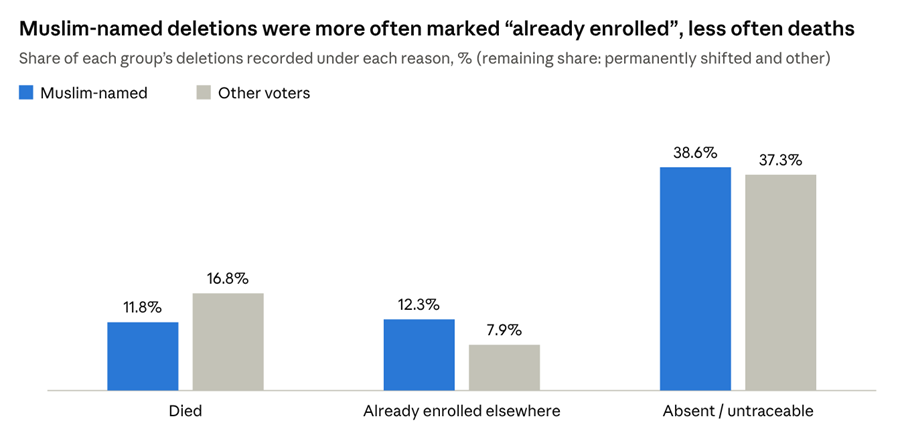
Deaths explain only a small part of it. The Sabar Institute attributes 16.8% of deletions to death, which leaves about 1.72 crore living people removed under three other headings: permanently shifted, absent or untraceable, and already enrolled elsewhere. Officials separately put the number of duplicate entries removed at roughly 17 lakh.
Muslim-named voters: 14.6% of deletions, 12.1% of the population
The institute counts 30,20,173 Muslim-named voters among those deleted, 14.6% of the total. That is about 2.5 percentage points above the community’s estimated share of the state’s population.
Sabar Institute, SIR Maharashtra preliminary report (Nov 2026); population share from Census 2011. District bars compare with the state line only for scale; district population shares differ.
The skew is concentrated, not uniform. In Mumbai, Muslim-named voters made up 21.3% of deletions, against 13.2% across the rest of the state. Outside Mumbai, the highest shares were in Aurangabad, Parbhani and Akola districts, but those need comparing with each district’s own Muslim population share, which the published summary does not set beside them.
Why they were removed: the “already enrolled” gap
The sharpest difference is not in who was marked absent but in who was marked a duplicate. Muslim-named voters were removed as “already enrolled” elsewhere at 1.6 times the rate of other voters, and were less often recorded as dead.
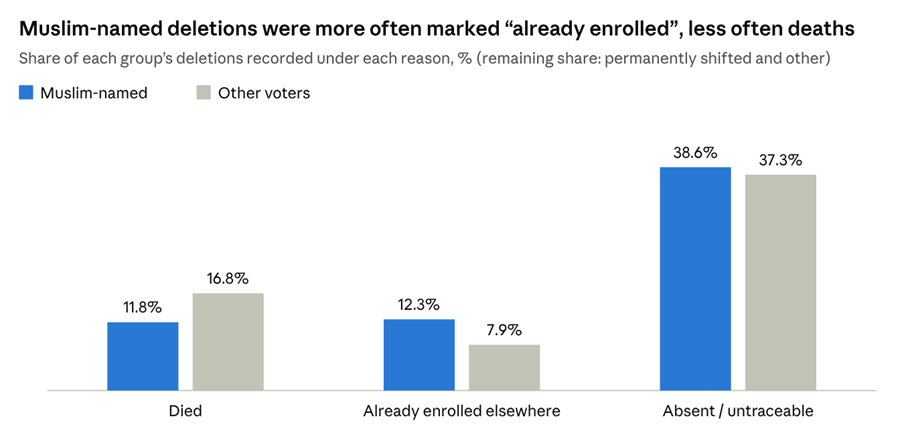
Sabar Institute, SIR Maharashtra preliminary report (Nov 2026), from ECI absent/shifted/dead/duplicate lists
After controlling for age and constituency, the institute estimates Muslim-named voters had 2.07 times the odds of being classed as already enrolled rather than dead, and 1.40 times the odds of being classed as absent or untraceable rather than dead. The pattern held in 285 of Maharashtra’s 288 constituencies.
The researchers offer one possible explanation: automated duplicate checks that match on names. Muslim names cluster around a relatively small set of surnames, such as Shaikh, Khan, Sayyed and Pathan, so two different people are more likely to look alike to a name-matching system. The institute stresses it could not test this, because the Election Commission’s lists do not say which other registration a deleted voter was matched against.
Surnames: Shaikh tops the list, but rankings are not proof of targeting
Shaikh appeared 7,53,978 times among deleted voters, more than any other surname and 2.7 lakh ahead of Patil in second place.
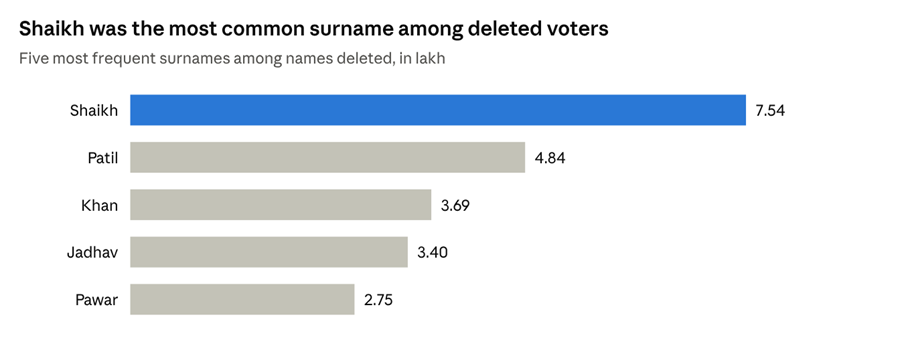
Sabar Institute, SIR Maharashtra preliminary report (Nov 2026)
Among deleted Shaikhs, 88% were removed for reasons other than death. About 30% were in Mumbai and 47% were women. The surname turned up among deletions in every one of the state’s 288 constituencies, most often in Mumbra-Kalwa in Thane district.
The report itself warns against reading this ranking as evidence of religious or caste targeting. A surname list measures how common a name is among the deleted, not what share of people with that name were deleted. Large Marathi surnames such as Patil, Jadhav and Pawar sit alongside Shaikh and Khan for the same reason: they are common. The 50 most frequent surnames together made up 30.1% of named deletions. The community-level comparison in the sections above is the more reliable measure.
Mumbai and Thane: where the rolls shrank most
Mumbai’s 36 constituencies hold 11% of Maharashtra’s pre-SIR electorate but produced 17% of all deletions; 34.7% of the city’s voters were dropped. Non-death deletions alone equalled 35.4% of the electorate in Thane district, 31.6% in Mumbai City and 29.7% in Mumbai Suburban.
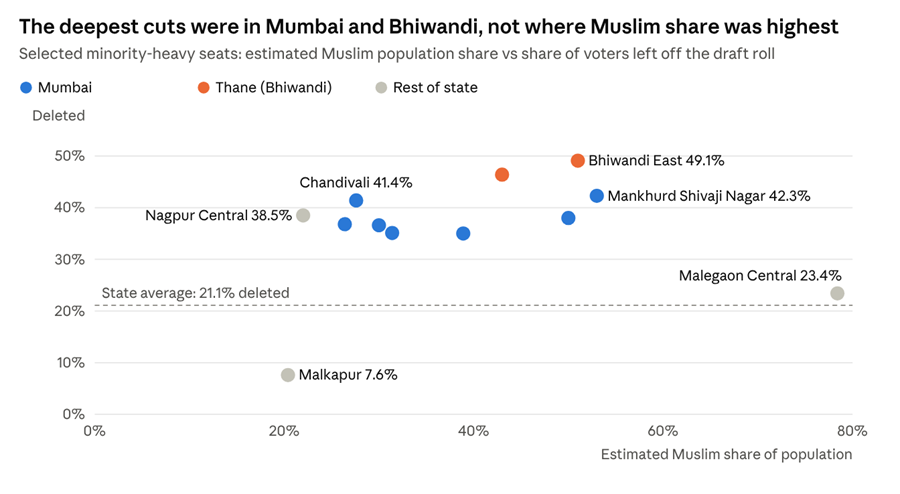
Draft-roll deletion rates from the state CEO’s constituency data as analysed by The Indian Express (via Scroll) and ThePrint, Sept 2026; Muslim shares are those outlets’ estimates and vary between them
Seat-level data, analysed separately by news outlets, points the same way. Bhiwandi East lost about half its voters and Mankhurd Shivaji Nagar 42%. Yet Malegaon Central, the most heavily Muslim seat in the state at an estimated 78%, lost 23%, close to the state average, and Malkapur lost under 8%. Dense, high-migration urban seats were hit hardest, which complicates any simple reading by religion alone.
In Colaba, 1,19,606 voters were deleted. That is more than the 1,18,499 votes cast there in the 2024 Assembly election.
Political stakes: deletions larger than winning margins
In 190 of Maharashtra’s 288 constituencies (66%), the number of living voters deleted is larger than the 2024 Assembly winning margin. In 95 seats (33%), the absent-or-untraceable category alone exceeds that margin.
This does not mean any result would have changed: many deleted voters may have moved, died years ago, or not voted at all. It does mean the roll revision touches more people than decided a majority of seats last time. Opposition parties have seized on the numbers, with Congress calling the scale of exclusion unprecedented and demanding an inquiry.
Third-gender voters: more than half removed
Of the 6,101 third-gender electors on Maharashtra’s pre-SIR roll, 3,250 (53.3%) were deleted, more than double the statewide rate. In Malad West, 313 of 345 third-gender voters were removed. A similar Sabar analysis of Hyderabad flagged the same pattern, listing transgender electors among the groups with the least documentation to fall back on.
The official position, the court and the road back
The Election Commission says the draft roll is not final and that those excluded could not be traced at their registered addresses. Maharashtra’s Chief Electoral Officer, S. Chockalingam, had promised before enumeration began that no eligible voter would be deleted, and later barred objections filed by people living outside the constituency concerned, to guard against targeted mass deletions. Officials put deaths at about 34 lakh and duplicates at about 17 lakh, and flagged a further 1.22 crore records for “logical discrepancies”.
| Date (2026) | What happened |
| 6 Nov | ECI lets voters marked absent, shifted, dead or duplicate in seven states, Maharashtra included, file fresh enrolment forms and keep their existing voter ID numbers |
| 5 Nov | Supreme Court listed to hear the Maharashtra challenge further; no outcome had been reported in sources checked |
| 26 Oct | Supreme Court issues notice to the ECI and Centre on Arun Anandagiri’s petition; declines to halt the exercise or extend the claims deadline; CJI Surya Kant says no one will be prosecuted for re-applying via Form 6 |
| 29 Sep | ECI orders a special drive in 20 states and UTs to re-enrol “left out” voters using the plain Form 6, comparing pre- and post-SIR rolls |
| 26 Sep | ECI moves the final Maharashtra roll to 16 November |
| 31 Aug | Draft roll published: 7.72 crore retained, 2.07 crore excluded |
| 30 Jun | Door-to-door enumeration begins |
The petitioner told the court that Mumbai and Pune residents temporarily displaced by building redevelopment were marked “person not found”. Critics of the re-enrolment route note that Form 6 is designed for first-time voters, which puts the burden on long-registered electors to apply afresh.