



Close to 44 lakh people struck off Delhi’s draft electoral roll could be missing from the final list too, as the window for claims under the Special Intensive Revision (SIR) closed on Wednesday with only a fraction of them having applied to return.
From August 31, when the draft roll was published, to November 24, the office of the Delhi Chief Electoral Officer (CEO) received 3,31,540 Form 6 applications the form used to seek inclusion on the roll. Against that, about 47.5 lakh names had been dropped from the draft. Officials expect the final Form 6 count to settle near 3.5 lakh, which would still leave roughly 44 lakh excluded voters unaccounted for.
The real gap may be wider. Form 6 is also the form first-time voters use, and young people who turned 18 on or before October 1, 2026 are eligible to apply with it. So not every one of those 3.3 lakh applications comes from someone who was cut from the draft.
The numbers matter because the SIR was meant to work in both directions. In the CEO office’s own words to political parties, the aim is that “no eligible citizen is left out while no ineligible person is included.” The deletions are well documented. The re-inclusions, so far, are not keeping pace.
Who was removed, and who came back
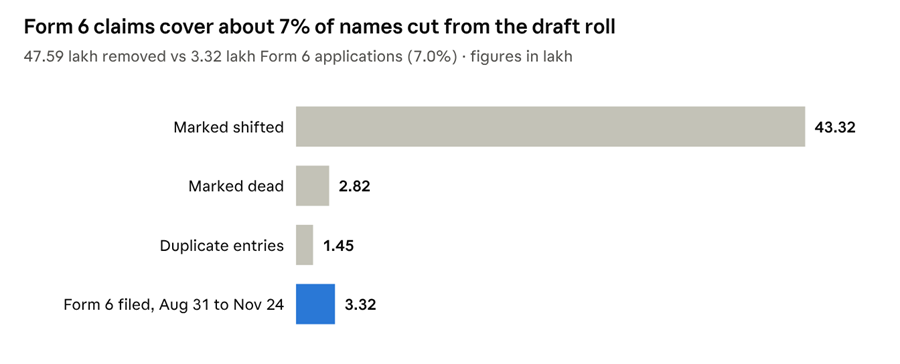
Source: Office of the Chief Electoral Officer, Delhi, via PTI and The Print (Nov 17 and Nov 24 data). Components rounded; the CEO’s headline exclusion figure is 47,56,722.
The draft roll published on August 31 cut Delhi’s electorate from about 1.45 crore to 97.5 lakh, roughly one voter in three. Of the names removed, 43.32 lakh were marked “shifted”, 2.82 lakh as dead and 1.45 lakh as duplicate entries. Shifted voters alone make up about nine in ten of all exclusions, and they are the group most likely to still be eligible somewhere in the city.
Another 2,12,400 Form 6 applications had been filed before the draft was published; those are not counted in the post-draft figure above.
A slow climb, even with more time
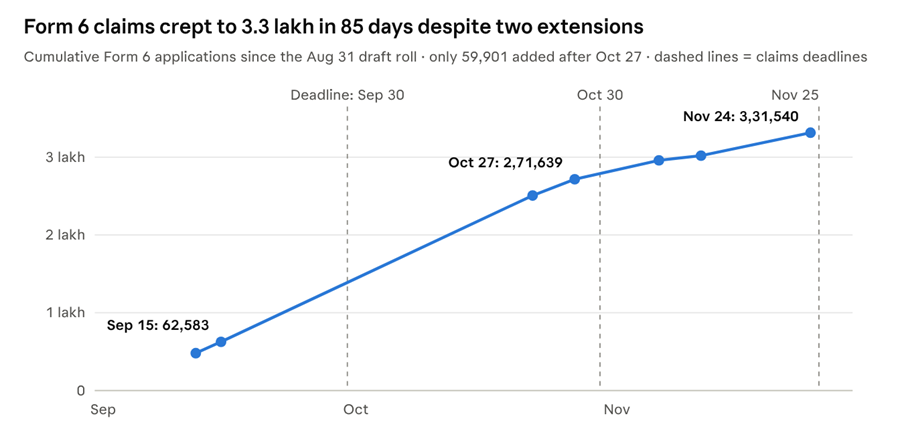
Source: Delhi CEO office bulletins as reported by PTI, The Print, Outlook, Deccan Chronicle and IANS (Sep 12 to Nov 24). Nov 6 and Nov 11 values rounded as reported (2.96 lakh, 3.02 lakh).
The claims window was first meant to close on September 30. By the halfway mark, just 62,583 people had filed Form 6. The Election Commission pushed the deadline to October 30, and then, a day after the Supreme Court asked it to consider more time, to November 25. Each extension bought fewer applications than the last: about 60,000 arrived in the final four weeks.
Why “shifted” voters are so hard to find
The biggest problem sits in the shifted category. Booth-level officers (BLOs) say many of these voters were tenants who left rented homes without leaving a forwarding address or phone number. In unauthorised colonies, frequent tenant turnover and landlords’ unwillingness to give written confirmation have made door-to-door verification even harder.
Voter-rights volunteers tell a similar story from the other side. Many people who rent and move within or between localities said they never received an enumeration form at their registered address, and only learnt they had been deleted when they tried to fill the form online despite having voted in 2025. Booth-level data shows how concentrated this can be: in one Okhla part, 827 of 1,874 voters were marked permanently shifted; in one Madanpur Khadar part, 1,136 of 1,509 were.
In the Supreme Court, petitioners have also questioned why excluded voters who were on earlier rolls must apply through Form 6, the form meant for new voters, rather than the shifting form, Form 8.
A second chance, with few takers so far
Following an Election Commission order of November 6, the Delhi CEO’s office launched a special drive giving voters marked Absent, Shifted, Dead or Duplicate (ASDD) another opportunity to submit fresh enumeration forms. Physical distribution began on November 17. Voters wrongly marked as shifted must attach an Annexure-B explaining why they missed the original deadline.
The early response has been thin: officials say only a few hundred forms have been distributed and very few submitted online.
Corrections and objections are rising too
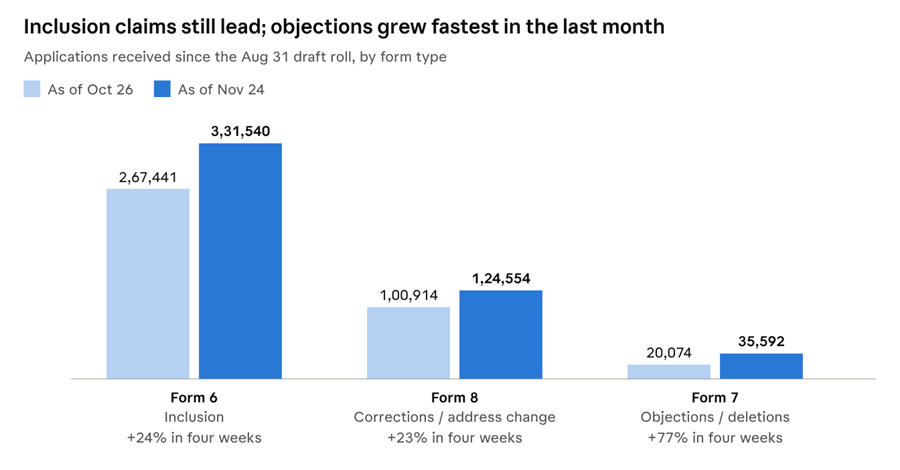
Between August 31 and November 24, the CEO’s office also received 1,24,554 Form 8 applications for corrections, including change of residence, and 35,592 Form 7 applications objecting to or seeking deletion of entries. Form 6 inclusion claims remain the largest stream, but Form 7 objections nearly doubled in four weeks and every name that comes back via Form 6 can still be challenged through Form 7 before the final roll.
Across districts, West Delhi has recorded the most Form 6 applications at 40,029, followed by North-East (32,673) and South-East (31,771). West has led the count since the first fortnight of the claims window.
A timeline that kept moving
| Milestone | Original date | 1st revision (Sep 26) | 2nd revision (Oct 29) |
| Claims and objections close | Sep 30 | Oct 30 | Nov 25 |
| Disposal of claims | Oct 29 | Nov 30 | Dec 15 |
| Final electoral roll | Nov 4 | Dec 4 | Dec 22 |
What happens next
- November 30: last day for distribution and collection of fresh enumeration forms under the special drive.
- December 10: these forms are to be processed.
- December 15: all claims and objections to be disposed of.
- December 22: final electoral roll published.
The Supreme Court has said it will review progress before deciding whether late availability of the fresh enumeration forms justifies extending the November 30 deadline. Political reactions remain split. The BJP has said every genuine voter who submitted a form with the required documents is on the draft roll. Opposition leaders, including Rahul Gandhi, have highlighted near-total deletions in pockets such as Bela Estate, where all but one of 729 voters in a booth were removed.