



The Supreme Court on November 27, 2026 took the Thiruparankundram Murugan temple out of its trustees’ hands and ordered the Karthigai Deepam lit at the hilltop Deepathoon on November 28. It acted three days after the lamp went unlit there despite its own order.
A Bench of Justices Aravind Kumar and Vipul M Pancholi suspended the Board of Trustees of the Arulmigu Subramaniya Swamy Temple. It appointed two retired judges as receivers, handed security of the hill to the CRPF, and issued contempt notices to Tamil Nadu’s Chief Secretary, the DGP, the Madurai Collector, the temple’s Executive Officer and the five trustees, among others.
The Bench called the failure on November 24 a prima facie case of “brazen and willful disobedience” and said the authorities had not even tried to purge the contempt. It also lifted its own November 20 stay on the Madras High Court’s judgment, opening the hill to devotees who wish to light lamps.
What the court ordered
| Direction | Detail |
| Lamp at Deepathoon | Lit on November 28, 2026, at a time fixed with the sthanikars, using the flame lit at Uchi Pillaiyar Mandapam on November 24 |
| Trustees | Board of Trustees suspended and superseded |
| Receivers | Justice S. Vaidyanathan (former Chief Justice, Meghalaya HC) and Justice V. Parthiban (former judge, Madras HC) take immediate charge of the temple |
| Security | CRPF to take over security of the temple and the whole hill |
| Stay | November 20, 2026 interim stay on the High Court judgment vacated |
| Devotees | May light lamps at the Deepathoon and at other spots at least 50 metres from the dargah, on all sides |
| Dargah | CRPF to protect the dargah; worshippers there must not be hindered |
| Contempt | Show-cause notices to the alleged contemnors; Chief Secretary to file an affidavit with officials’ emails, calls and messages, and appear in person |
| Next hearing | Replies within 10 days of service; all to appear in person on December 15, 2026 |
The State was told to give the receivers full logistic support. The receivers must run the temple according to its traditions and the governing Act and Rules, and may return to the court for directions.
How we got here
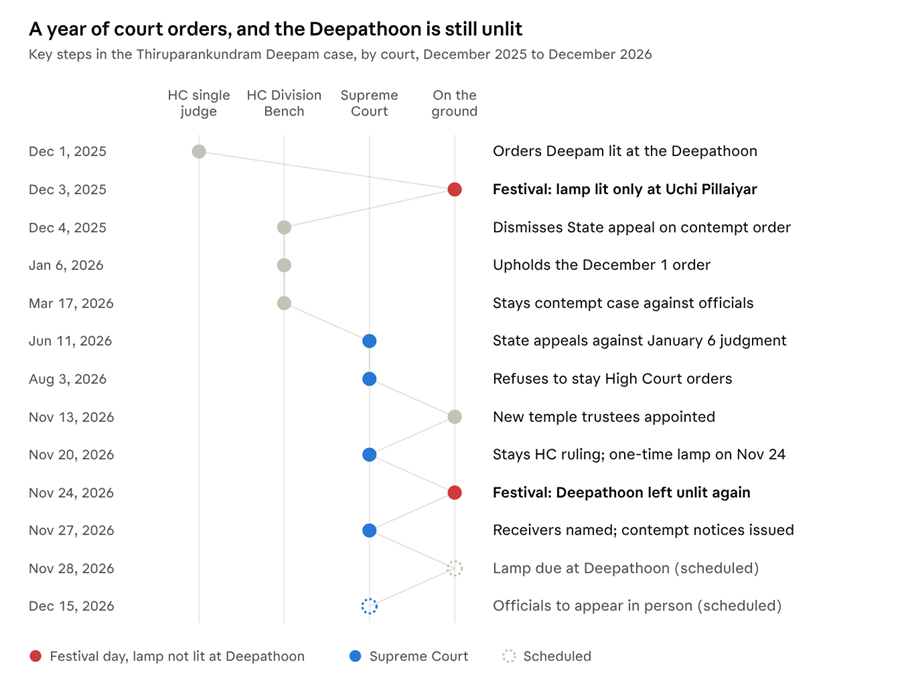
The case climbed from a single judge to the Supreme Court in under a year, yet on both festival days the lamp was lit only at Uchi Pillaiyar. Justice G.R. Swaminathan’s December 1, 2025 order started it; a Division Bench upheld it on January 6, 2026 and later stayed the contempt case. The Supreme Court refused a stay in August, then on November 20 stayed the High Court ruling while allowing a one-time lamp on November 24.
What went wrong on November 24
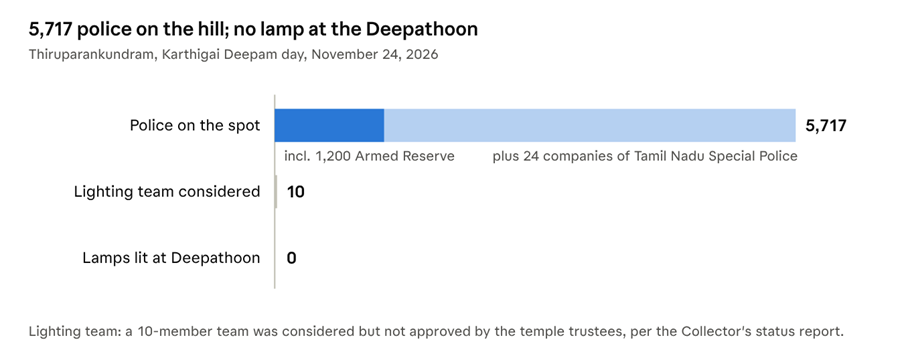
Police figures: submission for the Commissioner of Police in court, Nov 27, 2026 · team size: Collector’s Nov 25 status report as reported by Newsd
The hill was sealed by thousands of police, prohibitory orders under Section 163 of the BNSS were in force, and yet no one was sent up to light the lamp. The State’s case is that it could not act because the temple never named who should light it.
- The trustees’ resolution: On November 24 the Board resolved that, by custom, the lamp would be lit only at the Deepa Mandapam near Uchi Pillaiyar. No time of passing is recorded. The Board had been constituted only on November 13.
- The Collector’s email: The Collector wrote to the trustees asking them to authorise persons only in the afternoon or evening, according to the applicants.
- 3:00 pm: Per the ASI’s report, police halted its team and kept it away from the lamp; trustees said they had no instructions from above.
- 4:45 pm: The Collector was still logged into a Madras High Court hearing, where his counsel had earlier assured compliance, and did not say a team was missing.
On the same day the Madras High Court issued a John Doe order restraining the public from calling for the Supreme Court’s order to be defied (Verdictum). The State later apologised and filed a review petition against the November 20 interim order (Newsd).
Why the court came down hard
The Bench grounded its order in Article 144 of the Constitution, which requires every civil and judicial authority in India to act in aid of the Supreme Court. An executive officer who decides whether a court order deserves obedience, it said, claims a power the Constitution never gave.
The order opened with a single word, “Alas!”, and warned that defiance must be met “with an iron hand” or it could lead to “constitutional chaos”. It said the message was meant for anyone, “however high he is”.
On the facts, the court found three problems with the trustees’ resolution:
- It openly disobeyed the November 20 interim order.
- It undercut the court’s authority and ignored the undertaking the State gave the High Court that the order would be followed “in letter and spirit”.
- Its line that temple traditions “should be brought to the court’s notice” implied the court had not weighed them, though it had heard both sides on that point at length.
The court noted that the Board had never appeared before it or challenged the High Court’s January 6, 2026 judgment. It also said the record pointed to an alleged “clandestine understanding” between the State and the temple administrators to keep the Deepathoon dark, and described a state of “administrative chaos” in Tamil Nadu, or at least in Madurai district.
The Collector’s preliminary report blamed the temple administration for not naming anyone to light the lamp, and offered an apology. The Bench was unpersuaded. The Collector is the District Magistrate, it said; “his hands are quite long” and could have been used to carry out the order.
Who argued what
The applicants and the Union side pressed for criminal contempt; the State’s lawyers asked the court to wait for a full status report.
| Counsel | Appearing for | Main argument |
| Guru Krishna Kumar (Sr Adv) | Applicant | The Collector’s report reads like a confession: every step was taken except getting the lamp lit. The trustees were political appointees named on November 13, about ten days before the festival, and served as a “refuge” for a decision taken earlier. No time is recorded for their resolution. |
| Tushar Mehta (Solicitor General) | Archaeological Survey of India | Called it “aggravated contempt” and pressed criminal contempt. Per an ASI report, police stopped the ASI team at 3:00 pm and kept it from the lamp; the Collector’s meetings were “a cloak”. Asked for monitoring by an agency outside State control. |
| J Sai Deepak (Sr Adv) | Applicants | The order left no discretion to the temple management. Trustees are State appointees under the HR&CE Act. The Collector was logged into the High Court until 4:45 pm on November 24 and never said he lacked a list of approved persons. |
| Valliappan (Sr Adv) | Rama Ravikumar, original petitioner | Orders of the single judge, Division Bench and Supreme Court were all defied; ministers had said publicly the lamp would be lit only at Uchi Pillaiyar. Karthigai month was still running, so the lamp could still be lit. |
| Gopal Sankaranarayanan (Sr Adv) | Madurai Collector | The officials did their part: several meetings, the ASI attended on November 21. The press release was signed by the five trustees, not the Executive Officer. Wait for the full status report. |
| Sidharth Luthra (Sr Adv) | Commissioner of Police | 5,717 police were on the spot, including 1,200 Armed Reserve and 24 companies of Tamil Nadu Special Police. Prohibitory orders were sought by the Commissioner. |
| Abhishek Manu Singhvi (Sr Adv) | HR&CE (Respondent 1) | Not a direct contemnor. There may have been “a gross error” by the trustees, but the court should not pre-judge wilful disobedience. |
| Huzefa Ahmadi (Sr Adv) | Dargah | The earlier permission was a one-time measure and should not be diluted; dargah activities were affected; worried about “public mischief”. |
Two exchanges stood out. When Luthra described the deployment, Justice Kumar said the court would later decide “whether it is real tears or crocodile tears”. When Singhvi suggested the officials believed the court had deferred the merits, the Bench said it had given the trustees no liberty at all.
The dargah and the 50-metre line
The hill is home to both the Murugan temple and the Sikandar Badusha Dargah, and the Deepathoon is a stone lamp pillar near the dargah. Reports disagree on the gap: The News Minute has put it at about 15 metres in one report and about 50 metres in another (TNM, 2025; TNM, Nov 20, 2026).
The new order lets devotees light lamps at the Deepathoon and elsewhere, but only 50 metres or more from the dargah on all sides. The CRPF must also make sure no one going to the dargah or mosque is stopped from praying. The dargah’s counsel told the court 100 to 200 people visit; the Bench put the maximum at about 500. The dargah’s annual Urs falls on December 10, 2026.
The dispute over where the lamp belongs is old:
- 1920–1923: A civil suit by the temple ended with a trial court treating most of the hill as temple property and the summit, mosque area, Nellithope and mosque steps as Muslim property (Newsd).
- 1994–1996: A plea to move the lamp to the summit led the Madras High Court to rule it should “ordinarily” be lit at the traditional mandapam near Uchi Pillaiyar temple (ThePrint).
- For over a century: The lamp has been lit at the Deepa Mandapam near Uchi Pillaiyar (Deccan Herald). The temple administration told the High Court in December 2025 that there was no evidence the lamp was lit at the Deepathoon between 1862 and 2025 (TNM). The applicants say the temple’s Sthalapuranams show the Deepathoon is the traditional site.
What happens next
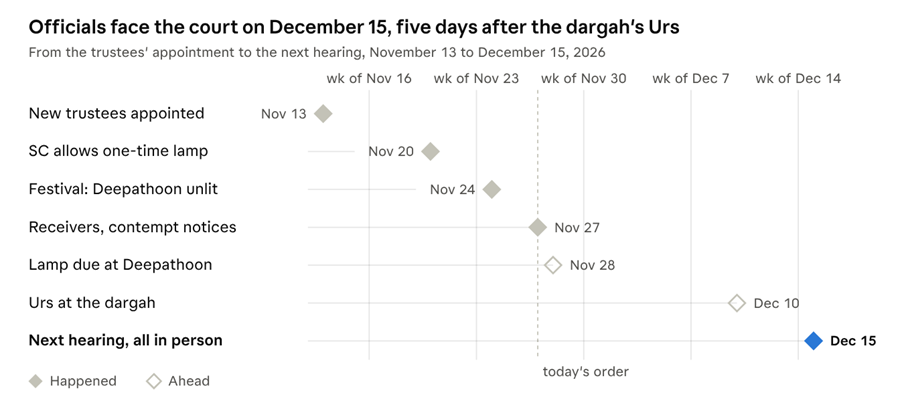
Dates from the Nov 27, 2026 order and arguments in court · 7 milestones
The receivers must get the lamp lit on November 28, using the flame from Uchi Pillaiyar, with the CRPF holding the hill. The alleged contemnors have 10 days from service to reply and must appear in person on December 15.
The main question still open is the merits: the November 20 order said its one-time permission was not a final ruling on the claimed custom (TNM). With the stay now vacated, the High Court judgment allowing the lamp at the Deepathoon is back in force until the Supreme Court decides the appeal.