Washington is offering up to $20 million, plus possible relocation, for information on Iran’s nuclear programme. The bounty is an admission that, eight months into a war it says has “obliterated” that programme, the US does not know where Iran’s most sensitive nuclear material and people are.
What was announced
- Who: The State Department’s Rewards for Justice (RFJ) programme; US Central Command (CENTCOM) amplified it on X late on Friday, 6 November (US time).
- What it wants: Tips on Iran’s nuclear facilities, equipment and associated personnel, including scientists, and the movement of any of them.
- Why, per State: Iran’s non-compliance with IAEA safeguards has cost the agency its “continuity of knowledge” over Iran’s production and inventory of key items such as centrifuges.
- What is unclear: State gave no criteria for what information earns the full $20 million or how a payout is sized.
Tehran rejected the move. Foreign Ministry spokesman Esmaeil Baghaei said Iran would not go along with it and that its programme is peaceful. Critics in the US seized on the contradiction: a bounty to locate a programme the White House calls destroyed.
How big is $20 million?
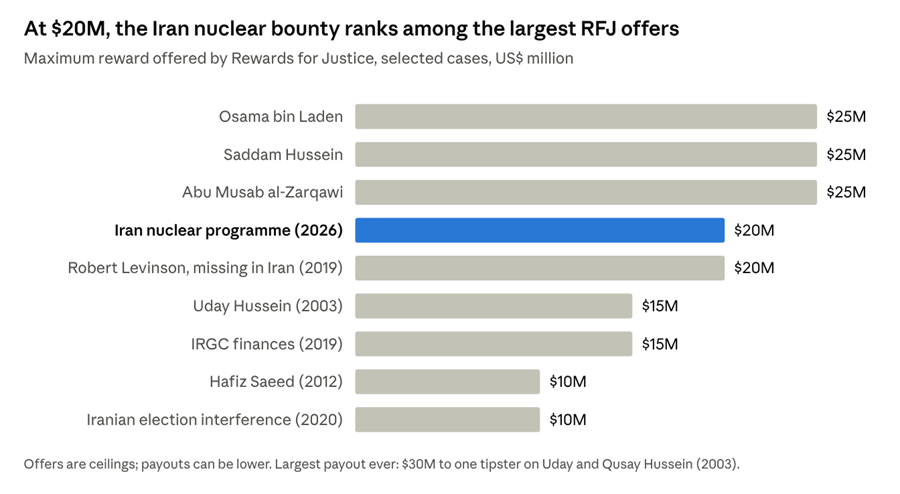
The offer sits just below the $25 million ceilings once placed on Osama bin Laden and Saddam Hussein, and it is unusual because it targets a state’s weapons programme, not a terrorist.
Sources: CNN Money, Stratfor/RANE, VOA, Fox News, Yahoo News, Radio Farda via GlobalSecurity (linked below)
Congress created RFJ in 1984 after the Beirut embassy and Marine barracks bombings; the Diplomatic Security Service runs it. By 2022 it had paid more than $250 million to 125 people. Its record payout was $30 million to one informant who located Uday and Qusay Hussein in 2003.
Big headline numbers do not guarantee results. Rewards were never authorised for Saddam Hussein or Zarqawi despite $25 million offers, and analysts note many would-be informants doubt the US can protect their families. That is why the relocation clause matters: for an Iranian scientist, it is likely worth more than the cash.
Why Washington is paying for tips: the IAEA has gone blind
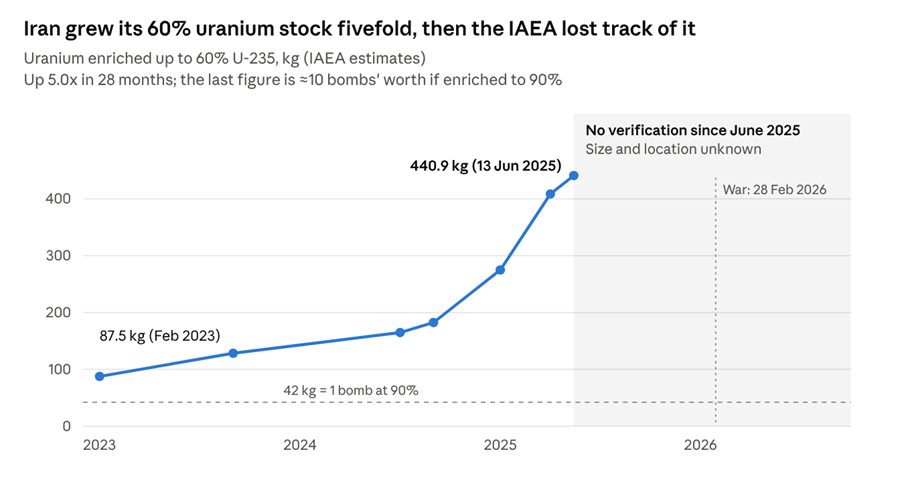
The IAEA’s last firm number is 440.9 kg of 60%-enriched uranium as of 13 June 2025, and nobody outside Iran has verified it since.
IAEA quarterly figures as reported by AP, Euronews, Bulletin of the Atomic Scientists, ISIS and the IAEA (GOV/2026/33), linked below
- The baseline: On 13 June 2025, the day Israel first struck, the IAEA estimated Iran’s total enriched stock at 9,874.9 kg, including the 440.9 kg at 60%. Iran is the only non-nuclear-weapon state in the NPT to have made 60% material.
- The blackout: Inspectors left Iran by the end of June 2025 for safety reasons. The agency’s 1 September 2026 report says it cannot establish the stockpile’s current size, composition or location; only the Bushehr power plant is still being checked.
- Where it might be: The IAEA saw regular vehicle traffic in February 2026 at the Isfahan tunnel complex where 20% and 60% material had been stored. Satellite analysis suggests Iran may have trucked most or all of its 60% stock to Isfahan on 9 June 2025. IAEA chief Rafael Grossi has said more is believed to be at Natanz, next to the new Pickaxe Mountain complex.
The ramp-up was steep: output of 60% material jumped from 6–9 kg a month to 35–40 kg a month after December 2024. Experts note 60% purity has no real civilian use.
Eight months of war, and the mountain still standing
The war began on 28 February 2026 with US-Israeli strikes that killed Supreme Leader Ali Khamenei; two truces have since collapsed, and the one suspected nuclear site never struck is now the stated next target.
| Date | Event |
| 6 Nov 2026 | RFJ bounty announced; Trump says the US carried out “minor” strikes on an Iranian anti-aircraft target, the first since the US election |
| 2–3 Nov 2026 | US strikes Qeshm Island; Qatari mediators fly to Tehran; US midterms held |
| 8 Jul 2026 | Ceasefire collapses after Iran attacks commercial ships in Hormuz |
| 17 Jun 2026 | Islamabad Memorandum signed; dual blockade lifted |
| 13 Apr 2026 | US naval blockade of Iranian ports begins |
| 7–8 Apr 2026 | Pakistan-brokered two-week ceasefire |
| 28 Feb 2026 | US-Israeli strikes begin (Operation Epic Fury); Iran closes the Strait of Hormuz |
| 13 Jun 2025 | Israel strikes Iran; US hits Fordow, Natanz and Isfahan days later |
Pickaxe Mountain (Kuh-e Kolang Gaz La) is a deeply buried tunnel complex beside Natanz. The US did not strike it in June 2025 or in the 2026 campaign. Iran says it has been building a centrifuge assembly plant there since 2021; satellite imagery from February showed it being hardened against air attack.
Trump told Fox News on 2 November that hitting it would not be “a big deal”. Commentator Tucker Carlson claimed a nuclear strike was being weighed; no evidence has backed that, and CBS reported plans built around the conventional MOAB bomb.
The claims, set against the record
Speaking in West Palm Beach on Friday night, Trump said the strikes saved Israel and kept a nuclear-armed Iran from devastating the region; the public record supports parts of this and leaves others unprovable.
| Claim (Trump) | What the record shows |
| US forces effectively “obliterated” Iran’s programme | Facilities were heavily hit, but the IAEA cannot locate the 440.9 kg of 60% material, Pickaxe Mountain is untouched, and State is now paying for tips on scientists and equipment. |
| “If we didn’t hit Iran, you wouldn’t have Israel today” | A counterfactual that cannot be tested. The US, IAEA and others assess Iran ran a weapons programme until 2003; Iran denies seeking a bomb. |
| Iran would have used a nuclear weapon | No public evidence either way; 60% material has no real civilian use, which is why it alarmed inspectors. |
| Tehran “wants to make a deal very badly” | Partly borne out: Pezeshkian says the supreme leader gave his government added authority to negotiate. But Iran’s security chief called the US reply “not satisfactory”. |
Tehran’s line is consistent: its programme is peaceful, Pickaxe Mountain is not a nuclear facility, and it will not cooperate with the bounty. Iranian officials have reportedly handed out iodine pills in anticipation of a strike on the site.
Diplomacy: talks running alongside strike plans
Qatar and Pakistan are carrying proposals between the two sides, and both governments say talks are active even as the US keeps striking limited targets.
- Iran’s opening: On 2 November Pezeshkian said Supreme Leader Mojtaba Khamenei had given the government new powers to pursue talks; Foreign Minister Abbas Araghchi called consultations “highly intensive”.
- Iran’s terms: Much of Tehran’s ask is a return to the June memorandum, with better sequencing and guarantees against future US or Israeli attacks.
- Security chief Mohsen Rezaei says Hormuz reopens only if Washington explicitly meets Iran’s seven conditions.
- Washington’s terms: The US is demanding nuclear concessions. Vice President JD Vance says there has been progress, and Secretary of State Marco Rubio says no decision on new strikes has been made.
What to watch: whether the US strikes Pickaxe Mountain, whether the IAEA regains access to Isfahan and Natanz, and whether a revived memorandum reopens Hormuz. The bounty itself signals that Washington expects any deal to need verification it cannot yet perform.